When discussing diversity, equality, and belonging, you may come across the terms inclusivity and inclusiveness. At first glance, they seem interchangeable because both relate to creating environments where everyone feels welcomed and valued. However, many writers, educators, and professionals wonder whether one term is more appropriate than the other.
The good news is that inclusivity and inclusiveness have nearly identical meanings. The difference lies mainly in style, usage, and context rather than definition. This guide explains their meanings, compares their usage, provides examples, highlights common mistakes, and helps you choose the right word with confidence.
Quick Answer
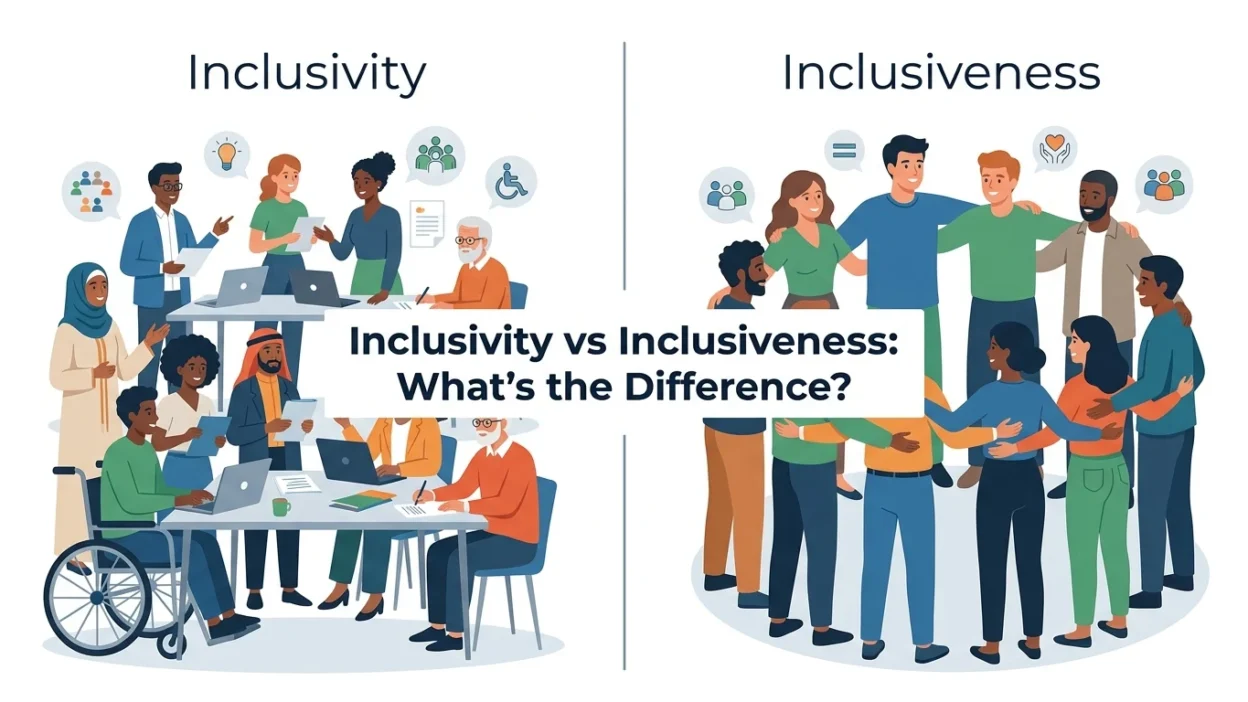
Inclusivity and inclusiveness both describe the practice or quality of including people from diverse backgrounds and ensuring everyone feels respected, valued, and welcomed.
The main difference is that inclusivity is more commonly used in modern discussions about diversity, equity, and inclusion (DEI), while inclusiveness often emphasizes the quality or characteristic of being inclusive.
- ✅ The company promotes inclusivity in the workplace.
- ✅ The school’s inclusiveness helps every student feel welcome.
In most everyday situations, either word is correct, but inclusivity is generally more common in current professional and organizational language.
What Does “Inclusivity” Mean?
Inclusivity is a noun that refers to the practice, policy, or commitment of including people regardless of their background, identity, ability, age, culture, religion, or other differences.
Today, it is widely used in workplaces, schools, universities, governments, healthcare, and community organizations.
Examples of “Inclusivity”
- The organization is committed to inclusivity.
- Workplace inclusivity encourages innovation.
- The conference focused on diversity and inclusivity.
- Schools benefit from greater inclusivity.
- The company introduced new inclusivity initiatives.
In these examples, inclusivity describes intentional efforts to create welcoming environments.
What Does “Inclusiveness” Mean?
Inclusiveness is also a noun. It refers to the quality, state, or characteristic of being inclusive.
Although it carries nearly the same meaning as inclusivity, it is slightly more descriptive and sometimes appears in broader contexts outside diversity discussions.
Examples of “Inclusiveness”
- The club is known for its inclusiveness.
- Community inclusiveness strengthens social connections.
- The policy reflects a spirit of inclusiveness.
- The school’s inclusiveness impressed many parents.
- Effective leadership promotes inclusiveness.
Here, inclusiveness emphasizes the quality or nature of including everyone.
Inclusivity vs Inclusiveness: Key Differences
| Feature | Inclusivity | Inclusiveness |
|---|---|---|
| Part of Speech | Noun | Noun |
| Meaning | Practice of including everyone | Quality of being inclusive |
| Common Usage | Diversity, equity, workplace, education | General descriptions of inclusion |
| Modern Popularity | More common | Slightly less common |
| Tone | Contemporary and policy-focused | Traditional and descriptive |
The meanings overlap significantly, and in many contexts the two words can be used interchangeably.
When Should You Use “Inclusivity”?
Use inclusivity when discussing deliberate actions, policies, programs, or organizational efforts to create welcoming and equitable environments.
Common situations include:
- Workplace culture
- Diversity initiatives
- Educational policies
- Corporate values
- Community engagement
- Accessibility programs
Example Sentences
- The company invested in inclusivity training.
- Greater inclusivity improves teamwork.
- The university encourages inclusivity across campus.
- Their mission emphasizes inclusivity and respect.
- Strong leadership supports inclusivity.
When Should You Use “Inclusiveness”?
Use inclusiveness when emphasizing the quality or characteristic of including people or ideas.
It is common in discussions about organizations, communities, leadership, education, and social relationships.
Example Sentences
- The organization’s inclusiveness attracted talented employees.
- Her leadership demonstrated remarkable inclusiveness.
- The event was praised for its inclusiveness.
- Community inclusiveness builds stronger relationships.
- Their inclusiveness created a welcoming atmosphere.
Side-by-Side Examples
Comparing the two words helps clarify their usage.
- The company promotes inclusivity through employee training.
- The company’s inclusiveness makes everyone feel valued.
- Educational inclusivity benefits all learners.
- The school’s inclusiveness is appreciated by parents.
- Workplace inclusivity improves collaboration.
- Workplace inclusiveness creates a positive culture.
In many of these examples, either word would be acceptable, although inclusivity often sounds more modern.
Common Mistakes to Avoid
These mistakes are common when using these terms.
Assuming the Words Have Completely Different Meanings
They do not. Both relate to including people and creating welcoming environments.
Believing Only One Word Is Correct
Both inclusivity and inclusiveness are correct English words.
Using Them Inconsistently
When writing an article, report, or policy, choose one preferred term and use it consistently throughout your document.
Thinking “Inclusivity” Is Only About Workplaces
Although common in professional settings, inclusivity also applies to education, healthcare, sports, communities, and everyday life.
Easy Memory Trick
Here’s a simple way to remember the difference.
Inclusivity = Active Practice
Think of inclusivity as the effort or commitment to include everyone.
It often refers to actions, programs, and policies.
Inclusiveness = Quality
Think of inclusiveness as the characteristic or quality of being welcoming.
A simple reminder is:
- Inclusivity = practice
- Inclusiveness = quality
Common Phrases with “Inclusivity”
These expressions are widely used.
- Workplace inclusivity
- Inclusivity initiatives
- Inclusivity training
- Inclusivity strategy
- Promote inclusivity
- Foster inclusivity
Example
The organization launched new inclusivity programs.
Common Phrases with “Inclusiveness”
These are also common.
- Spirit of inclusiveness
- Social inclusiveness
- Community inclusiveness
- Organizational inclusiveness
- Cultural inclusiveness
- Inclusiveness in education
Example
The school was recognized for its inclusiveness.
American vs British English
There is no major difference between American and British English in the meanings or spellings of inclusivity and inclusiveness.
Both varieties recognize and use both words.
However, inclusivity has become especially popular in modern discussions about diversity, equity, and inclusion in both American and British English.
Examples:
- American English: The company values inclusivity.
- British English: The company values inclusivity.
- American English: The community is known for its inclusiveness.
- British English: The community is known for its inclusiveness.
Practice Sentences
Choose the word that best fits the sentence.
- The organization launched new ______ initiatives.
- ✅ Inclusivity
- The school’s ______ impressed visiting families.
- ✅ Inclusiveness
- Workplace ______ encourages innovation.
- ✅ Inclusivity
- The club is admired for its ______.
- ✅ Inclusiveness
- Leaders should promote greater ______ across the organization.
- ✅ Inclusivity
FAQs
What is the difference between inclusivity and inclusiveness?
Inclusivity usually refers to the active practice of including everyone, while inclusiveness emphasizes the quality or characteristic of being inclusive. Their meanings are very similar.
Can inclusivity and inclusiveness be used interchangeably?
Yes. In many contexts they can be used interchangeably because they describe the same general concept of including people and creating welcoming environments.
Which word is more common today?
Inclusivity is generally more common in modern discussions about diversity, equity, inclusion, workplaces, and education.
Is inclusiveness an outdated word?
No. Inclusiveness is still widely used and is considered correct English. It simply appears slightly less often than inclusivity in contemporary professional language.
Which word should I use in business writing?
Inclusivity is often preferred because it aligns with current organizational and workplace terminology.
Is there a difference between American and British English?
No significant difference exists. Both American and British English use inclusivity and inclusiveness with the same meanings.
Are both words grammatically correct?
Yes. Both inclusivity and inclusiveness are standard English nouns and are accepted by major dictionaries.
Summary
Understanding inclusivity vs inclusiveness is easier than it first appears because both words share nearly the same meaning. They describe creating environments where people feel welcomed, respected, and valued regardless of their backgrounds or identities. The primary difference lies in emphasis: inclusivity often highlights active efforts, policies, and initiatives, while inclusiveness focuses more on the quality or characteristic of being inclusive.
In modern communication, especially in workplaces, education, and diversity discussions, inclusivity is the more frequently used term. However, inclusiveness remains equally correct and is often chosen when describing a welcoming culture or atmosphere. Whichever word you select, using it consistently will make your writing clear, professional, and effective.

Dani Morrison is a dedicated language writer and spelling expert at Spelword.com, where she focuses on helping readers understand common English spelling mistakes and confusing word pairs. With a passion for clear communication, Dani creates easy-to-follow guides that simplify complex grammar and spelling rules for everyday use.