English has many words that seem similar because they often appear in situations involving honesty or directness. One pair that frequently confuses writers is blatantly vs bluntly. Although both words can describe speech or behavior, they have very different meanings and should not be used interchangeably.
If you’ve ever wondered whether someone acted blatantly or spoke bluntly, you’re not alone. Understanding the distinction will help you communicate more accurately and avoid common vocabulary mistakes. This guide explains the meanings, examples, differences, common errors, and memory tips so you can confidently choose the right word.
Quick Answer
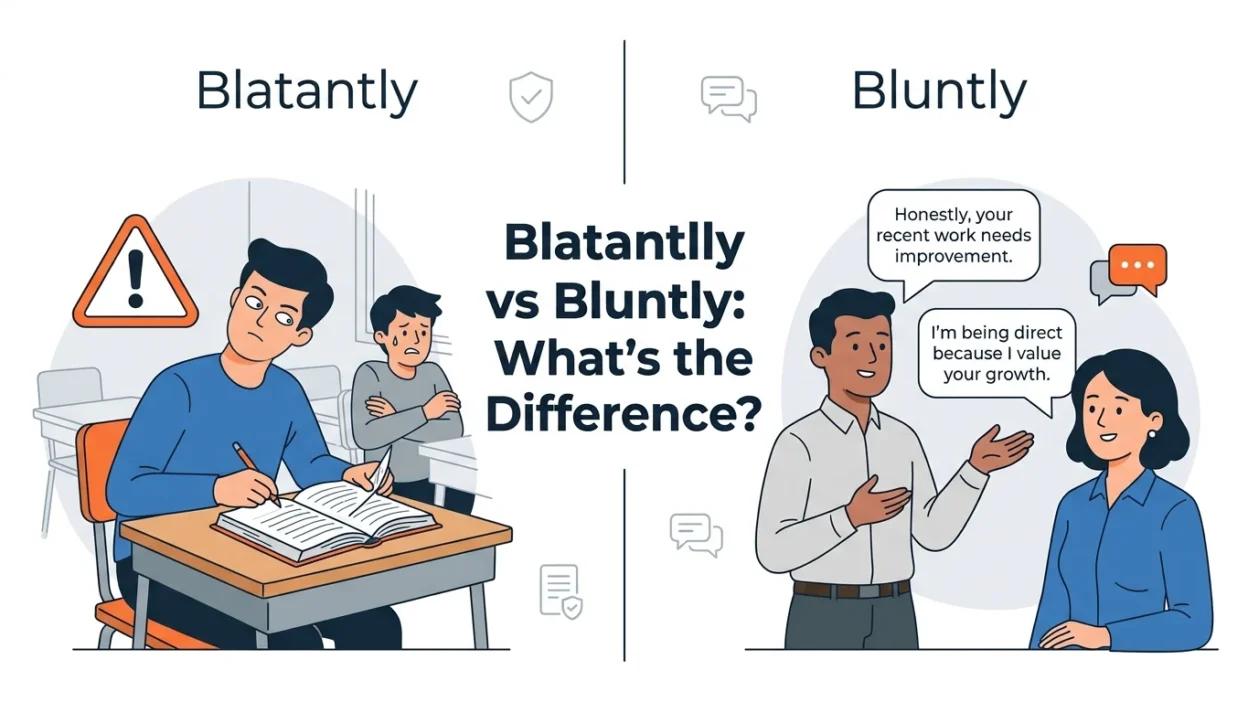
Blatantly means in an obvious, open, or shameless manner, often describing something that is clearly wrong or impossible to ignore.
Bluntly means in a direct, straightforward, or frank manner, usually referring to the way someone speaks.
- ✅ He blatantly ignored the rules.
- ✅ She bluntly told him the truth.
The easiest way to remember is:
- Blatantly = openly and obviously
- Bluntly = directly and honestly
What Does “Blatantly” Mean?
Blatantly is an adverb that means in a very obvious, unmistakable, or shameless way.
It often describes actions that are clearly dishonest, unfair, disrespectful, or against accepted rules.
Examples of “Blatantly”
- He blatantly lied during the interview.
- They blatantly ignored safety regulations.
- The company blatantly copied another brand’s design.
- She blatantly broke the classroom rules.
- The advertisement was blatantly misleading.
In each example, the action is obvious and difficult to deny.
What Does “Bluntly” Mean?
Bluntly is an adverb that means in a direct, honest, or straightforward way without softening the message.
It usually describes communication rather than actions.
Examples of “Bluntly”
- She bluntly said the project would fail.
- He bluntly refused the offer.
- The doctor bluntly explained the risks.
- My friend bluntly told me I was wrong.
- The manager bluntly criticized the report.
Here, bluntly describes how someone speaks or expresses an opinion.
Blatantly vs Bluntly: Key Differences
| Feature | Blatantly | Bluntly |
|---|---|---|
| Meaning | Openly, obviously, shamelessly | Directly, honestly, frankly |
| Part of Speech | Adverb | Adverb |
| Describes | Actions, behavior, situations | Speech, communication, opinions |
| Tone | Usually negative | Neutral or slightly negative |
| Example | Blatantly cheated | Bluntly answered |
Although both words can involve honesty or openness, they describe different ideas.
When Should You Use “Blatantly”?
Use blatantly when describing actions that are clearly visible, obvious, or shameless.
Common situations include:
- Breaking rules
- Lying
- Cheating
- Ignoring instructions
- Showing disrespect
- Copying someone’s work
Example Sentences
- The student blatantly cheated on the exam.
- They blatantly violated the agreement.
- He blatantly ignored the warning signs.
- The website blatantly copied its competitor.
- She blatantly denied the evidence.
When Should You Use “Bluntly”?
Use bluntly when referring to honest, direct, or straightforward communication.
Common situations include:
- Giving feedback
- Sharing opinions
- Rejecting offers
- Speaking honestly
- Delivering criticism
- Expressing difficult truths
Example Sentences
- She bluntly rejected the proposal.
- The teacher bluntly explained the mistake.
- He bluntly admitted he was wrong.
- They bluntly stated their concerns.
- I will bluntly tell you what happened.
Side-by-Side Examples
These comparisons make the distinction easier.
- He blatantly broke the rules.
- He bluntly admitted breaking the rules.
- The company blatantly copied the design.
- The manager bluntly criticized the design.
- She blatantly ignored the instructions.
- She bluntly said the instructions were confusing.
Notice that blatantly describes an action, while bluntly describes the manner of speaking.
Common Mistakes to Avoid
These mistakes are common among English learners.
Incorrect: He blatantly told me the truth.
⚠️ Better: He bluntly told me the truth.
Telling the truth directly requires bluntly, not blatantly.
Incorrect: She bluntly ignored the rules.
⚠️ Better: She blatantly ignored the rules.
Ignoring rules in an obvious way calls for blatantly.
Assuming Both Words Mean “Honestly”
While bluntly often relates to honesty, blatantly usually refers to actions that are obvious and often unacceptable.
Using “Blatantly” for Polite Conversations
Because blatantly usually carries a negative tone, it is rarely appropriate for describing respectful communication.
Easy Memory Trick
Here’s a simple way to remember the difference.
Blatantly = Boldly Obvious
Think of blatantly whenever an action is impossible to miss.
If someone openly breaks a rule, cheats, or lies, they are acting blatantly.
Bluntly = Blunt Speech
The word blunt describes direct speech.
If someone speaks honestly without softening their words, they speak bluntly.
A simple reminder is:
- Blatantly = obvious action
- Bluntly = direct speech
Common Phrases with “Blatantly”
These expressions are frequently used.
- Blatantly obvious
- Blatantly false
- Blatantly dishonest
- Blatantly ignored
- Blatantly illegal
- Blatantly unfair
Example
The report contained blatantly false information.
Common Phrases with “Bluntly”
These are common in everyday English.
- Bluntly speaking
- Bluntly honest
- Bluntly refused
- Bluntly admitted
- Bluntly answered
- Bluntly stated
Example
She bluntly explained why the idea would not work.
American vs British English
There is no significant difference between American and British English in the meanings or usage of blatantly and bluntly.
Both varieties use:
- Blatantly for obvious or shameless actions.
- Bluntly for direct and straightforward communication.
Examples:
- American English: He blatantly ignored the law.
- British English: He blatantly ignored the law.
- American English: She bluntly answered the question.
- British English: She bluntly answered the question.
Only pronunciation may vary slightly across accents.
Practice Sentences
Choose the correct word.
- The employee ______ ignored company policies.
- ✅ Blatantly
- She ______ told me the proposal was unrealistic.
- ✅ Bluntly
- The article contained ______ false claims.
- ✅ Blatantly
- My friend ______ admitted the mistake.
- ✅ Bluntly
- They ______ violated the contract.
- ✅ Blatantly
FAQs
What is the difference between blatantly and bluntly?
Blatantly means openly or obviously, often describing unacceptable actions. Bluntly means speaking in a direct and honest way without softening the message.
Can blatantly and bluntly be used interchangeably?
No. Blatantly usually describes actions, while bluntly usually describes speech or communication.
Is bluntly always rude?
Not necessarily. Bluntly often means honest and direct, but depending on the situation, it may sound insensitive.
Does blatantly always have a negative meaning?
Most of the time, yes. Blatantly often describes actions that are obviously wrong, dishonest, or inappropriate.
Which word should I use for giving honest feedback?
Bluntly is the correct choice because it refers to speaking directly.
Can I say someone blatantly told the truth?
That is uncommon. If someone told the truth directly, bluntly is the better word.
Is there a difference between American and British English?
No. Both American and British English use blatantly and bluntly with the same meanings.
Summary
Understanding blatantly vs bluntly becomes much easier once you focus on what each word describes. Blatantly refers to actions that are obvious, open, or shameless, often with a negative meaning. It is commonly used when discussing rule breaking, dishonesty, or behavior that is impossible to ignore. Bluntly, on the other hand, refers to speaking honestly, directly, and without unnecessary politeness or softening.
Although the two words sometimes appear in similar situations, they are not interchangeable. Choosing blatantly for obvious actions and bluntly for direct communication will make your writing more accurate, natural, and professional. Keeping this distinction in mind will help you avoid a common vocabulary mistake and improve your overall command of English.

Dani Morrison is a dedicated language writer and spelling expert at Spelword.com, where she focuses on helping readers understand common English spelling mistakes and confusing word pairs. With a passion for clear communication, Dani creates easy-to-follow guides that simplify complex grammar and spelling rules for everyday use.