
English spelling can be tricky, especially when two phrases look almost identical. One common question writers ask is whether they should use laid out or layed out. If you’ve ever paused while writing an email, essay, report, or social media post, you’re certainly not alone.
The good news is that the answer is straightforward once you understand how the verb lay works. In this guide, you’ll learn the difference between laid out vs layed out, see practical examples, discover common mistakes, and gain confidence in using the correct phrase every time.
Quick Answer
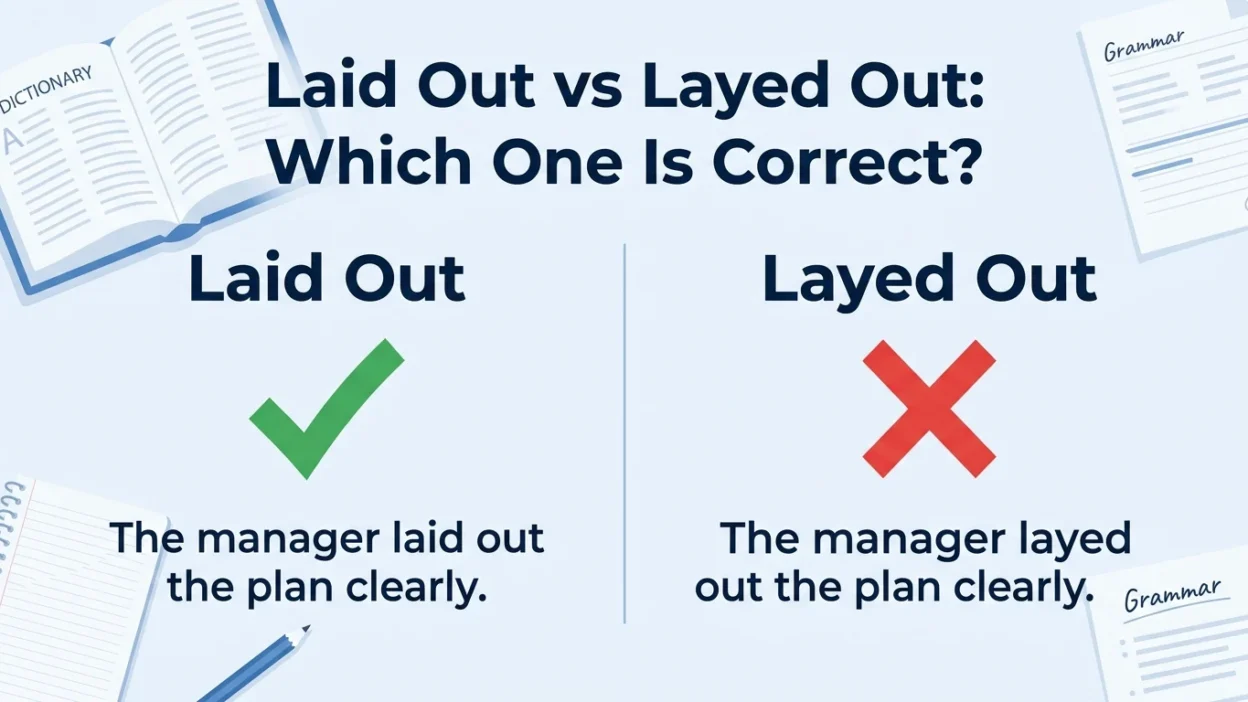
Laid out is the correct phrase.
✅ Correct: She laid out the plans for the project.
❌ Incorrect: She layed out the plans for the project.
The phrase laid out is the proper past tense form of the phrasal verb lay out. In standard English, layed out is generally considered a spelling mistake.
What Does “Laid Out” Mean?
The phrase laid out comes from the phrasal verb lay out, which can have several meanings depending on the context.
Common meanings include:
- To arrange something neatly
- To present information clearly
- To plan or organize something
- To spread items over a surface
- To explain something in detail
Examples:
- She laid out the clothes for tomorrow.
- The manager laid out the company’s goals.
- They laid out the budget for the upcoming year.
- He laid out all the documents on the table.
In each example, laid out refers to an action completed in the past.
What Does “Layed Out” Mean?
In standard English grammar, layed out is generally incorrect.
Many people assume that adding -ed to lay creates the past tense, just as it does with many regular verbs. However, lay is an irregular verb.
Examples of incorrect usage:
- ❌ She layed out the papers.
- ❌ We layed out the schedule.
- ❌ They layed out their strategy.
Correct versions:
- ✅ She laid out the papers.
- ✅ We laid out the schedule.
- ✅ They laid out their strategy.
For nearly all writing situations, laid out is the correct choice.
Laid Out vs Layed Out: Comparison Table
| Feature | Laid Out | Layed Out |
|---|---|---|
| Grammatically correct | ✔ Yes | ✘ No |
| Standard English usage | ✔ Yes | ✘ No |
| Accepted in academic writing | ✔ Yes | ✘ No |
| Accepted in business writing | ✔ Yes | ✘ No |
| Common spelling mistake | ✘ No | ✔ Yes |
| Recommended for everyday use | ✔ Yes | ✘ No |
Why Is “Laid Out” Correct?
The answer lies in verb forms.
The verb lay follows an irregular pattern:
| Verb Form | Word |
|---|---|
| Base form | Lay |
| Past tense | Laid |
| Past participle | Laid |
Examples:
- Today I lay out the documents.
- Yesterday I laid out the documents.
- I have laid out the documents already.
Because the past tense of lay is laid, the correct phrase becomes laid out.
Common Uses of “Laid Out”
Arranging Objects
One of the most common uses involves organizing or spreading items.
Examples:
- She laid out the ingredients before cooking.
- The teacher laid out the materials for the lesson.
- He laid out his tools in the garage.
Presenting Information
The phrase often means explaining something clearly.
Examples:
- The lawyer laid out the facts.
- The consultant laid out a detailed proposal.
- The professor laid out the course requirements.
Planning and Organizing
It can also describe creating a structured plan.
Examples:
- They laid out their business strategy.
- The team laid out a timeline for completion.
- Management laid out expectations for employees.
Designing Physical Spaces
The phrase may refer to arranging spaces or locations.
Examples:
- The architect laid out the building plans.
- Workers laid out the new garden.
- Engineers laid out the road design.
Common Mistakes With Laid Out and Layed Out
Many writers mistakenly use layed out because they apply the standard -ed rule.
Mistake 1
❌ The manager layed out the objectives.
✅ The manager laid out the objectives.
Mistake 2
❌ She layed out her clothes the night before.
✅ She laid out her clothes the night before.
Mistake 3
❌ The company layed out a growth plan.
✅ The company laid out a growth plan.
Mistake 4
❌ He layed out all the evidence.
✅ He laid out all the evidence.
These errors are common but easy to avoid once you remember that the past tense of lay is laid.
Examples of Laid Out in Sentences
Here are more examples showing correct usage:
- She laid out breakfast for the guests.
- The speaker laid out several important points.
- We laid out the project schedule last week.
- The designer laid out the webpage carefully.
- They laid out their expectations from the beginning.
- The committee laid out the rules clearly.
- He laid out every option before making a decision.
- The coach laid out a winning strategy.
Why People Confuse Laid Out and Layed Out
English contains many verbs that create the past tense by adding -ed.
For example:
- Walk → Walked
- Talk → Talked
- Work → Worked
Because of this pattern, many writers assume:
- Lay → Layed
However, English has many irregular verbs that change differently.
Examples:
- Say → Said
- Pay → Paid
- Lay → Laid
Since lay belongs to this irregular group, laid out is the correct form.
Easy Memory Trick
A simple way to remember the correct spelling is to compare it with similar words.
Think about these examples:
- Pay → Paid
- Say → Said
- Lay → Laid
If paid looks correct to you, then laid should feel familiar as well.
Whenever you’re describing something that was arranged, organized, presented, or spread out in the past, choose laid out.
American vs British English
Unlike some grammar and spelling differences, there is no major distinction between American and British English regarding laid out vs layed out.
In both varieties:
- Laid out is correct.
- Layed out is generally considered incorrect.
Whether you’re writing for readers in the United States, the United Kingdom, Canada, Australia, or New Zealand, laid out remains the accepted standard.
When to Use “Laid Out”
Use laid out when:
- Referring to a completed action in the past
- Describing arrangements or organization
- Explaining plans or ideas
- Presenting information clearly
- Writing formally or informally
Examples:
- The team laid out a clear roadmap.
- She laid out everything we needed.
- The report laid out the findings.
When to Avoid “Layed Out”
Avoid layed out in:
- Academic writing
- Professional communication
- Business reports
- Blog articles
- Essays
- Emails
- Formal documents
In almost every modern writing situation, laid out is the correct phrase.
Frequently Asked Questions
Is laid out or layed out correct?
Laid out is correct. It is the proper past tense form of the phrasal verb lay out.
Why is layed out wrong?
It is generally considered incorrect because the past tense of lay is laid, not layed.
Can I use layed out in formal writing?
No. Formal writing should use laid out.
What does laid out mean?
It can mean arranged, organized, presented, explained, planned, or spread out.
Is laid out used in business writing?
Yes. It is commonly used when discussing plans, goals, proposals, and strategies.
Do British and American English use laid out?
Yes. Both varieties use laid out as the standard form.
Is layed out ever acceptable?
In modern standard English, it is generally not accepted as the past tense form of lay out.
How can I remember the correct spelling?
Remember the pattern: pay → paid and lay → laid. This makes laid out easy to recall.
Summary
The choice between laid out vs layed out is simple once you understand the verb lay. The correct past tense form is laid, making laid out the proper phrase for describing something that was arranged, organized, explained, or presented in the past. In contrast, layed out is generally viewed as a spelling mistake and should be avoided in standard writing.
Whether you’re preparing a business report, writing an email, creating content, or completing an academic assignment, using laid out ensures your writing remains accurate and professional. By remembering that lay becomes laid, you’ll be able to choose the correct form confidently every time.

William Harved is a passionate language enthusiast and digital writer specializing in English spelling, grammar clarity, and common writing mistakes. As the primary author of Spelword.com, he focuses on helping readers understand confusing word pairs, correct spelling errors, and improve everyday communication.