If you’ve come across the words ascendency and ascendancy, you may have wondered whether they have different meanings or if one spelling is more correct than the other. Since both words look nearly identical and appear in dictionaries, it’s easy to assume they’re interchangeable. In most cases, they are but there are a few subtle differences in preference and usage worth knowing.
In this guide, you’ll learn the meaning of ascendency vs ascendancy, how each word is used, examples in context, common mistakes to avoid, and whether American or British English favors one spelling over the other. By the end, you’ll know which form best fits your writing.
Quick Answer
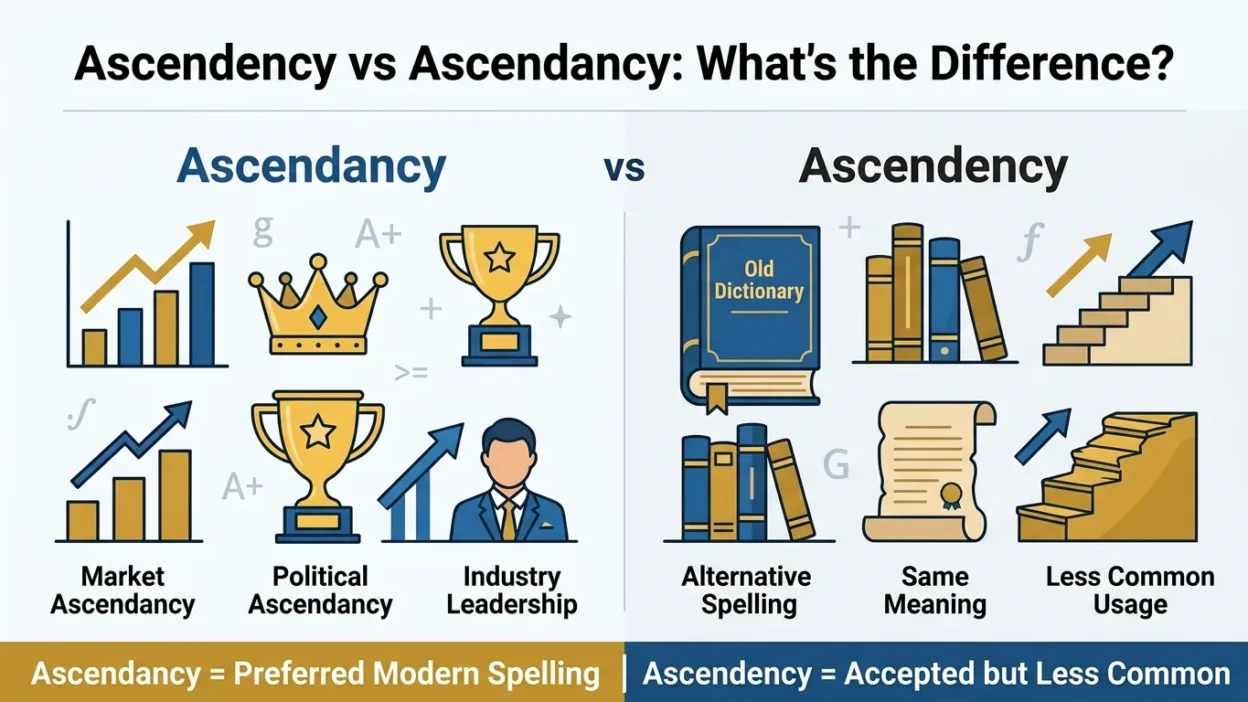
The difference between ascendency vs ascendancy is mainly one of spelling preference, not meaning.
- Ascendancy is the more common and widely preferred spelling in modern English.
- Ascendency is an accepted alternative but is much less frequently used.
Both words mean:
- Dominance or control over others.
- A position of influence, superiority, or power.
Examples:
- The company gained ascendancy in the global market. ✅
- The political party achieved ascendency after the election. ✅
While both are correct, ascendancy is generally the better choice because it is more common in modern writing.
What Does “Ascendancy” Mean?
Ascendancy is a noun that refers to a position of dominance, superiority, authority, or controlling influence over someone or something.
It often describes situations where one person, organization, country, or idea becomes more powerful than another.
Examples
- The team established its ascendancy in the league.
- The nation gained economic ascendancy.
- She achieved ascendancy through years of hard work.
- The company maintained its market ascendancy.
- Technology has given online businesses greater ascendancy.
In each example, ascendancy refers to influence, leadership, or dominance.
What Does “Ascendency” Mean?
Ascendency has the same meaning as ascendancy.
It also refers to a position of power, authority, influence, or dominance.
Although it appears in dictionaries and historical texts, it is considerably less common in contemporary English.
Examples
- The empire reached political ascendency.
- The general secured military ascendency.
- Their cultural ascendency lasted for decades.
These examples are grammatically correct, but many editors would choose ascendancy instead.
Ascendency vs Ascendancy: Comparison Table
| Feature | Ascendancy | Ascendency |
|---|---|---|
| Meaning | Dominance, influence, superiority | Dominance, influence, superiority |
| Part of Speech | Noun | Noun |
| Modern Usage | Very common | Less common |
| Preferred in Writing | Yes | Sometimes |
| Dictionaries Recognize It? | Yes | Yes |
Why Are There Two Spellings?
The two words developed as variant forms over time.
Historically, English often produced multiple spellings of the same word before standardization became more common.
Today:
- Ascendancy has become the dominant spelling.
- Ascendency survives as a recognized but less frequently used variant.
Most modern style guides and dictionaries list both spellings while indicating that ascendancy is preferred.
When Should You Use “Ascendancy”?
In most situations, ascendancy is the recommended spelling.
It is appropriate in:
- Academic writing
- Business communication
- Journalism
- Books
- Research papers
- News articles
- Professional reports
Examples
- The company achieved market ascendancy.
- Their technological ascendancy continues to grow.
- The country gained economic ascendancy.
- His political ascendancy lasted for many years.
- Education helped her achieve professional ascendancy.
Because readers encounter this spelling more often, it generally sounds more natural.
When Might You See “Ascendency”?
Although uncommon, ascendency still appears in:
- Older books
- Historical writing
- Literary works
- Some dictionaries
- Personal writing styles
If you’re quoting historical material, it is usually best to preserve the original spelling.
Otherwise, many editors recommend using ascendancy for consistency.
Real-Life Examples
Business
Correct:
- The company strengthened its market ascendancy.
Less common:
- The company strengthened its market ascendency.
Politics
Correct:
- The party gained political ascendancy after the election.
Also acceptable:
- The party gained political ascendency after the election.
Sports
Correct:
- The club maintained its ascendancy over its rivals.
Although both spellings are correct, the first version is generally preferred by publishers.
Common Mistakes People Make
Here are some common misunderstandings.
Believing One Is Incorrect
Both spellings are recognized by reputable dictionaries.
The difference lies in usage frequency, not correctness.
Mixing Spellings in One Document
Choose one spelling and use it consistently.
For modern writing, ascendancy is usually the better option.
Assuming They Have Different Meanings
They do not.
Both words refer to dominance, influence, superiority, or control.
Confusing Them with “Ascension”
Ascension means the act of rising or moving upward.
Ascendancy refers to the condition of having influence or dominance.
Example:
- Her ascension to leadership increased her political ascendancy.
Easy Trick to Remember the Difference
Here’s a simple tip.
If you’re writing today, choose:
Ascendancy
It is:
- More common
- More familiar to readers
- Preferred by many editors
- Widely used in modern publications
Think of ascendency as an older or less common spelling variation.
American vs British English Differences
Unlike many English words, there is no major American vs British English difference between ascendency and ascendancy.
Both American and British dictionaries recognize both spellings.
However:
- Ascendancy is the preferred spelling in both American and British English.
- Ascendency appears less frequently in publications from both regions.
If you’re writing for an international audience, ascendancy is usually the safest choice.
Similar Words
These words are related in meaning:
- Dominance
- Superiority
- Leadership
- Authority
- Influence
- Control
- Supremacy
- Power
- Preeminence
Although these words are similar, each has its own nuance depending on the context.
FAQs
What is the difference between ascendency and ascendancy?
There is virtually no difference in meaning. The main distinction is that ascendancy is the more commonly used spelling.
Is ascendency a real word?
Yes. Ascendency is a recognized English word and appears in major dictionaries.
Which spelling is more common?
Ascendancy is considerably more common in modern English writing.
Should I use ascendancy or ascendency in academic writing?
Most style guides and editors recommend using ascendancy because it is the preferred modern spelling.
Do the two words have different meanings?
No. Both mean dominance, influence, superiority, or controlling power.
Is ascendancy correct in American English?
Yes. It is the preferred spelling in American English.
Is ascendancy correct in British English?
Yes. It is also the preferred spelling in British English, although ascendency is still recognized.
Can I use both spellings in the same document?
It is better to choose one spelling and use it consistently throughout your writing.
Summary
Understanding ascendency vs ascendancy is easier than it first appears. Both words are correct, both have the same meaning, and both refer to a position of influence, authority, or dominance. The primary difference lies in usage: ascendancy is the spelling most commonly found in modern books, newspapers, academic writing, and professional communication, while ascendency remains an accepted but less frequently used variant.
If you’re unsure which form to choose, ascendancy is generally the best option. It is widely recognized, preferred by many editors, and suitable for both American and British English. Knowing this distinction will help you write with greater consistency, confidence, and clarity.