Have you ever wondered whether organizing or organising is the correct spelling? If you’ve seen both versions in books, websites, or emails, you’re not alone. These spellings often confuse English learners because they look nearly identical but differ by just one letter.
The good news is that both organizing and organising are correct. The difference isn’t about grammar or meaning it’s about the variety of English you’re using. In this guide, you’ll learn the difference between organizing vs organising, discover when to use each spelling, see practical examples, avoid common mistakes, and understand the American and British English preferences.
Quick Answer
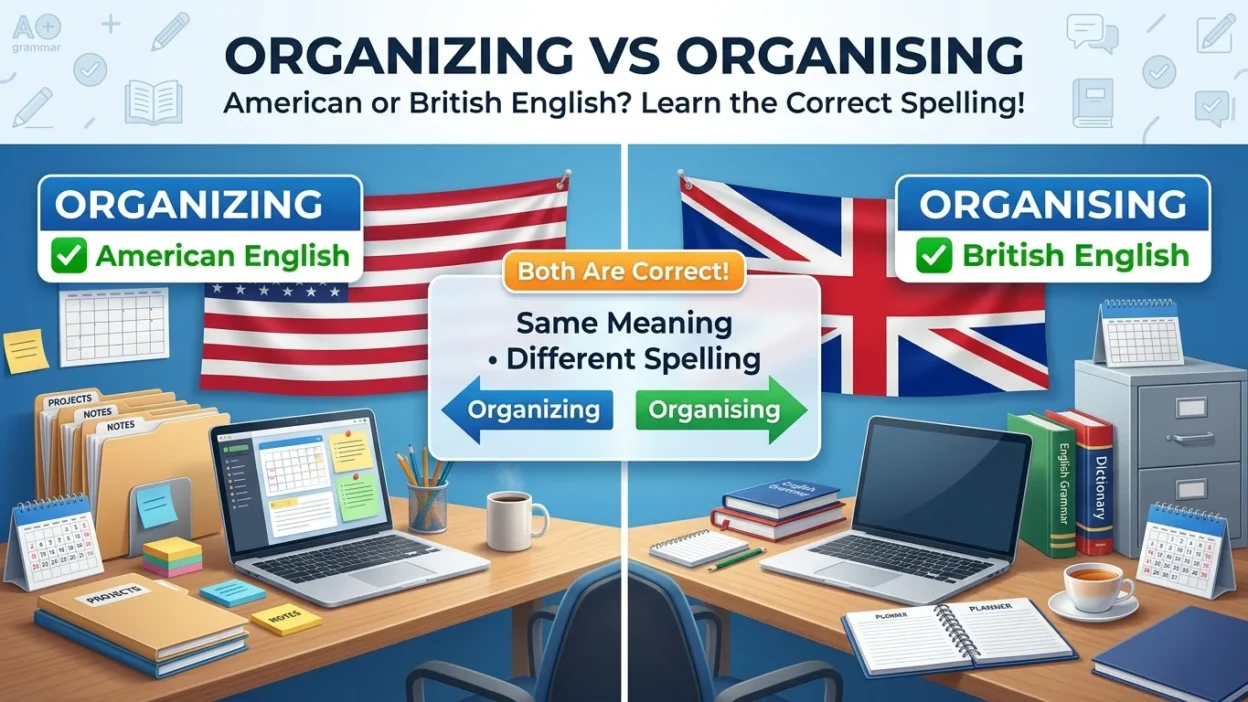
Both organizing and organising are correct spellings.
- Organizing is the preferred spelling in American English.
- Organising is commonly used in British English and many other English-speaking countries.
Examples:
- We are organizing a conference next month. ✅ (American English)
- We are organising a conference next month. ✅ (British English)
The meaning is exactly the same. Only the spelling changes.
What Does “Organizing” Mean?
Organizing is the present participle and gerund of the verb organize.
It means arranging, planning, coordinating, or putting things into a logical order.
In American English, this is the standard spelling.
Examples
- She is organizing her office.
- We’re organizing a fundraising event.
- They enjoy organizing community programs.
- He’s organizing his digital files.
- The company is organizing a training session.
The word can refer to physical objects, schedules, events, teams, or information.
What Does “Organising” Mean?
Organising has exactly the same meaning as organizing.
The only difference is spelling.
It is the preferred form in British English and is widely used in countries such as the United Kingdom, Australia, New Zealand, South Africa, and many Commonwealth nations.
Examples
- She’s organising a charity event.
- They’re organising their travel plans.
- The school is organising a science fair.
- We’re organising the meeting room.
- He’s organising the project timeline.
The meaning remains identical to organizing.
Organizing vs Organising: Comparison Table
| Feature | Organizing | Organising |
|---|---|---|
| Meaning | Arranging or planning | Arranging or planning |
| Correct? | Yes | Yes |
| Preferred In | American English | British English |
| Pronunciation | Same | Same |
| Grammar | Same | Same |
Why Are There Two Spellings?
The difference comes from spelling conventions between American and British English.
American English generally prefers -ize endings:
- Organize
- Realize
- Recognize
- Analyze
British English often accepts both -ize and -ise, although -ise is more common in everyday British publications.
For example:
American English:
- Organize
- Organizing
British English:
- Organise
- Organising
Neither spelling changes the meaning.
When Should You Use “Organizing”?
Use organizing when writing in American English.
It is appropriate for:
- American schools
- U.S. universities
- American businesses
- U.S. publications
- American websites
Examples
- She’s organizing the workshop.
- The volunteers are organizing supplies.
- We’re organizing our schedule.
- They’re organizing a celebration.
- He’s organizing company records.
If your audience is primarily American, this spelling is the better choice.
When Should You Use “Organising”?
Use organising when writing in British English or for audiences in countries that follow British spelling conventions.
Examples
- They’re organising the conference.
- She’s organising classroom activities.
- We’re organising a family reunion.
- The committee is organising volunteers.
- He’s organising financial records.
If your audience expects British spelling, this form is appropriate.
Common Mistakes People Make
Although both spellings are correct, consistency is important.
Mistake 1: Mixing American and British Spellings
Avoid writing:
- Organizing the event while organising the schedule.
Choose one spelling style and use it consistently throughout your document.
Mistake 2: Thinking One Spelling Is Incorrect
Both spellings are accepted.
The difference depends entirely on your chosen variety of English.
Mistake 3: Changing the Spelling Mid-Document
If you’re writing in American English, consistently use:
- Organize
- Organized
- Organizing
If you’re writing in British English, consistently use:
- Organise
- Organised
- Organising
Consistency makes your writing look more professional.
Easy Trick to Remember the Difference
Here’s a simple memory tip.
Think about the country.
- America → Organizing (z)
- Britain → Organising (s)
The meaning never changes.
Only the spelling does.
Everyday Examples
Using “Organizing”
- I’m organizing my desk.
- She’s organizing the guest list.
- They’re organizing a workshop.
- We enjoy organizing events.
- He’s organizing the files.
Using “Organising”
- I’m organising my wardrobe.
- She’s organising the celebration.
- They’re organising volunteers.
- We’re organising travel documents.
- He’s organising his calendar.
Each sentence has the same meaning.
Common Expressions
You’ll often hear these phrases.
With “Organizing”
- Organizing an event
- Organizing a meeting
- Organizing files
- Organizing documents
- Organizing a team
- Organizing a project
With “Organising”
- Organising an event
- Organising a meeting
- Organising volunteers
- Organising paperwork
- Organising supplies
- Organising activities
The expressions are identical except for spelling.
American vs British English
This is where the difference matters.
American English
Preferred spellings:
- Organize
- Organized
- Organizing
British English
Common spellings:
- Organise
- Organised
- Organising
It’s worth noting that some British publishers, including Oxford University Press, also accept -ize spellings. However, -ise remains more common in everyday British writing.
Both spellings are correct as long as they are used consistently.
Practice Sentences
Choose the correct spelling based on the variety of English.
- The company is ______ a seminar in New York.
Answer: organizing
- The charity is ______ a fundraising event in London.
Answer: organising
- We’re ______ our office this weekend.
Answer: organizing (American) / organising (British)
- She’s ______ the conference schedule.
Answer: organizing or organising
- They’re ______ volunteers for the project.
Answer: organizing or organising
Frequently Asked Questions (FAQs)
What is the difference between organizing and organising?
There is no difference in meaning. Organizing is the American English spelling, while organising is the British English spelling.
Which spelling is correct?
Both are correct. The appropriate spelling depends on whether you’re using American or British English.
Is organizing used in the UK?
Yes. Although organising is more common, some British publishers also use organizing, especially those following Oxford spelling conventions.
Which spelling should I use for international audiences?
Choose one spelling style and use it consistently throughout your writing. Consistency is more important than the specific variant.
Is organising wrong in American English?
It is understood, but American publications almost always prefer organizing.
Is organizing wrong in British English?
No. It is accepted by some British style guides, although organising is generally more common.
Why do American and British English have different spellings?
Many spelling differences developed over time as American English adopted simplified spelling conventions while British English preserved traditional forms.
Summary
Understanding organizing vs organising is simple once you know that both spellings are correct. Organizing is the preferred spelling in American English, while organising is commonly used in British English and many Commonwealth countries. The meaning, pronunciation, and grammar remain exactly the same regardless of which spelling you choose.
The key to using these words correctly is consistency. If you’re writing for an American audience, use organizing throughout your document. If you’re writing for a British audience, use organising consistently. Following the spelling conventions of your intended audience helps your writing appear polished, professional, and easy to read.

Dani Morrison is a dedicated language writer and spelling expert at Spelword.com, where she focuses on helping readers understand common English spelling mistakes and confusing word pairs. With a passion for clear communication, Dani creates easy-to-follow guides that simplify complex grammar and spelling rules for everyday use.