
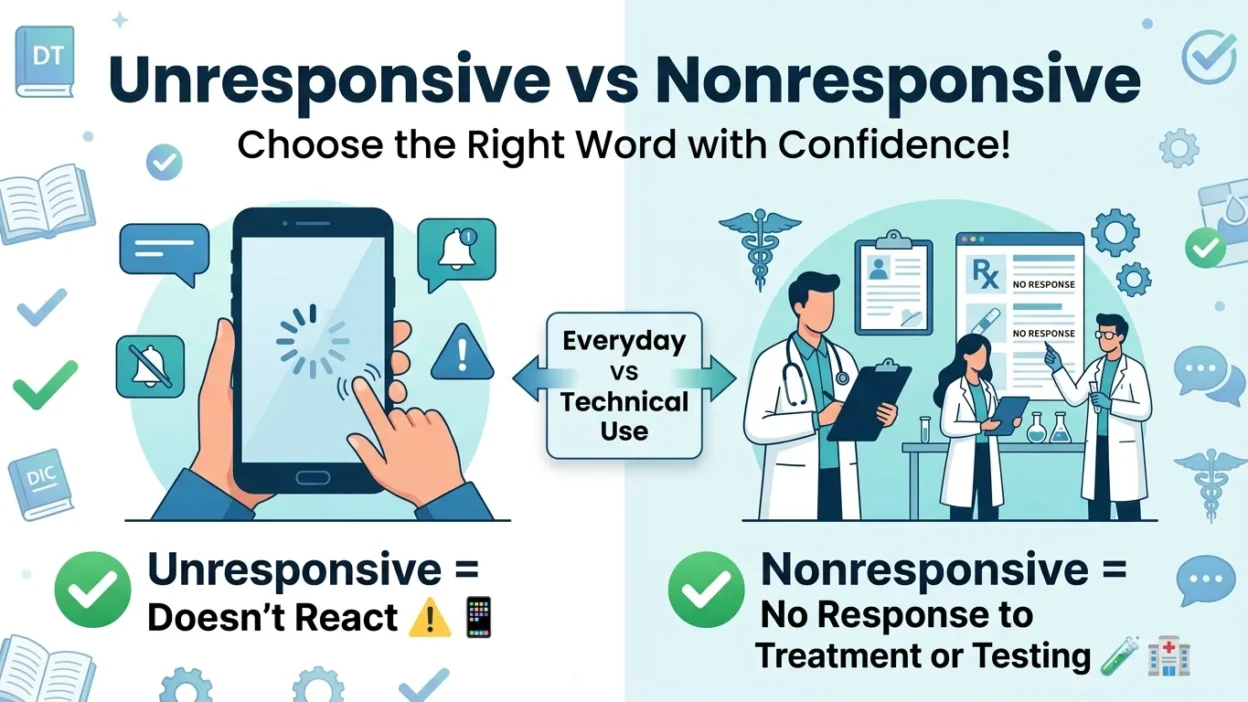
Have you ever wondered whether you should write unresponsive or nonresponsive? These two words look and sound similar, and both describe someone or something that does not respond. Because of this, many English learners and even native speakers use them interchangeably.
Although unresponsive and nonresponsive often share the same meaning, there are subtle differences in tone, context, and preferred usage. In this guide, you’ll learn the difference between unresponsive vs nonresponsive, discover when each word is appropriate, explore practical examples, avoid common mistakes, and gain confidence in choosing the right word.
Quick Answer
Both unresponsive and nonresponsive describe someone or something that does not respond.
However:
- Unresponsive is the more common word in everyday English and medical situations.
- Nonresponsive is often preferred in technical, scientific, research, and formal writing.
Examples:
- The patient was unresponsive after the accident. ✅
- The treatment was nonresponsive in some patients. ✅
In many situations, either word is acceptable, but context often determines the better choice.
What Does “Unresponsive” Mean?
Unresponsive is an adjective meaning not reacting, replying, or responding to people, events, or stimuli.
It is widely used in everyday conversation, medicine, technology, and customer service.
Examples
- The patient remained unresponsive.
- My phone became unresponsive after the update.
- The customer service team was unresponsive.
- The audience seemed unresponsive.
- The child was unresponsive to repeated questions.
The word often implies an expected response that never happened.
What Does “Nonresponsive” Mean?
Nonresponsive is also an adjective meaning not responding.
It often appears in scientific, medical, educational, technical, and research writing.
It may sound slightly more formal than unresponsive.
Examples
- Some tumors are nonresponsive to treatment.
- The software remained nonresponsive during testing.
- The students were nonresponsive to the intervention.
- The device became nonresponsive after installation.
- Certain bacteria are nonresponsive to the medication.
In many professional fields, nonresponsive emphasizes the absence of an expected reaction under specific conditions.
Unresponsive vs Nonresponsive: Comparison Table
| Feature | Unresponsive | Nonresponsive |
|---|---|---|
| Part of Speech | Adjective | Adjective |
| Meaning | Not responding | Not responding |
| Common Usage | Everyday English, medicine | Technical, scientific, formal writing |
| Tone | More natural and conversational | More formal and specialized |
| Interchangeable? | Often | Often |
When Should You Use “Unresponsive”?
Use unresponsive when describing people, devices, services, or situations in everyday communication.
Examples
- The keyboard became unresponsive.
- He was unresponsive during the meeting.
- The support team remained unresponsive.
- The patient was found unresponsive.
- The website became unresponsive after heavy traffic.
This word is common in both spoken and written English.
When Should You Use “Nonresponsive”?
Use nonresponsive when writing in technical, scientific, academic, or research contexts.
Examples
- The patients were nonresponsive to chemotherapy.
- The sample remained nonresponsive during testing.
- The software became nonresponsive after deployment.
- The treatment proved nonresponsive in severe cases.
- Some participants were nonresponsive to the intervention.
Professional documents often favor this term because it sounds more precise and objective.
Are They Interchangeable?
In many cases, yes.
Consider these examples:
- The computer became unresponsive.
- The computer became nonresponsive.
Both are grammatically correct.
However, unresponsive sounds more natural in everyday conversation, while nonresponsive is more common in technical documentation.
Common Mistakes to Avoid
Although these words are similar, choosing the right one improves clarity.
Mistake 1: Thinking One Word Is Incorrect
Both unresponsive and nonresponsive are valid English words.
The choice depends on style and context.
Mistake 2: Using “Nonresponsive” in Casual Conversation
Although correct, nonresponsive can sound unnecessarily formal.
Instead of:
“The waiter was nonresponsive.”
Many native speakers would naturally say:
“The waiter was unresponsive.”
Mistake 3: Assuming They Have Completely Different Meanings
The meanings overlap significantly.
The main difference lies in tone and usage rather than definition.
Easy Trick to Remember the Difference
Here’s a simple memory tip.
Ask yourself:
Am I writing casually or generally?
Choose unresponsive.
Am I writing for a scientific, medical, or technical audience?
Choose nonresponsive.
For example:
- The doctor found the patient unresponsive.
- The study identified nonresponsive participants.
Both are correct, but each better fits its context.
Everyday Examples
Using “Unresponsive”
- My laptop became unresponsive.
- The manager was unresponsive to complaints.
- The audience remained unresponsive.
- The patient was unresponsive after surgery.
- The application became unresponsive.
Using “Nonresponsive”
- The cells were nonresponsive to treatment.
- The software remained nonresponsive during testing.
- Several patients were nonresponsive.
- The equipment became nonresponsive.
- Some participants were nonresponsive to the therapy.
Common Expressions
These combinations frequently appear in English.
With “Unresponsive”
- Unresponsive patient
- Unresponsive device
- Unresponsive website
- Unresponsive customer service
- Unresponsive behavior
- Unresponsive screen
With “Nonresponsive”
- Nonresponsive treatment
- Nonresponsive patients
- Nonresponsive system
- Nonresponsive participants
- Nonresponsive software
- Nonresponsive cells
Learning these common expressions helps you use both words naturally.
American vs British English
There is no significant difference between American and British English regarding unresponsive and nonresponsive.
Both forms are accepted in both varieties of English.
However:
- Unresponsive is generally more common in everyday communication.
- Nonresponsive appears more frequently in academic papers, scientific publications, medical journals, and technical reports.
These usage patterns are similar in both American and British English.
Practice Sentences
Choose the correct word.
- The patient remained ______ after the accident.
Answer: unresponsive
- Several participants were ______ to the treatment.
Answer: nonresponsive
- My computer became ______ after the update.
Answer: unresponsive
- The cells were ______ to the medication.
Answer: nonresponsive
- The customer support team was ______.
Answer: unresponsive
Frequently Asked Questions (FAQs)
What is the difference between unresponsive and nonresponsive?
Both words mean not responding. Unresponsive is more common in everyday English, while nonresponsive is often used in technical and scientific writing.
Are unresponsive and nonresponsive interchangeable?
In many situations, yes. The difference is mainly one of style and context rather than meaning.
Which word is more common?
Unresponsive is generally more common in everyday conversation and general writing.
Is nonresponsive a real word?
Yes. Nonresponsive is a standard English word frequently used in medicine, science, and technical fields.
Which word should I use for a frozen computer?
Most people naturally use unresponsive, although nonresponsive is also acceptable.
Which term is preferred in medical writing?
Both appear in medical writing, but nonresponsive is especially common when describing a lack of response to treatment, while unresponsive is commonly used for a patient’s physical condition.
Is there any difference between American and British English?
No. Both varieties use unresponsive and nonresponsive with the same meanings, although preferences may vary slightly by profession rather than by region.
Summary
Understanding unresponsive vs nonresponsive is easier once you recognize that the two words share the same basic meaning but differ in tone and context. Unresponsive is the preferred choice for everyday communication, customer service, technology, and many medical situations because it sounds more natural and conversational. Nonresponsive, on the other hand, is more common in technical, scientific, academic, and research writing where precise terminology is often preferred.
Since both words are grammatically correct, the best choice depends on your audience and purpose. Whether you’re describing a patient, a computer, a treatment, or a research study, selecting the word that fits the context will make your writing clearer, more professional, and easier to understand.

William Harved is a passionate language enthusiast and digital writer specializing in English spelling, grammar clarity, and common writing mistakes. As the primary author of Spelword.com, he focuses on helping readers understand confusing word pairs, correct spelling errors, and improve everyday communication.