Have you ever wondered whether you should say sitting or seating? These two words are closely related, but they are not interchangeable. Because they both come from the verb sit, many English learners and even native speakers occasionally confuse them in conversation and writing.
In this complete guide, you’ll learn the difference between sitting vs seating, understand their meanings, see practical examples, avoid common mistakes, and know exactly when to use each word. Whether you’re writing an email, describing furniture, or talking about people in a room, this guide will help you choose the correct word with confidence.
Quick Answer
The difference between sitting and seating is straightforward.
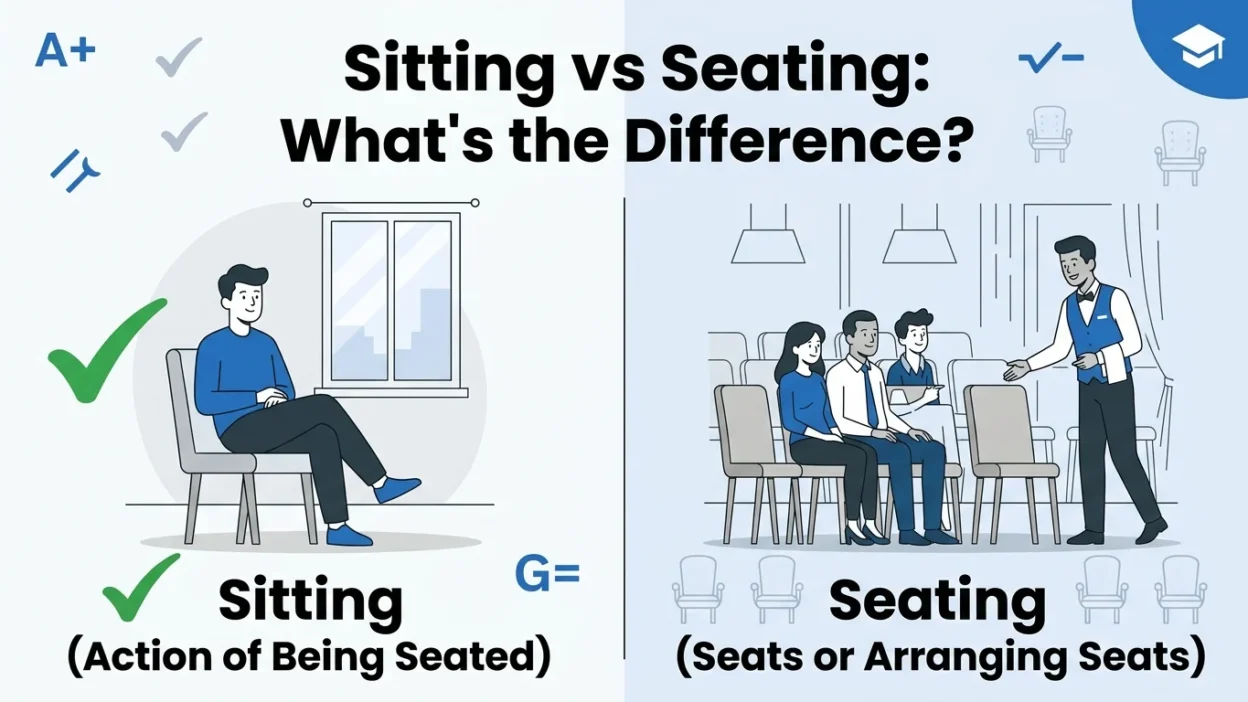
- Sitting usually refers to the action or position of being seated.
- Seating usually refers to the act of providing seats, arranging where people sit, or the available seats in a place.
Examples:
- She is sitting by the window. ✅
- The theater has seating for 500 people. ✅
- The hostess is seating the guests. ✅
Think of it this way:
- Sitting = being seated.
- Seating = placing people in seats or referring to seats themselves.
What Does “Sitting” Mean?
Sitting is the present participle and gerund form of the verb sit. It describes someone who is in a seated position or the action of remaining seated.
It can also function as a noun in certain expressions.
Examples
- She is sitting near the door.
- We spent the afternoon sitting in the garden.
- The cat is sitting on the sofa.
- He enjoys sitting quietly with a good book.
- They were sitting together during the concert.
In every example, sitting describes the action or state of being seated.
What Does “Seating” Mean?
Seating has several common meanings in English.
It may refer to:
- The act of helping or directing someone to a seat.
- The number of seats available.
- Furniture or arrangements designed for sitting.
Examples
- The restaurant offers seating for 120 guests.
- The hostess is seating customers.
- Outdoor seating is available.
- The stadium has limited seating.
- Premium seating costs more than general admission.
Unlike sitting, seating often relates to seats rather than the people using them.
Sitting vs Seating: Comparison Table
| Feature | Sitting | Seating |
|---|---|---|
| Part of Speech | Verb form or noun | Noun or verb form |
| Meaning | Being in a seated position | Providing seats or available seats |
| Focus | Person’s action or position | Seats or arranging people |
| Example | She is sitting outside. | The venue has comfortable seating. |
| Common Use | Daily conversation | Restaurants, theaters, events, furniture |
When to Use “Sitting”
Choose sitting when describing:
- Someone who is seated.
- The act of remaining seated.
- A person’s position.
- Continuous action.
Examples
- I am sitting in the front row.
- The children are sitting quietly.
- We were sitting together all evening.
- She prefers sitting near the window.
If the focus is on the person’s position or action, sitting is the correct choice.
When to Use “Seating”
Use seating when discussing:
- Capacity
- Furniture
- Seat arrangements
- Assigning seats
- Available places to sit
Examples
- Reserved seating begins at 6 p.m.
- There isn’t enough seating in the waiting room.
- The manager is seating guests.
- Additional seating has been added for the event.
- Wheelchair seating is available.
Here, the emphasis is on seats rather than the people sitting.
Common Mistakes People Make
These two words are easy to confuse because both relate to sitting.
Mistake 1: Using “Seating” Instead of “Sitting”
❌ She is seating on the bench.
✅ She is sitting on the bench.
Mistake 2: Using “Sitting” for Seat Capacity
❌ The stadium has sitting for 30,000 people.
✅ The stadium has seating for 30,000 people.
Mistake 3: Confusing Actions with Objects
Remember:
- Sitting describes what people are doing.
- Seating describes seats or arranging people.
Easy Trick to Remember the Difference
Here’s a simple memory tip:
If you can replace the word with being seated, use sitting.
If you’re talking about chairs, seats, capacity, or assigning seats, use seating.
For example:
- The guests are sitting.
- The hotel has outdoor seating.
This quick rule works in almost every situation.
Everyday Examples
Using “Sitting”
- My grandparents are sitting on the porch.
- The students were sitting silently.
- I spent hours sitting at my desk.
- He’s sitting next to his sister.
- The dog is sitting patiently.
Using “Seating”
- Indoor seating is fully booked.
- Balcony seating offers a better view.
- VIP seating includes refreshments.
- The usher is seating guests.
- Extra seating has been arranged.
Common Expressions
Here are some expressions you’ll frequently encounter.
With “Sitting”
- Sitting quietly
- Sitting comfortably
- Sitting together
- Sitting still
- Sitting by the window
With “Seating”
- Assigned seating
- Open seating
- Reserved seating
- Outdoor seating
- Limited seating
- Stadium seating
Learning these phrases helps your English sound more natural.
American vs British English
The meanings of sitting and seating are essentially the same in both American and British English.
However, there are slight differences in usage.
In American English:
- “Open seating” is commonly used for schools, events, and transportation.
- Restaurants often advertise “outdoor seating.”
In British English:
- You’ll also hear “open seating” and “outdoor seating,” although terms like “places to sit” may appear more often in everyday conversation.
Overall, there are no spelling differences between the two varieties.
Practice Sentences
Choose the correct word.
- The audience is ______ quietly.
sitting
- The café offers outdoor ______.
seating
- The hostess is ______ guests.
seating
- We spent hours ______ by the fireplace.
sitting
- The theater has comfortable ______.
Answer: seating
Frequently Asked Questions (FAQs)
What is the difference between sitting and seating?
Sitting refers to being in a seated position, while seating refers to seats, seat arrangements, or the act of placing people in seats.
Can seating be used as a verb?
Yes. For example: “The usher is seating the guests.”
Is sitting a verb or a noun?
It can be both. It is commonly used as the present participle of sit, but it also functions as a noun in certain expressions.
Which is correct: sitting room or seating room?
Sitting room is correct. “Seating room” is not standard English.
What does seating capacity mean?
It refers to the maximum number of people that a venue or room can accommodate with available seats.
Is there any difference between American and British English?
No significant difference exists. Both varieties use sitting and seating with the same meanings.
Can I say “The guests are seating”?
No. The correct sentence is “The guests are sitting.” If someone is placing guests in their seats, you would say “The hostess is seating the guests.”
Summary
Understanding sitting vs seating is easier once you remember what each word focuses on. Sitting describes the action or position of being seated, while seating refers to seats, seating arrangements, available capacity, or the act of directing someone to a seat. Although both words come from the verb sit, they serve different grammatical purposes and should not be used interchangeably.
Using the correct word makes your English more natural and precise. Whether you’re talking about a person relaxing on a chair, a restaurant’s outdoor area, or the seating capacity of a stadium, knowing the distinction between sitting and seating will help you communicate clearly in both spoken and written English.

William Harved is a passionate language enthusiast and digital writer specializing in English spelling, grammar clarity, and common writing mistakes. As the primary author of Spelword.com, he focuses on helping readers understand confusing word pairs, correct spelling errors, and improve everyday communication.