Many English words sound almost identical but have completely different meanings. Shudder vs shutter is one of the most common word pairs that confuses English learners and even native speakers. Because they are pronounced similarly, it’s easy to mix them up in writing, especially when typing quickly.
If you’ve ever wondered whether someone should shudder or shutter, this guide will clear up the confusion. You’ll learn the meaning of each word, when to use it correctly, practical examples, common mistakes to avoid, and simple tips to remember the difference.
Quick Answer
The difference between shudder and shutter is simple:
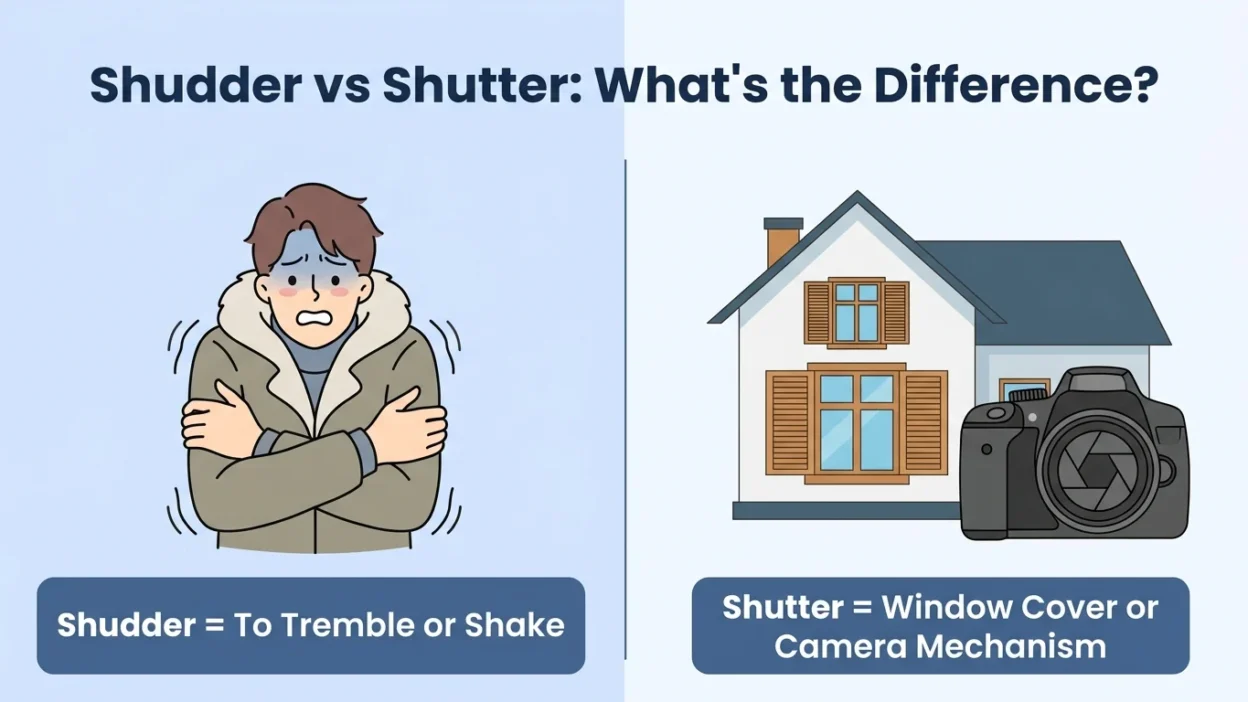
- Shudder is a verb or noun that refers to shaking or trembling because of fear, cold, disgust, or strong emotion.
- Shutter is usually a noun referring to a window cover or a camera part. It can also be a verb meaning to close a business or cover something with shutters.
Although these words sound similar, they are never interchangeable because they describe completely different actions and objects.
What Does “Shudder” Mean?
Shudder means to shake suddenly and uncontrollably due to a physical feeling or emotional reaction.
It can describe reactions caused by:
- Fear
- Cold weather
- Disgust
- Excitement
- Anxiety
- Pain
Examples of “Shudder”
- I shudder whenever I watch horror movies.
- She shuddered after hearing the frightening news.
- The child shuddered in the freezing wind.
- He gave a shudder at the memory of the accident.
In all these examples, the word refers to trembling or shaking.
What Does “Shutter” Mean?
Shutter has several meanings depending on the context.
As a noun, it usually means:
- A movable cover for a window
- The mechanism inside a camera that controls light exposure
As a verb, shutter means:
- To close a building or business
- To cover windows with shutters
Examples of “Shutter”
- Please close the shutters before the storm.
- The photographer adjusted the camera shutter speed.
- The company decided to shutter the factory.
- Several stores were shuttered after the flood.
Unlike shudder, this word has nothing to do with shaking.
Shudder vs Shutter: Comparison Table
| Feature | Shudder | Shutter |
|---|---|---|
| Part of speech | Verb, noun | Noun, verb |
| Main meaning | Shake or tremble | Window cover, camera mechanism, or close something |
| Related to | Emotion or physical reaction | Buildings, windows, photography, businesses |
| Example | I shudder at scary stories. | Close the shutters before leaving. |
| Common confusion | Mistaken for shutter | Mistaken for shudder |
How to Remember the Difference
A simple memory trick can help.
- Shudder contains “udder,” but think of the “d” standing for disgust, danger, or dread—feelings that make people shake.
- Shutter contains “tt,” which you can connect with two window panels or a camera shutter.
Remember:
- If someone shakes, use shudder.
- If you’re talking about windows, cameras, or closing a business, use shutter.
Example Sentences Using “Shudder”
Here are more examples showing the correct use of shudder.
- I always shudder when I hear thunder at night.
- She couldn’t help but shudder after touching the icy water.
- His voice made me shudder with fear.
- The terrible smell made everyone shudder.
- They watched the movie and shuddered during the final scene.
Example Sentences Using “Shutter”
These examples demonstrate the correct use of shutter.
- The old house has wooden shutters.
- Increase the camera shutter speed for moving subjects.
- Heavy snowfall forced the restaurant to shutter temporarily.
- Workers shuttered the building before the hurricane.
- The photographer checked the shutter before taking the picture.
Common Mistakes People Make
Many writers accidentally replace one word with the other because they sound alike.
Mistake 1: Using “Shutter” for Fear
❌ I shuttered when I saw the snake.
✅ I shuddered when I saw the snake.
Fear causes trembling, not closing.
Mistake 2: Using “Shudder” for Windows
❌ Please close the shudders.
✅ Please close the shutters.
Windows have shutters, not shudders.
Mistake 3: Confusing Photography Terms
❌ Increase the camera shudder speed.
✅ Increase the camera shutter speed.
Photography always uses shutter.
Mistake 4: Business Closure
❌ The company decided to shudder its offices.
✅ The company decided to shutter its offices.
Businesses are shuttered, not shuddered.
Shudder vs Shutter in Everyday English
Both words appear regularly in daily conversations, but in different situations.
You will hear shudder when people describe emotional or physical reactions.
Examples include:
- Watching a scary movie
- Feeling cold
- Remembering something unpleasant
- Experiencing fear
You will hear shutter when discussing:
- Photography
- Home improvement
- Window coverings
- Business closures
- Storm preparation
Knowing the context usually makes choosing the correct word easy.
American vs British English
There is no difference between American and British English in the meanings or spelling of shudder and shutter.
Both varieties of English use:
- Shudder for trembling or shaking.
- Shutter for window coverings, camera parts, or closing businesses.
The pronunciation is also nearly identical in both forms of English, which explains why many learners confuse them.
Tips to Avoid Confusing Shudder and Shutter
Keep these simple tips in mind:
- Think about whether someone is shaking or closing something.
- Fear, cold, or disgust always point to shudder.
- Cameras and windows always use shutter.
- Read your sentence aloud to check whether the meaning makes sense.
- Proofread carefully since spellcheck may not catch correctly spelled but incorrect words.
Practice Sentences
Choose the correct word.
- I couldn’t help but ______ after hearing the ghost story.
- The photographer changed the camera ______ speed.
- Please close the window ______ before the rain starts.
- The unpleasant smell made everyone ______.
- The company decided to ______ several locations.
Answers
- shudder
- shutter
- shutters
- shudder
- shutter
Frequently Asked Questions
What is the difference between shudder and shutter?
Shudder means to shake because of fear, cold, or emotion. Shutter refers to a window covering, a camera mechanism, or the act of closing a business or building.
Is it “I shudder” or “I shutter”?
The correct expression is I shudder when describing trembling or a strong emotional reaction.
What does shutter mean in photography?
In photography, a shutter is the camera mechanism that opens and closes to control how much light reaches the camera sensor.
Can shutter be used as a verb?
Yes. Shutter can mean to close a business, secure a building, or cover windows with shutters.
Why do people confuse shudder and shutter?
They sound very similar when spoken, but they have unrelated meanings, making them easy to mix up in writing.
Is shudder always related to fear?
No. Shudder can describe shaking caused by fear, cold, disgust, excitement, pain, or any intense emotional or physical reaction.
Are shudder and shutter pronounced the same?
Their pronunciation is very similar, especially in fast speech, but careful pronunciation may reveal a slight difference depending on the speaker’s accent.
Summary
Understanding shudder vs shutter is easier once you remember that they belong to completely different situations. Shudder describes trembling caused by fear, cold, disgust, or another strong feeling, while shutter refers to window coverings, camera mechanisms, or the act of closing a business or building. Although they sound alike, their meanings never overlap.
The best way to master these words is through regular reading and practice. Whenever you encounter one of them, pause for a moment and ask yourself whether the sentence is describing shaking or closing something. That simple question will help you choose the correct word with confidence every time.

Dani Morrison is a dedicated language writer and spelling expert at Spelword.com, where she focuses on helping readers understand common English spelling mistakes and confusing word pairs. With a passion for clear communication, Dani creates easy-to-follow guides that simplify complex grammar and spelling rules for everyday use.