
Have you ever paused while writing and wondered whether to use either or neither? You’re not alone. These two words are common in everyday English, yet they often cause confusion because they seem closely related. Understanding the difference can make your writing clearer, more accurate, and more professional.
Whether you’re writing an email, completing an assignment, or simply trying to improve your grammar skills, learning either vs neither is essential. In this guide, you’ll discover their meanings, correct usage, examples, common mistakes, and simple tricks to remember when to use each one.
Quick Answer
The difference between either and neither is simple:
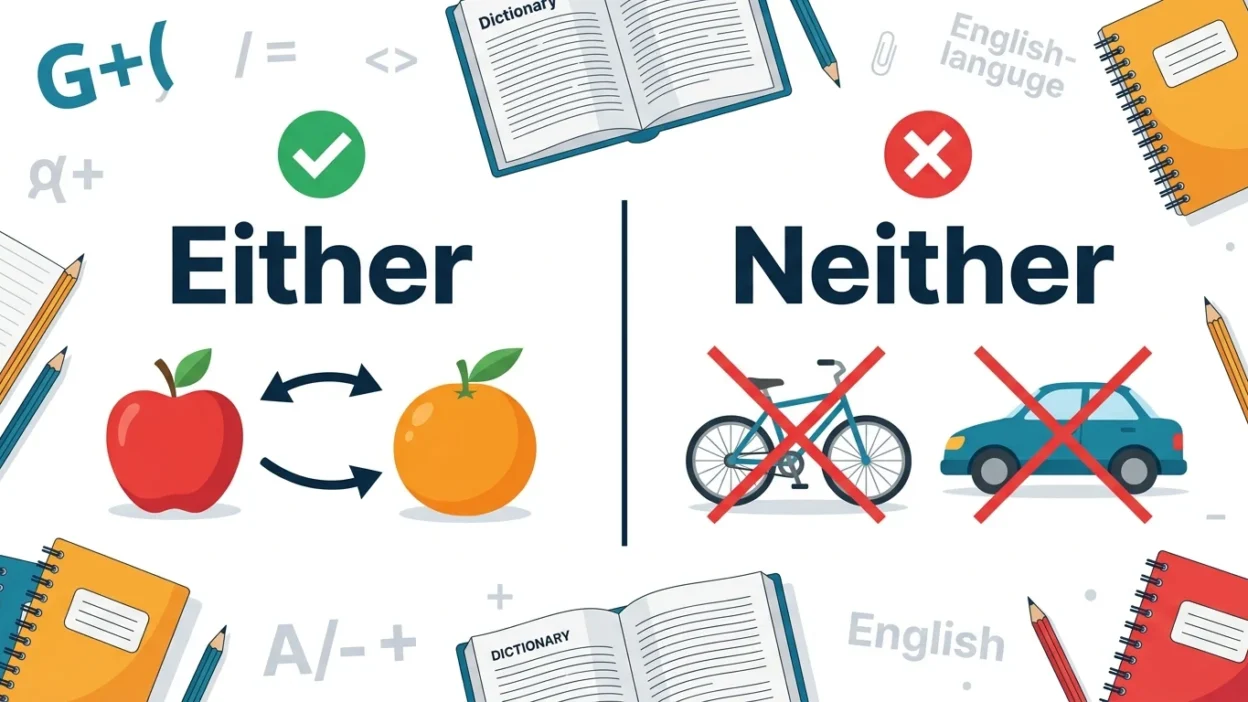
- Either means one of two choices or both choices are possible.
- Neither means not one and not the other.
Examples
✅ Either restaurant serves excellent food.
✅ You can choose either option.
✅ Neither answer is correct.
✅ Neither of the candidates was selected.
Think of it this way:
- Either = one or the other
- Neither = not this one and not that one
What Does “Either” Mean?
The word either refers to one of two people, things, choices, or possibilities. It is often associated with alternatives.
Common Uses of Either
- One of two options
- A choice between alternatives
- Used with “or” in a sentence
Examples of Either
- You can take either road to reach the city.
- Either candidate would be a good manager.
- We can meet on either Monday or Tuesday.
- I don’t like coffee, and I don’t like tea either.
In these examples, either suggests that one option can be chosen from two possibilities.
What Does “Neither” Mean?
The word neither is the negative form of either. It means not one and not the other.
Common Uses of Neither
- Rejecting both options
- Expressing a negative choice
- Used with “nor”
Examples of Neither
- Neither solution solved the problem.
- Neither student completed the assignment.
- She likes neither coffee nor tea.
- Neither of the books was available.
In each example, both options are excluded.
Either vs Neither: Comparison Table
| Feature | Either | Neither |
|---|---|---|
| Meaning | One of two choices | Not one and not the other |
| Tone | Positive or neutral | Negative |
| Common Pairing | Either…or | Neither…nor |
| Indicates Choice | Yes | No |
| Excludes Both Options | No | Yes |
| Example | Either answer works. | Neither answer works. |
This table highlights the key distinction: either includes possibilities, while neither excludes them.
How to Use Either Correctly
1. Showing a Choice Between Two Options
Use either when one of two alternatives is acceptable.
Examples:
- You may sit in either seat.
- Either route will get you there.
- We can start either today or tomorrow.
2. Using “Either…Or”
This structure presents two alternatives.
Examples:
- Either you apologize or you leave.
- We can travel either by train or by bus.
- Either Sarah or John will attend the meeting.
3. Using Either at the End of Negative Sentences
Examples:
- I don’t like spicy food either.
- He didn’t call, and she didn’t text either.
In this context, either means “also not.”
How to Use Neither Correctly
1. Referring to Two Negative Choices
Use neither when both options are rejected.
Examples:
- Neither proposal was approved.
- Neither movie interested me.
- Neither answer was correct.
2. Using “Neither…Nor”
This structure connects two negative ideas.
Examples:
- Neither the manager nor the employees knew about the change.
- She likes neither pizza nor pasta.
- Neither rain nor snow stopped the event.
3. Using “Neither Of”
Examples:
- Neither of the applicants met the requirements.
- Neither of my friends could attend.
- Neither of the answers was accurate.
Common Mistakes with Either and Neither
Many English learners—and even native speakers—mix these words up. Here are the most common errors.
Mistake 1: Using Double Negatives
❌ I don’t want neither option.
✅ I want neither option.
✅ I don’t want either option.
Since neither already has a negative meaning, adding another negative creates an incorrect double negative.
Mistake 2: Mixing Up Either and Neither
❌ Either of the answers is wrong.
✅ Neither of the answers is correct.
If both answers are incorrect, use neither, not either.
Mistake 3: Using “Neither” with “Or”
❌ Neither coffee or tea sounds good.
✅ Neither coffee nor tea sounds good.
The correct pairing is always neither…nor.
Mistake 4: Using “Either” with “Nor”
❌ Either pizza nor pasta is available.
✅ Either pizza or pasta is available.
The correct pair is either…or.
Easy Memory Trick
A simple way to remember the difference:
Either = One Choice Available
Think of the letter E in Either as standing for Eligible.
One option is available.
Neither = No Choice Available
Think of the letter N in Neither as standing for None.
Neither option works.
This quick association helps many learners remember the correct usage instantly.
Either vs Neither in Everyday Conversations
These words appear frequently in spoken and written English.
Everyday Examples
Either
- You can choose either color.
- Either answer is acceptable.
- We can leave either now or later.
Neither
- Neither option fits my budget.
- Neither person responded.
- Neither of us knew the answer.
Mastering these expressions will make your communication sound more natural and fluent.
Grammar Rules for Subject-Verb Agreement
One area that often causes confusion is verb agreement.
With Either
When using either of, a singular verb is generally preferred.
Examples:
- Either of the books is useful.
- Either of the candidates has experience.
With Neither
Similarly, neither of usually takes a singular verb.
Examples:
- Neither of the answers is correct.
- Neither of the students was absent.
In informal conversation, plural verbs are sometimes heard, but singular verbs remain the standard choice in formal writing.
American vs British English Differences
When comparing either vs neither, the meanings remain the same in both American and British English.
However, pronunciation may differ.
American English
- Either: EE-ther or EYE-ther
- Neither: NEE-ther or NYE-ther
British English
- Either: Often EYE-ther
- Neither: Often NYE-ther
Despite pronunciation differences, the grammar rules and meanings are identical.
Related Words and Phrases
Understanding related expressions can strengthen your grammar skills.
Similar Expressions
- Both
- One or the other
- None
- Not either
- Alternative
- Choice
- Option
- Selection
Examples
- Both candidates qualified.
- Neither candidate qualified.
- Choose either option.
- None of the options worked.
These related terms help clarify the distinction between positive and negative choices.
Why Learning Either vs Neither Matters
Using these words correctly improves:
- Writing clarity
- Professional communication
- Academic performance
- Grammar accuracy
- Reading comprehension
Whether you’re writing an essay, email, report, or blog post, choosing the correct word prevents confusion and ensures your message is understood exactly as intended.
Frequently Asked Questions (FAQs)
What is the difference between either and neither?
Either means one of two options, while neither means not one and not the other.
Is neither always negative?
Yes. Neither carries a negative meaning and excludes both options.
Can I say “I don’t want neither”?
No. This creates a double negative. Say either “I want neither” or “I don’t want either.”
Which is correct: neither or nor?
These words often work together as neither…nor. They are not interchangeable.
Can either mean both?
No. Either refers to one of two choices, not both simultaneously.
Does neither take a singular or plural verb?
In formal English, neither generally takes a singular verb.
Is there a difference between American and British English?
The meanings are the same. The main difference is pronunciation.
Can either be used at the end of a sentence?
Yes. It commonly appears at the end of negative sentences, such as: “I don’t like it either.”
Summary
Understanding either vs neither is easier than it first appears. Either refers to one of two choices and is commonly used with or. Neither, on the other hand, means not one and not the other and is usually paired with nor. While the words are related, they express opposite ideas.
Using them correctly helps make your writing more precise and professional. Whether you’re making a choice, rejecting options, or building complex sentences, knowing when to use either and neither can dramatically improve your grammar and communication skills.

William Harved is a passionate language enthusiast and digital writer specializing in English spelling, grammar clarity, and common writing mistakes. As the primary author of Spelword.com, he focuses on helping readers understand confusing word pairs, correct spelling errors, and improve everyday communication.