Have you ever paused while writing because you weren’t sure whether to use onstage or on stage? Since both expressions describe someone performing or appearing before an audience, they often seem interchangeable. However, their usage depends on grammar, writing style, and context.
In this guide, you’ll learn the difference between onstage vs on stage, understand when each form is appropriate, explore practical examples, avoid common mistakes, and discover easy memory tricks to help you choose the correct expression every time.
Quick Answer
The difference between onstage and on stage is mainly grammatical.
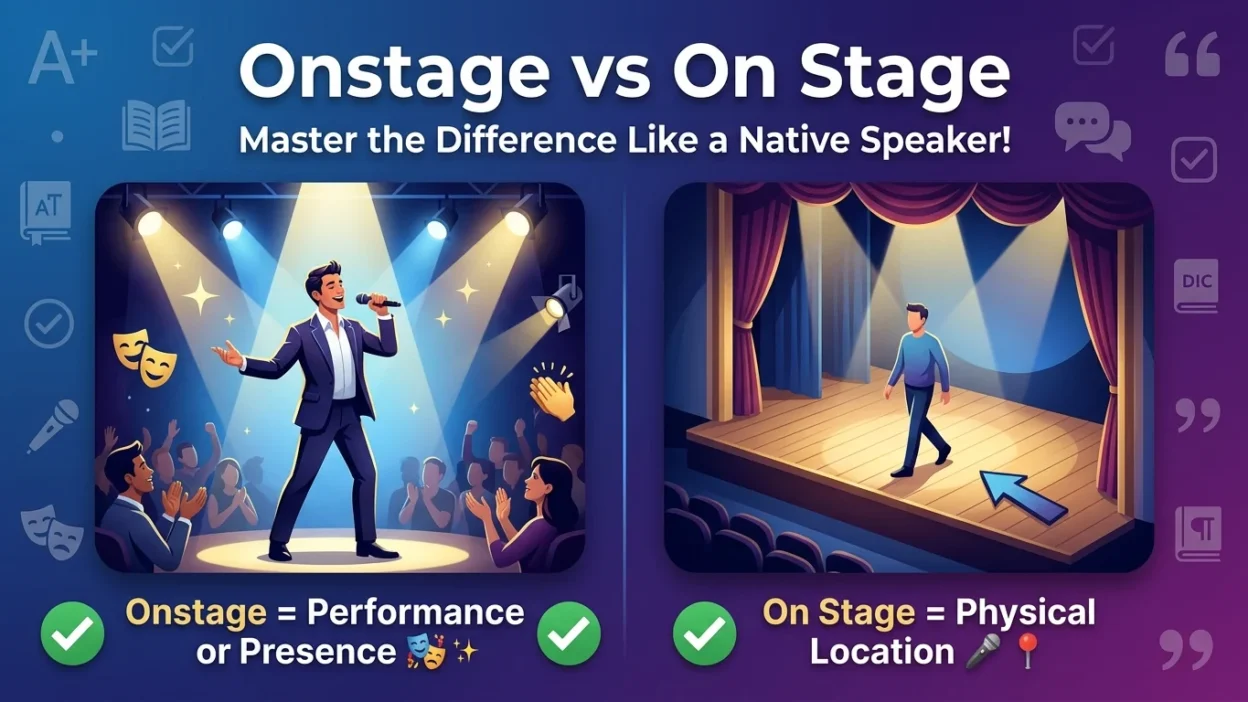
- Onstage is usually an adjective or adverb that describes something happening as part of a theatrical performance or while someone is performing.
- On stage is a prepositional phrase that literally means “on the stage.”
In modern English, both forms are accepted, but on stage remains more common in general writing.
Examples:
- The actor walked on stage. ✅
- Her onstage performance impressed everyone. ✅
- He looked confident onstage. ✅
Think of it this way:
- On stage = location.
- Onstage = performance-related description.
What Does “On Stage” Mean?
On stage is a prepositional phrase.
It literally refers to someone or something being physically on a stage.
Examples
- The singer walked on stage.
- Several dancers were already on stage.
- The director joined the cast on stage.
- The microphone was left on stage.
- The audience applauded when she appeared on stage.
Here, the emphasis is on physical location.
What Does “Onstage” Mean?
Onstage is commonly used as an adjective or adverb.
It often describes activities, behavior, performances, or events associated with being in front of an audience.
Examples
- His onstage presence was remarkable.
- She appeared calm onstage.
- Their onstage chemistry delighted the audience.
- The comedian felt confident onstage.
- The band’s onstage performance received standing ovations.
In these examples, onstage describes performance rather than location.
Onstage vs On Stage: Comparison Table
| Feature | Onstage | On Stage |
|---|---|---|
| Part of Speech | Adjective or adverb | Prepositional phrase |
| Main Meaning | Related to performing | Physical location |
| Focus | Performance or appearance | Position on a stage |
| Example | Onstage performance | Standing on stage |
| Common Use | Theater, entertainment writing | General English |
When Should You Use “On Stage”?
Use on stage when you’re referring to someone’s physical location.
Examples
- The musicians gathered on stage before the concert.
- A piano stood on stage.
- The children danced on stage.
- She placed the award on stage.
- The presenter welcomed the guests on stage.
The emphasis is simply where something or someone is.
When Should You Use “Onstage”?
Use onstage when describing performance, appearance, personality, or behavior during a performance.
Examples
- His onstage energy inspired the audience.
- The actress remained confident onstage.
- Their onstage partnership lasted for years.
- She developed strong onstage communication skills.
- The magician looked relaxed onstage.
The focus is on qualities associated with performing.
Are They Interchangeable?
Sometimes they are.
Consider these examples:
- She looked confident on stage.
- She looked confident onstage.
Both are acceptable.
However:
- On stage emphasizes where she was.
- Onstage emphasizes her performance or presence.
In descriptive writing about theater, onstage often sounds smoother.
Common Mistakes People Make
Because both forms are accepted, confusion is common.
Mistake 1: Using “Onstage” as a Literal Location Every Time
Although possible in some contexts, on stage is usually preferred when referring only to physical location.
Example:
✅ The chairs were placed on stage.
Mistake 2: Splitting an Established Adjective
❌ His on stage personality amazed everyone.
✅ His onstage personality amazed everyone.
Here, onstage functions as a compound adjective.
Mistake 3: Thinking One Form Is Always Wrong
Both are correct.
The best choice depends on grammar and style.
Easy Trick to Remember the Difference
Here’s a simple memory tip.
Ask yourself:
Am I describing where someone is?
Use on stage.
Am I describing how someone performs or behaves?
Use onstage.
For example:
- The actor walked on stage.
- The actor’s onstage confidence impressed everyone.
This simple question usually leads you to the correct choice.
Everyday Examples
Using “On Stage”
- The performers stood on stage.
- A spotlight shone on stage.
- The dancers returned on stage.
- The orchestra assembled on stage.
- Flowers decorated the area on stage.
Using “Onstage”
- Her onstage confidence was inspiring.
- He smiled naturally onstage.
- Their onstage relationship felt authentic.
- The actor displayed incredible onstage charisma.
- The band’s onstage performance was unforgettable.
Common Expressions
Here are some frequently used combinations.
With “Onstage”
- Onstage performance
- Onstage presence
- Onstage chemistry
- Onstage personality
- Onstage confidence
- Onstage appearance
With “On Stage”
- Walk on stage
- Stand on stage
- Dance on stage
- Perform on stage
- Speak on stage
- Appear on stage
Learning these common phrases helps your English sound more natural.
American vs British English
Both onstage and on stage are accepted in American and British English.
However, there are slight style preferences.
In American English:
- Onstage is slightly more common in entertainment journalism and theater reviews.
In British English:
- On stage is often preferred in more traditional writing, although onstage is also widely accepted.
Neither spelling is considered incorrect. Style guides or publishers may simply prefer one form over the other.
Practice Sentences
Choose the correct form.
- The singer walked ______ before the concert.
Answer: on stage
- Her ______ performance received excellent reviews.
Answer: onstage
- The dancers waited ______ for the curtain to rise.
Answer: on stage
- His ______ confidence impressed the judges.
Answer: onstage
- The presenter welcomed everyone ______.
Answer: on stage
Frequently Asked Questions (FAQs)
What is the difference between onstage and on stage?
Onstage is generally an adjective or adverb describing performance, while on stage is a prepositional phrase describing physical location.
Is onstage one word or two?
Both forms are correct. The choice depends on grammar and context.
Which is more common, onstage or on stage?
On stage is generally more common in everyday writing, while onstage is frequently used in theater and entertainment writing.
Can I say “onstage performance”?
Yes. Onstage performance is a common and grammatically correct expression.
Is “walked onstage” correct?
Yes. As an adverb, onstage can describe where the action occurs. However, many writers still prefer walked on stage for literal movement onto a stage.
Is there a difference between American and British English?
Only slight stylistic preferences exist. Both forms are accepted in both varieties of English.
Should I always write “on stage” as two words?
No. Use onstage when it functions as an adjective or adverb describing performance, and on stage when emphasizing physical location.
Summary
Understanding onstage vs on stage is easier once you recognize their grammatical roles. On stage usually refers to the physical location of a person or object, while onstage commonly describes performance related qualities such as confidence, presence, personality, or behavior. Although both forms are correct, choosing the one that best matches your sentence makes your writing clearer and more natural.
Whether you’re writing about theater, music, public speaking, or live performances, knowing the distinction between onstage and on stage will improve both your grammar and style. Paying attention to context ensures that your writing remains accurate, polished, and easy for readers to understand.

Dani Morrison is a dedicated language writer and spelling expert at Spelword.com, where she focuses on helping readers understand common English spelling mistakes and confusing word pairs. With a passion for clear communication, Dani creates easy-to-follow guides that simplify complex grammar and spelling rules for everyday use.