If you have ever wondered whether to write as well or aswell, you are not alone. This is a common English spelling question, especially for people who are improving their writing or trying to make emails, essays, and professional content sound more natural. The good news is that the correct form is straightforward once you understand how the expression works.
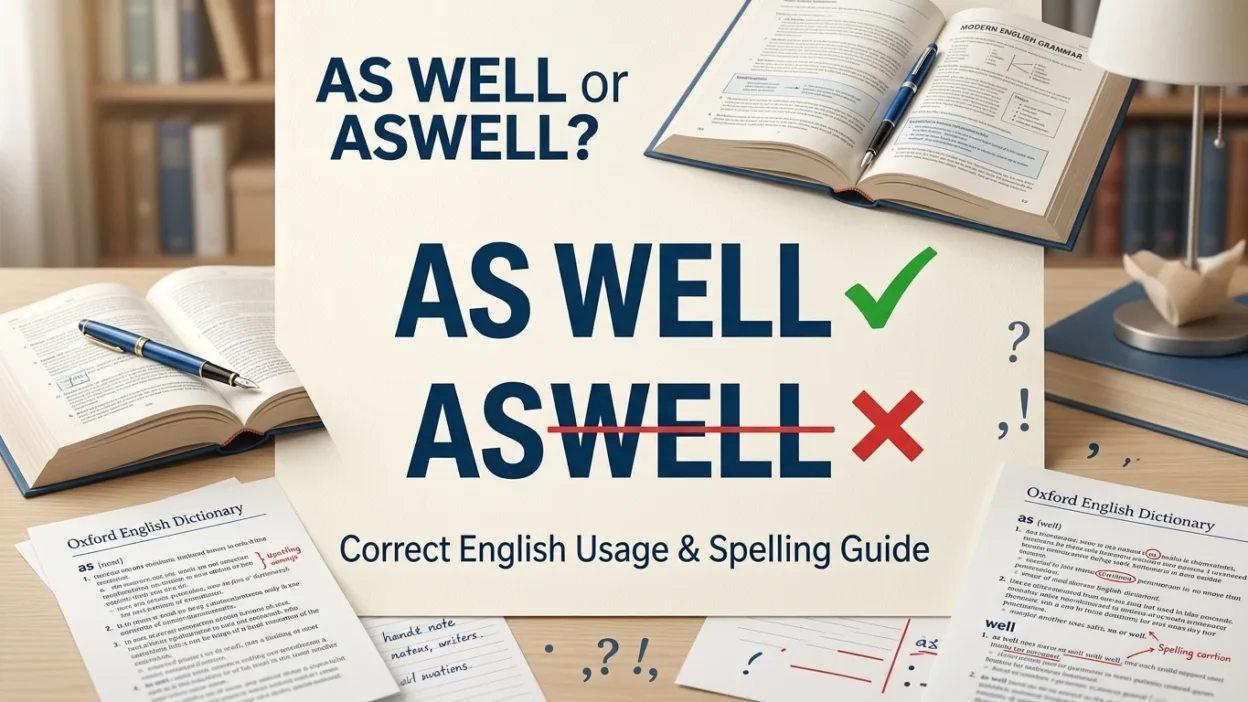
As well is the standard and correct form in modern English. It is written as two separate words. Aswell is generally considered a misspelling and should be avoided in standard English writing. In this guide, we will explain what “as well” means, how to use it correctly, common mistakes to avoid, and whether American and British English use the expression differently.
Quick Answer: As Well or Aswell?
The correct form is as well, written as two separate words.
- Correct: I would like some tea as well.
- Correct: She speaks French as well.
- Incorrect: I would like some tea aswell.
- Incorrect: She speaks French aswell.
Aswell is not normally accepted as a standard English word. When you mean “also,” “too,” or “in addition,” use as well.
What Does “As Well” Mean?
As well is an adverbial expression that commonly means “also,” “too,” or “in addition.” It is used when you want to add another person, thing, action, or idea to something already mentioned.
For example:
- I want to attend the meeting as well.
- She bought a new laptop as well.
- He is a talented writer as well.
In these examples, as well adds information to the sentence. It is similar in meaning to also or too.
“As Well” Meaning “Also”
One of the most common uses of as well is to mean “also.”
- Maria is coming as well.
- I enjoy reading as well.
- They invited their neighbors as well.
You could often replace “as well” with “also” without changing the basic meaning: - Maria is also coming.
- I also enjoy reading.
- They also invited their neighbors.
However, the position of also and as well in a sentence can be different.
How to Use “As Well” Correctly
The most common position for as well is at the end of a sentence or clause.
Examples
- I would like to join as well.
- She wants to participate as well.
- We need to consider the cost as well.
- He studies biology and chemistry as well.
- They are planning to attend the conference as well.
This placement sounds natural in both everyday conversation and many forms of writing.
“As Well” in Questions
“As well” is also common in questions when asking whether something applies to another person or situation.
- Are you coming as well?
- Do you want some coffee as well?
- Did Sarah attend the meeting as well?
- Can I submit my application as well?
In these sentences, the expression usually means “too” or “also.”
“As Well as” vs. “As Well”
It is important not to confuse as well with as well as. They have related meanings but different grammatical functions.
As well often means “also” or “too.”
- She is attending as well.
As well as means “in addition to” and is commonly used to connect two things. - She is attending as well as her colleague.
More examples: - He speaks English as well as Spanish.
- The job requires experience as well as technical knowledge.
- As well as studying, she works part-time.
The expression as well as can introduce another noun, pronoun, or activity, while as well commonly adds information to an existing statement.
As Well vs. Aswell: Comparison Table
| Form | Correct? | Meaning/Use | Example |
|---|---|---|---|
| as well | Yes | Also; too; in addition | I want to go as well. |
| aswell | No | Standard English does not use this spelling | I want to go aswell. |
| as well as | Yes | In addition to; together with | She studies biology as well as chemistry. |
| also | Yes | Also; additionally | She also studies biology. |
| too | Yes | Also; in addition | She studies biology too. |
Why Is “Aswell” Incorrect?
English contains many expressions that look as though they could be written as one word, but as well has remained a two-word expression in standard usage.
The words as and well have separate grammatical roles, and together they form an adverbial phrase. Combining them into aswell is generally a spelling error rather than an accepted alternative.
For example:
- Correct: He wants to come as well.
- Incorrect: He wants to come aswell.
The same rule applies in formal writing, academic writing, business communication, websites, emails, and most edited English.
Common Mistakes With “As Well”
Mistake 1: Writing “Aswell” as One Word
This is the most common error.
Incorrect:
- I would like to attend aswell.
Correct: - I would like to attend as well.
Always keep the two words separate.
Mistake 2: Confusing “As Well” With “As Well As”
These expressions are not interchangeable in every sentence.
Incorrect:
- She likes mathematics as well physics.
Correct: - She likes mathematics as well as physics.
If you are connecting two nouns or activities with the meaning “in addition to,” as well as is generally required.
Mistake 3: Using “As Well” When “As Well As” Is Needed
Consider:
- He teaches English as well as history.
Here, “as well as” connects English and history.
But: - He teaches English. He teaches history as well.
Here, “as well” adds another piece of information.
Understanding the sentence structure makes the choice easier.
As Well vs. Also vs. Too
As well, also, and too can all mean “in addition” or “also,” but they do not always occupy the same position.
Compare:
- She also wants to come.
- She wants to come as well.
- She wants to come too.
All three sentences communicate a similar idea.
In many situations, as well and too naturally appear toward the end of a sentence, while also can appear before the main verb or after a form of “be.”
For example: - I also like coffee.
- I like coffee as well.
- I like coffee too.
Is “As Well” Formal or Informal?
As well is a standard expression that can be used in both formal and informal English. It is perfectly appropriate for professional emails, academic writing, reports, essays, and everyday conversation.
For example:
- The researchers examined the environmental effects as well.
- Please send the completed form as well.
- I would like to attend the workshop as well.
In very formal academic writing, writers may sometimes prefer also, additionally, or furthermore, depending on the context. However, as well is not grammatically incorrect or inherently informal.
American vs. British English: As Well or Aswell
There is no meaningful American-versus-British spelling difference here. Both American English and British English use as well as two separate words.
For example, both varieties use:
- I would like to attend as well.
- She speaks Spanish as well.
- He is interested in agriculture as well.
Aswell is not the standard spelling in either variety.
There can be differences between American and British English in vocabulary, spelling, punctuation, and pronunciation, but the spelling of this expression is generally the same.
Examples of “As Well” in Everyday English
Here are some natural examples:
- I need a pen as well.
- She wants to come as well.
- We should invite Ahmed as well.
- They ordered dessert as well.
- I enjoyed the movie as well.
- Can you bring some water as well?
- He applied for the scholarship as well.
- We need to check the results as well.
- She works in research as well.
- I would like to learn Spanish as well.
Examples of “As Well” in Professional and Academic Writing
The expression is also useful in formal contexts.
- The study examined plant growth as well as nutrient uptake.
- The researchers evaluated soil properties as well.
- The report considers economic factors as well as environmental impacts.
- The company provides training as well as technical support.
- The findings are relevant to farmers as well as policymakers.
Notice that the last three examples use as well as because the expression connects two elements.
How to Remember the Correct Spelling
A simple memory trick is to think of as well as a phrase rather than a single word.
Whenever you mean “also” or “too,” write:
as well
not:
aswell
For example:
I want to participate as well.
If you can replace the expression with “also” or “too,” you are probably using as well in its common adverbial sense.
Frequently Asked Questions
Is “aswell” a correct English word?
No. “Aswell” is generally considered a misspelling. The standard form is as well, written as two separate words.
Is “as well” one word or two?
As well is two words. It should not normally be combined into “aswell.”
What does “as well” mean?
“As well” commonly means also, too, or in addition. It is often placed at the end of a sentence or clause.
Is “as well” the same as “also”?
They can have the same basic meaning, but their position in a sentence often differs. “Also” commonly appears before the main verb, while “as well” frequently appears at the end.
Is “as well as” different from “as well”?
Yes. As well commonly means “also” or “too,” while as well as commonly means “in addition to” and connects two elements.
Do American and British English spell “as well” differently?
No. Both American and British English generally spell the expression as as well.
Can I use “as well” in formal writing?
Yes. “As well” is standard English and is suitable for academic, professional, business, and everyday writing.
Is “aswell” ever acceptable?
In standard edited English, aswell should be avoided. It may occasionally appear as a typographical or informal error, but it is not the standard spelling.
Final Summary
When choosing between as well or aswell, the answer is simple: as well is the correct standard form. It is written as two separate words and commonly means “also,” “too,” or “in addition.” For example, “I would like to attend as well” is correct, while “I would like to attend aswell” is not standard English.
It is also important to distinguish as well from as well as. Use as well when adding information, and use as well as when connecting two things or expressing “in addition to.” Whether you are writing an academic paper, professional email, blog post, or everyday message, keeping these expressions separate will make your writing clearer and more polished.