Have you ever typed “you too” or “you to” and suddenly wondered whether you were using the right phrase? You are not alone. These two expressions sound exactly the same in everyday English, but they have completely different meanings and grammatical functions.
The good news is that choosing between you too and you to is much easier once you understand what each phrase does. In this guide, we’ll explain the difference in simple English, show you clear examples, point out common mistakes, and help you remember which form to use in everyday writing and conversation.
Quick Answer: You Too or You To?
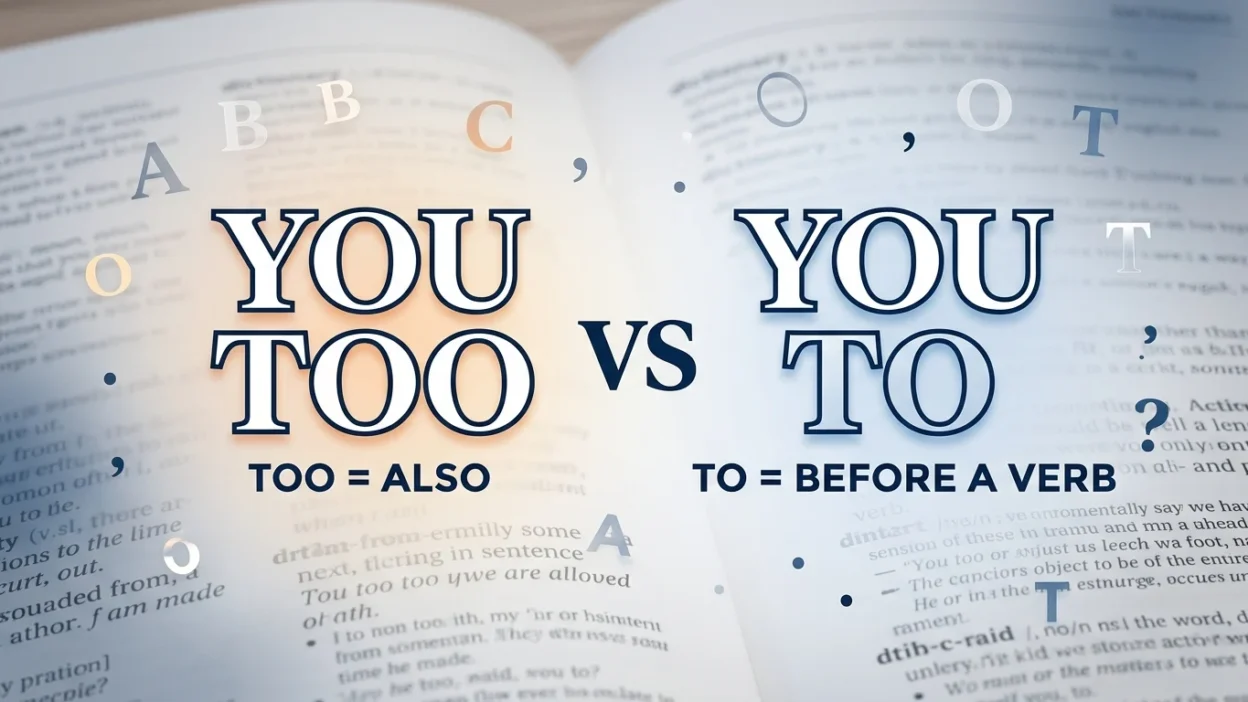
“You too” is usually correct when you mean “the same to you” or “also you.”
- You too = also you / the same to you
- You to = “you” used with the preposition “to” and is normally part of a longer sentence
For example:
- “Have a great day!” → “You too!”
- “I want you to come with us.” → “you to” is correct.
So, if someone wishes you something and you want to return the same wish, use you too, not you to.
What Does “You Too” Mean?
You too is a common English expression meaning “the same to you” or “also you.” It is especially common when responding to a greeting, good wish, compliment, or statement.
The word too means “also” or “as well.”
For example:
- “Have a nice evening.”
“You too!”
Here, “you too” means “I hope you have a nice evening too.”
Similarly:
- “Good luck with your exam!”
“You too!”
The speaker is returning the good wish.
Examples of “You Too”
Here are some natural examples:
- “Have a wonderful weekend.” — “You too!”
- “Good morning!” — “You too!”
- “Enjoy your vacation.” — “You too!”
- “Take care.” — “You too!”
- “I’m happy to see you.” — “You too.”
- “Have a safe journey.” — “You too!”
In each example, too means “also.”
What Does “You To” Mean?
You to is not normally a standalone expression. Instead, it appears when you is followed by the preposition to or when “you” is part of an infinitive structure such as “to + verb.”
For example:
- “I want you to help me.”
- “She asked you to wait.”
- “It is important for you to understand.”
- “I need you to call him.”
- “He told you to be careful.”
In these sentences, to is not replacing too. It has a grammatical role in the sentence.
This is why writing “You to!” as a response to “Have a nice day!” is incorrect.
You Too vs. You To: Comparison Table
| Phrase | Meaning | Main Use | Example |
|---|---|---|---|
| You too | Also you / same to you | Returning a wish or agreeing | “Have a nice day!” — “You too!” |
| You to | You + to | Used within a larger sentence | “I want you to come.” |
The easiest way to remember the difference is to look at the word too. When it means “also,” you need too with two o’s.
When Should You Use “You Too”?
Use you too when you want to return the same sentiment to another person.
It commonly follows expressions such as:
- Have a good day.
- Have a great weekend.
- Good luck.
- Enjoy yourself.
- Take care.
- Have a safe trip.
- Happy holidays.
- Merry Christmas.
- Happy birthday.
For example:
Person A: “Have a great day!”
Person B: “You too!”
This is short, natural, and grammatically correct.
“You Too” in Casual Conversation
“You too” is extremely common in everyday speech. It is often used as a complete sentence even though the rest of the meaning is understood from context.
For example:
A: “Enjoy the movie!”
B: “You too!”
Technically, the complete meaning could be understood as “I hope you enjoy the movie too,” but English speakers commonly shorten it to “You too!”
When Should You Use “You To”?
Use you to when to is functioning as part of a grammatical construction.
One common pattern is:
verb + you + to + verb
Examples:
- I need you to listen.
- She wants you to stay.
- They expect you to arrive early.
- We asked you to help us.
- He told you to wait outside.
Another common structure is:
for + you + to + verb
Examples:
- It is difficult for you to understand.
- It is important for you to practice.
- There is enough time for you to finish.
Here, to is connected to the verb that follows it.
Why Do People Confuse “You Too” and “You To”?
The main reason is pronunciation.
In standard English, too and to are usually pronounced the same way in connected speech. This makes them homophones—words that sound alike but have different meanings or spellings.
Compare:
- too → also / excessively
- to → a preposition or part of an infinitive
Because they sound alike, it is easy to choose the wrong spelling when writing quickly.
A useful strategy is to focus on meaning rather than pronunciation.
If you mean “also,” use too.
If you are introducing a destination, relationship, or infinitive verb, to may be correct.
Common Mistakes With “You Too” and “You To”
Mistake 1: Writing “You to!” as a response
Incorrect:
“Have a nice day!”
“You to!”
Correct:
“Have a nice day!”
“You too!”
The response means “the same to you,” so too is required.
Mistake 2: Writing “I want you too come”
Incorrect:
“I want you too come with me.”
Correct:
“I want you to come with me.”
Here, to comes before the verb “come,” so it is part of the infinitive construction.
Mistake 3: Thinking “too” is always correct
The opposite mistake is also possible.
Incorrect:
“I asked you too wait.”
Correct:
“I asked you to wait.”
Although “too” sounds the same, it cannot perform the grammatical role required in this sentence.
A Simple Trick to Remember the Difference
Try replacing too with also.
If the sentence still makes sense, too is probably correct.
For example:
“Have a great day. You too!”
Replace “too” with “also”:
“You also.”
The meaning is clear: the same wish applies to you.
Now consider:
“I want you to come.”
You cannot replace “to” with “also”:
“I want you also come.”
That does not work.
So remember:
Too = also
To = direction, relationship, or part of a verb construction
“You Too” in American vs. British English
There is no major difference between American and British English when it comes to the spelling or basic meaning of you too and you to.
Both varieties use:
- You too!
- I want you to come.
- She asked you to wait.
The expression you too is natural in both American and British English.
Differences may appear in pronunciation, accent, or conversational style, but the spelling rule remains the same.
Is “You Too” Grammatically Correct?
Yes. You too is grammatically correct and extremely common.
It can function as a shortened response in conversation.
For example:
“Have a wonderful evening!”
“You too!”
The phrase is understood as something like:
“I hope you have a wonderful evening too.”
Because the full meaning is obvious from context, English speakers naturally shorten the response.
Is “You To” Ever Correct?
Yes. You to can absolutely be correct when it appears as part of a larger grammatical structure.
Examples include:
- “I expect you to arrive early.”
- “She wants you to join us.”
- “He needs you to sign this form.”
- “They encouraged you to apply.”
- “I told you to be careful.”
The important point is that you to usually does not work as a standalone response.
Quick Examples to Remember
Here are some simple examples:
Correct:
- “Have a good evening!” — “You too!”
- “Good luck!” — “You too!”
- “I want you to stay.”
- “She asked you to call.”
- “He expects you to help.”
Incorrect:
- “Have a good evening!” — “You to!”
- “I want you too stay.”
- “She asked you too call.”
The context tells you which spelling you need.
Frequently Asked Questions
Is “you too” or “you to” correct?
Both can be correct, but they are used differently. Use “you too” to mean “also you” or “the same to you.” Use “you to” as part of a larger sentence, such as “I want you to come.”
Should I say “you too” after “Have a nice day”?
Yes. “You too!” is the natural and correct response when you want to return the same good wish.
Is “you to” grammatically correct?
Yes, but it is normally part of a larger sentence. For example, “I need you to help me” is correct.
Why do “too” and “to” sound the same?
They are commonly pronounced alike in English, making them homophones. Their different meanings and grammatical functions determine which spelling you should use.
Can “you too” be a complete sentence?
Yes. In everyday conversation, “You too!” works as a shortened response because the rest of the meaning is understood from context.
Is “you too” used in both American and British English?
Yes. The expression is standard in both American and British English, with no significant difference in spelling or basic usage.
What is an easy way to remember “you too”?
Remember that too can mean also. If you can replace it with “also,” use “too.”
Is “I want you too come” correct?
No. The correct sentence is “I want you to come.” Here, “to” introduces the verb “come.”
Final Summary
The difference between you too and you to is simple once you focus on their meanings. You too means “also you” or “the same to you,” and it is commonly used when returning a greeting, wish, or positive statement. For example, “Have a great day!” → “You too!”
You to, on the other hand, is generally part of a larger sentence, especially structures such as “I want you to help,” “She asked you to wait,” or “They expect you to arrive.” Although the two forms sound alike, their spelling and grammatical functions are different. When in doubt, remember: too = also, while to has a grammatical function involving direction, connection, or an infinitive verb.

Dani Morrison is a dedicated language writer and spelling expert at Spelword.com, where she focuses on helping readers understand common English spelling mistakes and confusing word pairs. With a passion for clear communication, Dani creates easy-to-follow guides that simplify complex grammar and spelling rules for everyday use.