If you have ever wondered whether to write long-term or long term, you are not alone. Both forms are correct, but they are used differently depending on their position and function in a sentence. This small punctuation difference can make a sentence look more polished and grammatically accurate.
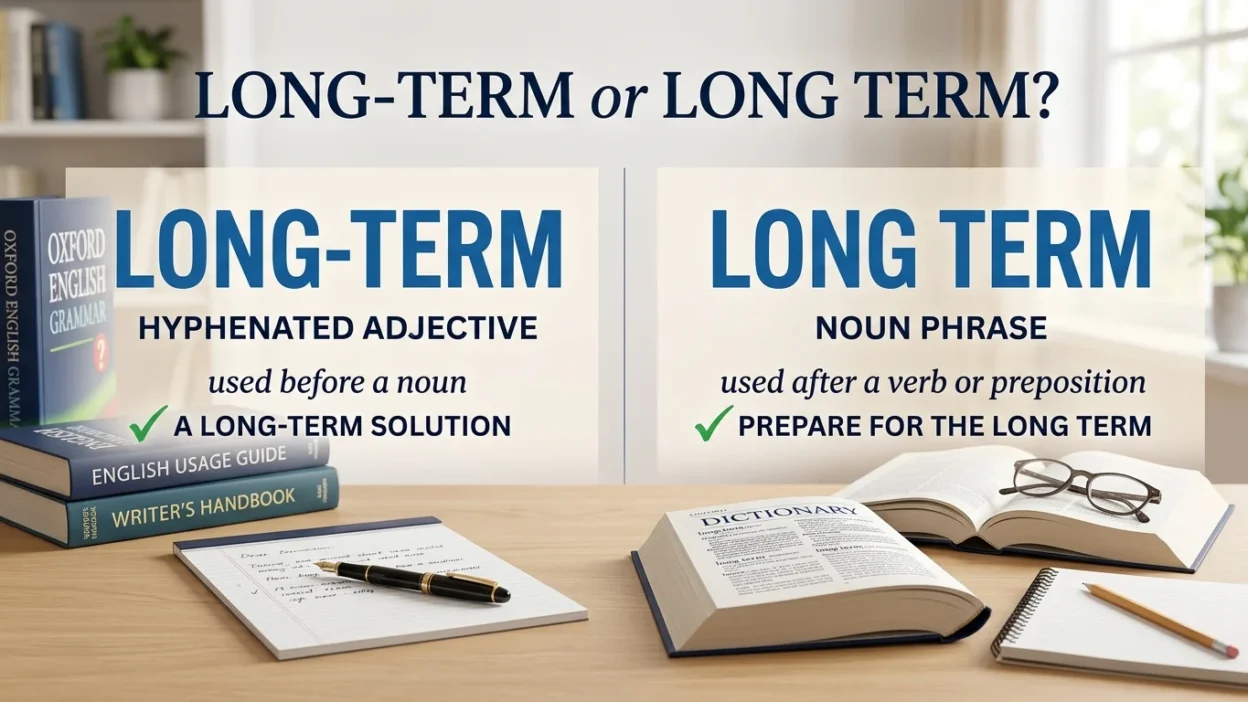
The good news is that the rule is relatively simple. Long-term is usually hyphenated when it works as a compound adjective before a noun, while long term is generally written as two words when it functions as a noun phrase or appears after certain linking verbs. Understanding this distinction will help you write more naturally in emails, essays, academic papers, business documents, and everyday English.
Quick Answer: Long-Term or Long Term?
Long-term is usually correct when the phrase comes before a noun and describes it.
- We need a long-term plan.
- She is looking for a long-term solution.
- They made a long-term investment.
Long term is generally correct when it functions as a noun phrase. - We are thinking about the long term.
- This decision will benefit us in the long term.
- What are your goals for the long term?
A simple rule to remember is: Before a noun, use “long-term.” As a noun phrase, use “long term.”
What Does “Long-Term” Mean?
Long-term describes something that continues, develops, or is planned over a relatively extended period. It is commonly used for plans, goals, effects, relationships, investments, strategies, solutions, and commitments.
For example:
- The company needs a long-term strategy.
- Exercise can have long-term benefits.
- They are searching for a long-term solution.
Here, long-term modifies a noun. Because the two words work together as one descriptive unit, the hyphen helps show that they belong together.
The exact length of a “long term” depends on the context. In business, a long-term plan might cover several years. In another situation, it could refer to a period of months or decades.
What Does “Long Term” Mean?
Long term without a hyphen is generally used as a noun phrase referring to an extended period of time.
For example:
- We should consider the long term.
- The policy may be expensive in the short term but beneficial in the long term.
- She is thinking about what will happen in the long term.
In these examples, long term is not directly describing a following noun. Instead, it refers to an extended period itself.
You will often see it in the expression “in the long term.”
For example:
In the long term, this decision could save the company money.
This is one of the most common situations where long term appears without a hyphen.
Long-Term vs. Long Term: Comparison Table
| Form | Main Function | Example |
|---|---|---|
| long-term | Compound adjective | We need a long-term solution. |
| long term | Noun phrase | We are planning for the long term. |
| long-term | Describes a noun | They developed a long-term strategy. |
| long term | Refers to an extended period | It will be beneficial in the long term. |
| long-term | Before a noun | She has long-term goals. |
| long term | After “the” or in time expressions | Think about the long term. |
When Should You Use “Long-Term”?
Use long-term when the phrase acts as a compound adjective before a noun. The hyphen connects the words and makes their relationship clear.
Examples of “Long-Term”
- We need a long-term solution to the problem.
- He made a long-term commitment to the project.
- The government introduced a long-term development plan.
- Regular exercise offers long-term health benefits.
- They are focused on long-term growth.
- She wants to build a long-term career in research.
- The company has a long-term investment strategy.
Notice that in each sentence, long-term comes immediately before a noun or noun phrase and describes it.
When Should You Use “Long Term”?
Use long term when it functions as a noun phrase rather than directly modifying a noun.
The most common expression is in the long term.
Examples of “Long Term”
- This approach may work in the long term.
- We need to think about the long term.
- The changes could have serious consequences in the long term.
- Short-term costs may lead to long-term savings.
- What will happen in the long term?
Another common structure is for the long term, although the exact wording depends on the sentence. - They are preparing for the long term.
- We need a strategy that works for the long term.
Why Does the Hyphen Matter?
The hyphen is useful because it shows that two words are functioning together as a single modifier.
Compare these examples:
- We need a long-term plan.
- We need to plan for the long term.
In the first sentence, long-term describes “plan.” It acts as one compound adjective.
In the second sentence, long term refers to a period of time. It functions as a noun phrase.
This same pattern appears with many compound modifiers in English, such as short-term, high-quality, well-known, and full-time.
Short-Term vs. Long-Term
The same grammatical principle applies to short-term and short term.
Before a noun:
- We need a short-term solution.
- The company faces short-term challenges.
As a noun phrase: - The decision may be difficult in the short term.
- We are focused on both the short term and the long term.
This makes it easier to remember the rule: when the phrase directly modifies a noun, the hyphen is generally appropriate.
Common Mistakes With Long-Term and Long Term
Even native English speakers sometimes hesitate over hyphenation. Here are some common mistakes to avoid.
Mistake 1: Writing “long term” Before a Noun
Incorrect or less standard:
- We need a long term solution.
Better: - We need a long-term solution.
When “long” and “term” work together to describe “solution,” the hyphen makes the compound modifier clear.
Mistake 2: Hyphenating “Long Term” in Every Situation
Incorrect:
- The decision will be beneficial in the long-term.
Better: - The decision will be beneficial in the long term.
Here, “long term” is a noun phrase following “the,” so the hyphen is unnecessary.
Mistake 3: Assuming One Form Is Always Correct
Neither spelling is universally correct. The correct choice depends on how the phrase is used.
- long-term investment → adjective
- in the long term → noun phrase
Looking at the words around the phrase is often enough to determine which form you need.
Long-Term or Long Term in Academic Writing
Both forms are common in academic and professional writing, but using the correct form improves clarity and consistency.
Examples include:
- The study examined the long-term effects of soil management.
- Biochar may provide long-term benefits for soil quality.
- Further research is needed to evaluate the treatment in the long term.
- The intervention could produce positive outcomes over the long term.
In formal writing, consistency is particularly important. If you use long-term effects in one section, do not randomly change the style without a grammatical reason.
Long-Term or Long Term in Business English
Business writing frequently uses long-term because many business concepts involve planning, investment, growth, and strategy.
Common expressions include:
- long-term strategy
- long-term goals
- long-term investment
- long-term growth
- long-term partnership
- long-term planning
- long-term commitment
- long-term success
However, when referring to the period itself, use long term: - We need to consider the long term.
- This investment should be profitable in the long term.
American vs. British English: Is There a Difference?
There is no major American-versus-British English difference in the basic rule for long-term and long term. Both varieties commonly use the hyphenated form when the words function together as a compound adjective before a noun.
For example, both American and British English commonly write:
- a long-term agreement
- a long-term solution
- a long-term strategy
Both also commonly use: - in the long term
- for the long term
Hyphenation can vary slightly according to individual style guides, publishing conventions, and editorial preferences, but the adjective-versus-noun distinction remains a useful general rule.
How to Remember the Difference
A simple trick can help you choose the correct form.
Ask yourself: “Is long term describing a noun immediately after it?”
If the answer is yes, use long-term.
- long-term plan
- long-term goal
- long-term effect
- long-term relationship
If it refers to the period itself, use long term. - in the long term
- for the long term
- consider the long term
This quick test works in most everyday writing situations.
More Examples of Long-Term
- The researchers studied the long-term impact of the treatment.
- We need a long-term approach to climate challenges.
- They developed a long-term management plan.
- The company is interested in long-term profitability.
- A long-term relationship requires trust and communication.
- Farmers need long-term strategies for improving soil health.
- The project requires long-term financial support.
More Examples of Long Term
- The changes may be expensive initially, but they will help in the long term.
- We need to think about the long term before making a decision.
- Their current problems may not matter in the long term.
- She is preparing for the long term.
- What are the consequences in the long term?
- Good planning is important when considering the long term.
Frequently Asked Questions
Is “long-term” one word or two words?
“Long-term” is two words connected by a hyphen when it functions as a compound adjective, such as “long-term goals.” “Long term” is written as two separate words when it functions as a noun phrase.
Is it “in the long term” or “in the long-term”?
The standard form is “in the long term” without a hyphen because “long term” functions as a noun phrase in this expression.
Is “long-term” always hyphenated?
No. It is generally hyphenated when it comes before a noun as a compound modifier. When it functions as a noun phrase, it is usually written as long term.
Which is correct: “long-term goal” or “long term goal”?
Long-term goal is the standard choice because “long-term” acts as a compound adjective describing “goal.”
Is “long term” grammatically correct?
Yes. Long term is grammatically correct when it functions as a noun phrase, especially in expressions such as “in the long term” and “consider the long term.”
Do American and British English use “long-term” differently?
Not significantly. Both American and British English generally use long-term before a noun and long term when referring to an extended period as a noun phrase.
Is “long-term” formal English?
Yes. Long-term is standard and widely accepted in formal, academic, professional, and everyday English.
What is the easiest way to remember long-term vs. long term?
If the phrase comes directly before a noun and describes it, use long-term. If it refers to an extended period by itself, use long term.
Final Summary
The difference between long-term or long term depends mainly on grammatical function. Use long-term when the phrase acts as a compound adjective before a noun, such as “long-term goals,” “long-term effects,” or “long-term planning.” The hyphen shows that the two words work together to modify the noun that follows.
Use long term when the phrase functions as a noun phrase, especially in expressions such as “in the long term,” “for the long term,” and “consider the long term.” Once you recognize whether the phrase is describing a noun or referring to a period of time, choosing between long-term and long term becomes straightforward.

Dani Morrison is a dedicated language writer and spelling expert at Spelword.com, where she focuses on helping readers understand common English spelling mistakes and confusing word pairs. With a passion for clear communication, Dani creates easy-to-follow guides that simplify complex grammar and spelling rules for everyday use.