If you’ve ever wondered whether “informations” or “information” is the correct word, you’re not alone. Many English learners and even fluent speakers get confused because some languages use a plural form of this noun. In English, however, the rule is different.
The good news is that the answer is simple. Once you understand how information works as a noun, you’ll avoid one of the most common grammar mistakes in both speaking and writing. This guide explains the difference with clear examples, common errors, and easy tips to help you use the correct word every time.
Quick Answer
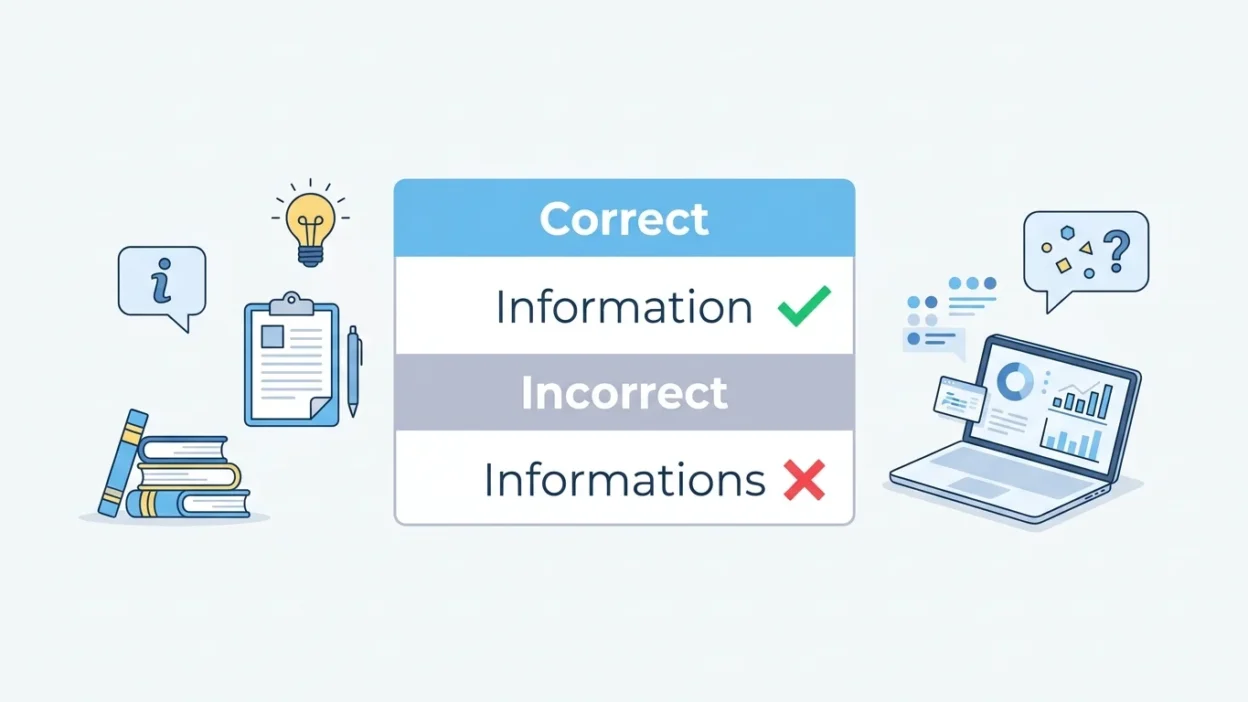
Information is the correct word in standard English.
Informations is almost always incorrect because information is an uncountable noun. It does not normally have a plural form.
Correct:
- I need more information.
- She shared useful information with us.
- The website provides detailed information.
Incorrect:
- I need more informations.
- He gave me many informations.
When you want to refer to multiple facts, use expressions such as pieces of information, bits of information, or items of information.
Is It “Informations” or “Information”?
The correct choice is information.
In English grammar, information is an uncountable (mass) noun. This means it refers to knowledge, facts, or data as a whole rather than individual countable items.
Because it is uncountable, it does not usually take an -s to become plural.
For example:
- The teacher gave us important information.
- We need more information before making a decision.
- This guide contains helpful information.
Instead of saying informations, English speakers naturally say:
- pieces of information
- bits of information
- items of information
These phrases allow you to count separate facts without changing the noun itself.
What Does “Information” Mean?
Information refers to facts, knowledge, details, or data that help someone understand something.
It can describe:
- Facts about a topic
- Instructions
- News or updates
- Knowledge shared by someone
- Data collected for a purpose
Examples
- The brochure contains useful information about the course.
- Can you send me more information?
- The doctor provided important information about the treatment.
- We found all the information online.
No matter how much information there is, the word remains information, not informations.
Why Is “Informations” Incorrect?
Many learners assume every noun can become plural by adding -s, but English has many uncountable nouns that never follow this rule.
Words like these remain singular even when referring to large amounts.
Examples include:
- information
- advice
- furniture
- equipment
- knowledge
- research
So just as we don’t say advices or furnitures, we also don’t say informations.
How to Talk About Multiple Facts
If you need to mention several individual facts, use countable expressions before information.
Examples include:
- a piece of information
- two pieces of information
- several pieces of information
- an item of information
- bits of information
Examples
- She gave me three pieces of information.
- Every piece of information was helpful.
- The report contains several items of information.
- We collected many bits of information during the investigation.
This is the natural way native English speakers express quantity.
Informations vs Information Comparison
| Feature | Information | Informations |
|---|---|---|
| Correct in modern English | ✅ Yes | ❌ No |
| Countable | ❌ No | Not standard |
| Used in everyday English | ✅ Always | ❌ Almost never |
| Used in formal writing | ✅ Yes | ❌ No |
| Standard grammar | ✅ Correct | ❌ Incorrect |
Examples of Correct Usage
Here are examples showing how information is used naturally.
- Thank you for the information.
- We need additional information before deciding.
- This article provides valuable information.
- The manager requested more information.
- I couldn’t find enough information online.
- Your information was very helpful.
- The application asks for personal information.
- The news report included updated information.
Common Mistakes to Avoid
Many learners make the same grammar mistakes with information.
Mistake 1: Adding an “S”
❌ I received many informations.
✅ I received a lot of information.
Mistake 2: Using Numbers Directly
❌ Three informations were missing.
✅ Three pieces of information were missing.
Mistake 3: Using “An Information”
❌ He gave me an information.
✅ He gave me a piece of information.
Mistake 4: Incorrect Verb Agreement
❌ The information are useful.
✅ The information is useful.
Since information is uncountable, it takes a singular verb.
Easy Trick to Remember
Think of information like these words:
- advice
- knowledge
- furniture
- equipment
- research
None of these normally become plural by adding -s.
If you can remember that advice never becomes advices, you’ll also remember that information never becomes informations.
American vs British English
There is no difference between American English and British English regarding this word.
Both varieties use information as an uncountable noun.
Examples:
American English:
- I need more information.
British English:
- I need more information.
Neither variety uses informations in standard grammar.
When Might You See “Informations”?
Although informations is considered incorrect in modern everyday English, you may occasionally see it in:
- Historical documents
- Old legal texts
- Certain specialized legal or administrative contexts in a few countries
- Direct translations from other languages
Even in these rare situations, everyday English speakers should continue using information.
Tips for Using “Information” Correctly
Keep these simple rules in mind.
- Always use information instead of informations.
- Use is, not are, after information.
- Say a piece of information when counting.
- Use more information, not more informations.
- Remember that information is always treated as an uncountable noun.
Following these rules will make your English sound more natural and grammatically correct.
FAQ
Is “informations” ever correct?
In modern English, informations is generally considered incorrect. Use information instead.
Why is information uncountable?
It refers to facts or knowledge as a whole rather than separate countable objects, so it is treated as an uncountable noun.
How do I count information?
Use expressions like a piece of information, two pieces of information, or several items of information.
Is “many information” correct?
No. Since information is uncountable, say much information, more information, or a lot of information.
Do British and American English use different forms?
No. Both use information as the standard form and do not use informations.
Can I say “an information”?
No. Instead, say a piece of information.
Why do some learners say “informations”?
Many languages allow a plural form of the equivalent word, so learners sometimes apply that rule to English. Standard English does not.
Summary
The difference between informations and information is straightforward. Information is the correct word in modern English because it is an uncountable noun. It never normally takes a plural s, regardless of how many facts or details you are talking about. Whenever you need to express quantity, use phrases like pieces of information or items of information instead.
Remember that both American and British English follow the same rule. By using information correctly and avoiding informations, your writing and speech will sound more natural, accurate, and professional in every situation.