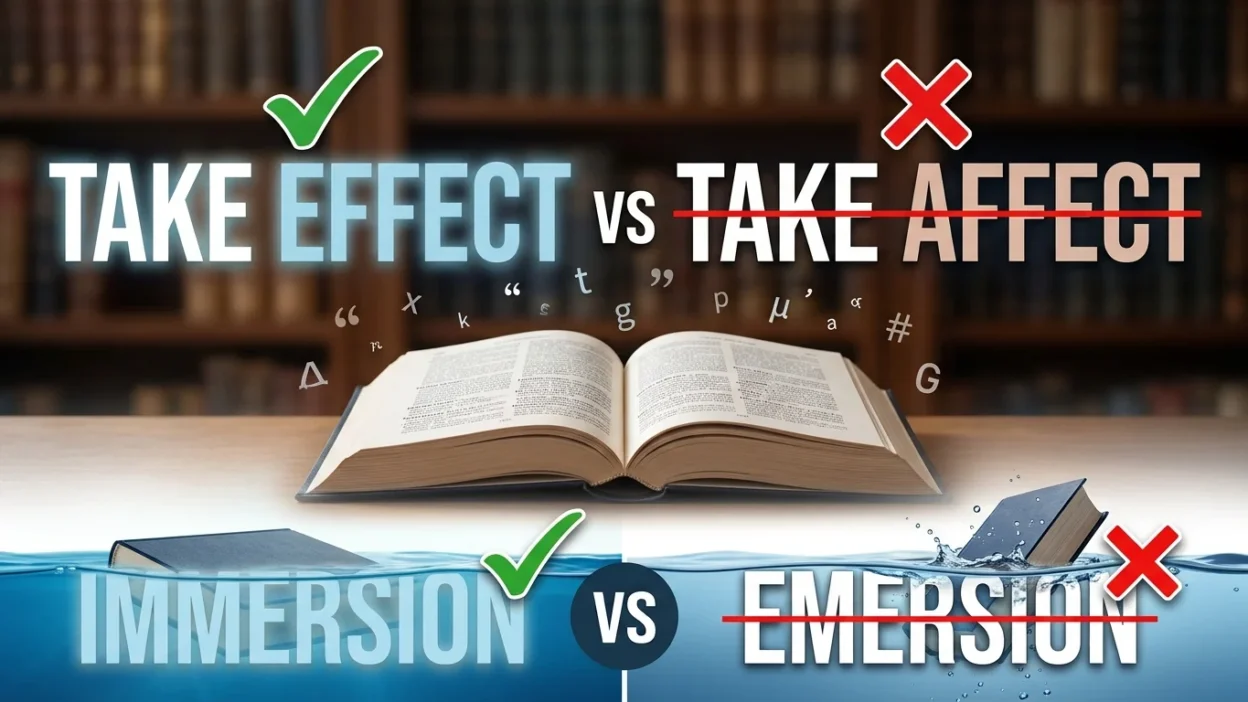
If you have ever wondered whether something should “take effect” or “take affect,” you are dealing with one of the most common English usage questions. The confusion is understandable because effect and affect are pronounced similarly and have closely related meanings. However, only one form is normally correct in the expression “take effect.”
The word immersion creates a different kind of confusion. It describes the act of becoming deeply involved in something or being completely surrounded by a particular environment. Understanding the difference between take effect, take affect, and immersion can make your writing more accurate, natural, and professional.
Quick Answer: Take Effect or Take Affect vs. Immersion
“Take effect” is the correct standard expression. “Take affect” is generally incorrect.
- Take effect = to begin producing a result or to become operational.
- Take affect = generally an incorrect spelling of “take effect.”
- Immersion = deep involvement in an activity, environment, language, or experience.
- Emersion = a real but uncommon word meaning the act of emerging or coming out of something, especially from water or an occultation.
For example:
- “The new policy will take effect next month.”
- “The student learned Spanish through immersion.”
- “The moon’s emersion from the shadow was observed.”
These words are not interchangeable because they describe completely different ideas.
What Does “Take Effect” Mean?
The phrase take effect means to begin producing a result, influence, or change. It can also mean that a law, rule, agreement, medicine, or decision officially becomes operational.
The noun effect refers to a result or consequence.
For example:
- “The new law will take effect on January 1.”
- “The medicine began to take effect after an hour.”
- “The changes will take effect immediately.”
- “The safety regulations took effect last week.”
In each sentence, something begins to produce a result or becomes active.
Examples of “Take Effect”
Here are several natural examples:
- The new rules will take effect tomorrow.
- The treatment started to take effect after several minutes.
- The agreement will take effect once both parties sign it.
- The discount will take effect at the beginning of the month.
- The policy took effect earlier than expected.
The phrase is particularly common in formal writing, business communication, government announcements, academic writing, and legal documents.
What Does “Take Affect” Mean?
In standard English, take affect is generally considered incorrect when you mean “begin to operate” or “begin producing a result.”
The correct expression is:
take effect
For example:
Incorrect:
“The new policy will take affect next week.”
Correct:
“The new policy will take effect next week.”
This mistake happens because affect and effect can sound very similar, especially in fast speech.
There are situations where affect is a correct word, but it does not normally follow take in this expression.
What Does “Affect” Mean?
Affect is most commonly used as a verb meaning to influence or have an impact on something.
Examples:
- “Weather conditions can affect crop production.”
- “The decision may affect thousands of employees.”
- “Lack of sleep can affect concentration.”
- “The economic downturn affected local businesses.”
A simple way to remember it is:
Affect = influence
For example:
“The rain affected the match.”
This means the rain influenced or changed the situation.
Can “Affect” Be a Noun?
Yes, although this use is much less common in everyday English. In psychology and related academic contexts, affect can refer to the observable expression of emotion.
For most everyday writing, however, you will usually encounter affect as a verb.
What Does “Effect” Mean?
Effect is most commonly used as a noun meaning a result, consequence, or outcome.
Examples:
- “The policy had a positive effect.”
- “The medicine produced an immediate effect.”
- “The storm had a serious effect on transportation.”
- “The new rules had little effect on productivity.”
A useful memory trick is:
Effect = result
For example:
“The new policy had a positive effect.”
The positive outcome is the effect.
What Does “Immersion” Mean?
Immersion means becoming deeply involved in something or being completely surrounded by a particular environment, activity, or experience.
It can be used literally or figuratively.
For example:
- “Language immersion helped her become fluent.”
- “The program provides students with cultural immersion.”
- “He spent several weeks in total immersion in the local community.”
- “The virtual reality game creates an immersive experience.”
In language learning, immersion means learning by spending substantial time surrounded by people, conversations, media, and situations involving the target language.
For example:
“She improved her French through immersion.”
This means she learned French by being surrounded by French-speaking environments and using the language naturally.
What Does “Emersion” Mean?
Emersion is a legitimate English word, but it is much less common than immersion.
It refers to the process of emerging from something or becoming visible again after being hidden or covered.
The word is particularly used in astronomy and related technical contexts.
For example:
- “Scientists recorded the moon’s emersion from the eclipse.”
- “The satellite became visible again after its emersion.”
- “The observation focused on the star’s emersion from occultation.”
A helpful distinction is:
- Immersion → going into or being deeply involved in something.
- Emersion → coming out or emerging.
The two words differ by only one letter, but their meanings are opposite in certain literal contexts.
Take Effect vs. Take Affect vs. Immersion vs. Emersion
| Word or Phrase | Meaning | Typical Use | Example |
|---|---|---|---|
| Take effect | Begin to operate or produce a result | Rules, laws, medicine, decisions | “The law will take effect Monday.” |
| Take affect | Generally incorrect | Common spelling mistake | “The law will take effect.” |
| Affect | Influence something | Everyday and academic writing | “Weather can affect crops.” |
| Effect | Result or consequence | General writing | “The change had a major effect.” |
| Immersion | Deep involvement or being surrounded | Language, culture, education, technology | “Language immersion improved her fluency.” |
| Emersion | Emerging or becoming visible | Technical and astronomical contexts | “The star’s emersion was observed.” |
Take Effect vs. Affect: The Easiest Way to Remember
One of the simplest methods is to remember:
Affect = Action
Both words begin with A, which can remind you that affect is usually an action—the act of influencing something.
Effect = End result
An effect is commonly the result produced by an action.
Consider this example:
“Heavy rain affected the crops, and the effect was a lower yield.”
Here:
- affected = influenced
- effect = result
This distinction can help you avoid writing “take affect.”
Common Mistakes
Mistake 1: Writing “Take Affect”
Incorrect:
“The new policy will take affect tomorrow.”
Correct:
“The new policy will take effect tomorrow.”
Use effect when something begins operating or producing a result.
Mistake 2: Confusing “Effect” With “Affect”
Incorrect:
“The weather effected crop growth.”
In most ordinary contexts, the intended sentence is:
“The weather affected crop growth.”
Here, weather influenced crop growth.
Mistake 3: Using “Emersion” When You Mean “Immersion”
Incorrect:
“The language course uses emersion to teach students.”
Correct:
“The language course uses immersion to teach students.”
If you mean deep involvement in a language or environment, use immersion.
Mistake 4: Assuming “Immersion” and “Emersion” Are Interchangeable
They are not.
Immersion generally involves entering, being surrounded by, or becoming deeply involved in something.
Emersion refers to emerging or coming out from something.
American vs. British English Differences
There is no significant American-versus-British spelling difference in take effect, affect, effect, immersion, or emersion.
Both American English and British English use:
- “The new rules will take effect tomorrow.”
- “The change affected the results.”
- “The decision had a significant effect.”
- “Students learned through language immersion.”
The main challenge is therefore not regional spelling but choosing the word that matches the intended meaning.
How to Choose the Correct Word
When writing, ask yourself what you actually mean.
Use “take effect” when:
- A law becomes operational.
- A rule starts applying.
- A medicine begins working.
- A decision begins producing results.
- A policy becomes active.
Example:
“The revised regulations will take effect next month.”
Use “affect” when:
- Something influences another thing.
- You are describing an impact as a verb.
Example:
“The drought affected agricultural production.”
Use “effect” when:
- You mean a result or consequence.
Example:
“The drought had a significant effect on production.”
Use “immersion” when:
- Someone becomes deeply involved.
- Someone is surrounded by a language or culture.
- A learning environment provides extensive exposure.
- A technology creates a highly engaging experience.
Example:
“Immersion is an effective way to develop practical language skills.”
Use “emersion” when:
- Something emerges or becomes visible again.
- You are discussing a technical or astronomical event involving emergence.
Example:
“Researchers recorded the emersion of the star.”
Why Correct Word Choice Matters
Choosing the right word does more than prevent a spelling mistake. It makes your writing clearer and more credible.
In professional, academic, technical, and formal writing, confusing take effect, affect, effect, immersion, and emersion can distract readers from your main point.
Using the correct term also helps communicate your intended meaning without forcing readers to interpret what you meant.
Frequently Asked Questions
Is “take effect” or “take affect” correct?
“Take effect” is the standard and correct expression when you mean that something begins operating or producing a result. “Take affect” is generally an error.
What is the difference between affect and effect?
“Affect” is most commonly a verb meaning to influence, while “effect” is most commonly a noun meaning a result or consequence.
What does immersion mean?
Immersion means becoming deeply involved in something or being surrounded by a particular environment, language, culture, activity, or experience.
Is emersion a real word?
Yes. “Emersion” is a real but uncommon word referring to emerging or becoming visible after being hidden, especially in technical or astronomical contexts.
What is the difference between immersion and emersion?
Immersion refers to going into or being deeply involved in something, while emersion refers to emerging or coming out. They have different meanings despite their similar spelling.
Can I say “the law will take affect”?
No. The standard expression is “the law will take effect.” Here, “effect” refers to the point at which the law begins operating.
Is “take effect” the same in American and British English?
Yes. “Take effect” has the same spelling and basic meaning in both American and British English.
How can I remember affect vs. effect?
A useful memory aid is Affect = Action and Effect = End result. Although this is not an absolute rule, it works well for many everyday sentences.
Final Summary
Take effect is the correct phrase when you mean that something begins to operate, become active, or produce a result. Take affect is generally an incorrect form caused by confusion between the words affect and effect. Remember that affect usually means “influence,” while effect commonly means “result.”
Immersion and emersion are different words altogether. Immersion describes deep involvement or being surrounded by something, while emersion refers to emerging or becoming visible after being hidden. Understanding these distinctions will help you write more accurately in everyday, professional, academic, and formal English.