Have you ever paused while writing and wondered whether to use “any time” or “anytime”? You are not alone. These two expressions look almost identical, but they serve different grammatical purposes. Using the wrong one can make your writing appear less polished, especially in professional, academic, or business communication.
The good news is that the difference between any time vs anytime is simple once you understand the rule. In this guide, you’ll learn exactly when to use each form, see practical examples, avoid common mistakes, and gain confidence in your everyday writing.
Quick Answer
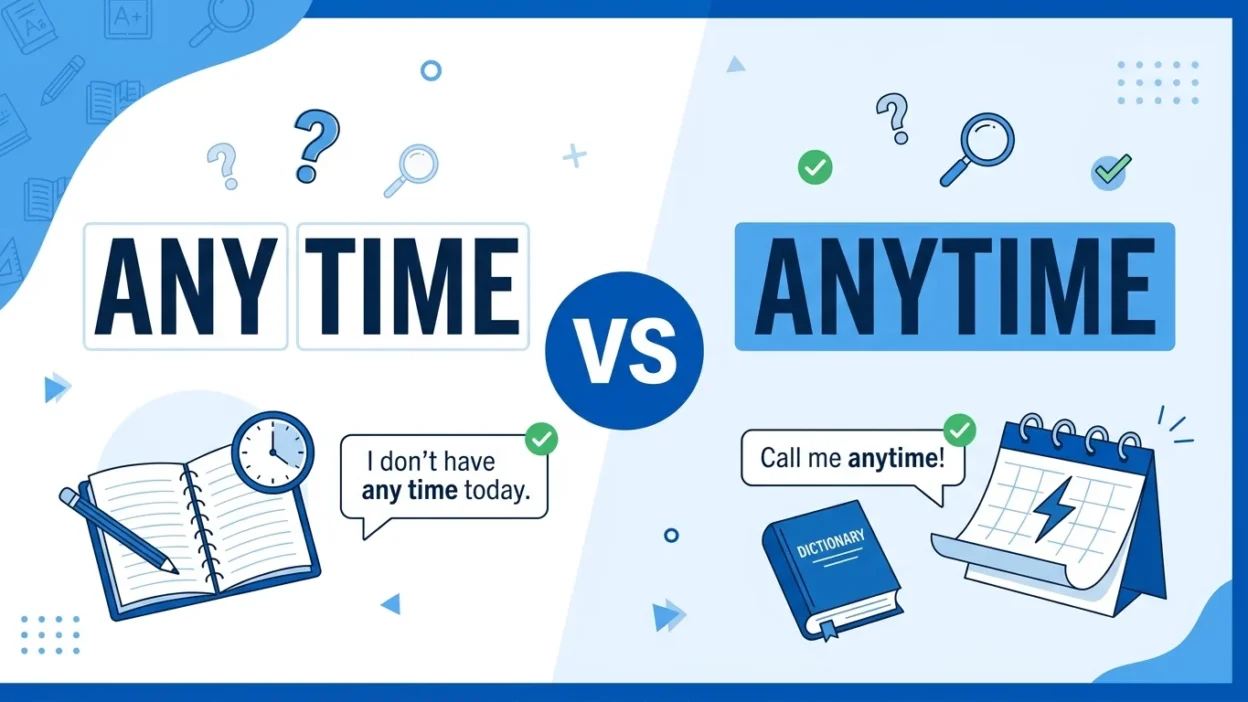
- Any time (two words) is a noun phrase that means “at any point in time.”
- Anytime (one word) is an adverb that means “whenever” or “at any time.”
- In formal writing, any time is often preferred after prepositions such as at.
- Example:
- ✅ Call me any time you need help.
- ✅ You can call me anytime.
What Does “Any Time” Mean?
Any time is a noun phrase consisting of the adjective any and the noun time. It refers to an unspecified amount or point of time.
You can usually replace any time with “any amount of time” or “any point in time.”
Examples of “Any Time”
- I don’t have any time to waste.
- Let me know if you need any time off work.
- You may visit us at any time during office hours.
- Is there any time available this afternoon?
In these examples, time functions as a noun, which is why the two-word form is required.
What Does “Anytime” Mean?
Anytime is an adverb meaning whenever, at any time, or without restriction on time.
It modifies a verb and describes when an action can happen.
Examples of “Anytime”
- You can stop by anytime.
- Feel free to contact me anytime.
- She can join the meeting anytime this week.
- We’re ready to start anytime.
Here, anytime acts as an adverb, explaining when something may occur.
Any Time vs Anytime: Key Difference
The easiest way to remember the distinction is to identify the role the word plays in the sentence.
| Any Time | Anytime |
|---|---|
| Two words | One word |
| Noun phrase | Adverb |
| Refers to an amount or point of time | Means whenever or at any time |
| Often follows prepositions | Usually modifies verbs |
| More common in formal constructions | Common in casual and modern writing |
Examples Side by Side
| Correct Usage of Any TimeCorrect Usage of Anytime | |
|---|---|
| Do you have any time available tomorrow? | You can arrive anytime tomorrow. |
| I don’t have any time for distractions. | Call me anytime. |
| At any time, emergencies may occur. | We’re ready anytime you’re ready. |
A Simple Trick to Remember
Try replacing the phrase with “any amount of time.”
If the sentence still makes sense, use any time.
Example
- I don’t have any time to spare.
- I don’t have any amount of time to spare.
The sentence works, so any time is correct.
Now test anytime:
- Call me anytime.
- Call me any amount of time.
This doesn’t make sense, so anytime is the correct choice.
Common Mistakes with Any Time and Anytime
Many writers confuse these forms because they sound identical when spoken.
Mistake 1: Using “Anytime” as a Noun
❌ I don’t have anytime to finish the project.
✅ I don’t have any time to finish the project.
Because time is functioning as a noun, the two-word form is required.
Mistake 2: Using “Any Time” as an Adverb
❌ You can visit us any time.
✅ You can visit us anytime.
While many style guides accept both forms in casual writing, anytime is generally preferred when it functions as an adverb.
Mistake 3: Confusing Formal and Informal Usage
In formal writing, some editors prefer at any time instead of at anytime.
✅ You may cancel your subscription at any time.
This construction remains widely accepted in professional and academic writing.
When to Use “At Any Time”
One situation deserves special attention.
After the preposition at, many grammar experts recommend using any time rather than anytime.
Examples
- You may leave at any time.
- The system can fail at any time.
- Contact support at any time.
Although anytime is increasingly accepted in informal contexts, at any time remains the safer choice for formal writing.
American vs British English
The distinction between any time and anytime exists in both American and British English.
However, American English tends to accept anytime more readily in everyday writing and speech.
In British English, writers may use the two-word form more frequently, especially in formal documents.
American English Examples
- Stop by anytime.
- Call me anytime you need assistance.
British English Examples
- You can contact us at any time.
- Assistance is available at any time.
Regardless of the variety of English you use, understanding the grammatical function remains the best guide.
Examples in Everyday Sentences
Here are additional examples to help reinforce the difference.
Any Time
- Do you have any time available next week?
- She rarely has any time for herself.
- We can schedule the meeting at any time.
- Is there any time left before the deadline?
Anytime
- You’re welcome to visit anytime.
- Let me know anytime you need help.
- We can begin anytime.
- Come back anytime.
Why the Difference Matters
Choosing between any time and anytime may seem like a small detail, but correct usage improves clarity and professionalism.
Whether you’re writing emails, blog posts, reports, academic papers, or social media content, using the correct form helps your message appear more polished and trustworthy.
Small grammar choices often make a big difference in how readers perceive your writing skills.
Frequently Asked Questions
Is anytime one word or two words?
Both forms are correct. Anytime is usually an adverb, while any time is a noun phrase referring to an amount or point of time.
Can I use anytime in formal writing?
Yes, but many formal style guides still prefer at any time in certain constructions. Consider your audience and writing style.
Which is more common in American English?
Anytime is commonly used in American English, especially in casual and conversational writing.
Is “at anytime” correct?
Some writers use it, but at any time is generally considered the more standard and widely accepted form.
How do I know which one to use?
Determine whether the word functions as a noun or an adverb. Use any time for a noun phrase and anytime as an adverb.
Can I say “Call me any time”?
Yes. This expression is widely accepted and commonly used. In many contexts, both call me any time and call me anytime are considered acceptable.
Is anytime becoming more accepted?
Yes. Modern usage has made anytime increasingly common, particularly in informal and digital communication.
Do British and American English treat these differently?
The basic rule is the same, but American English tends to use anytime more freely, while British English often favors any time in formal contexts.
Summary
Understanding any time vs anytime is easier than it first appears. Any time is a noun phrase that refers to an amount or point of time, while anytime is an adverb meaning whenever or at any time. The key is to identify how the expression functions within the sentence.
When in doubt, remember this simple guideline: if you can replace it with “any amount of time,” use any time. If it describes when an action can happen, use anytime. Following this rule will help you write with greater accuracy, confidence, and clarity.

William Harved is a passionate language enthusiast and digital writer specializing in English spelling, grammar clarity, and common writing mistakes. As the primary author of Spelword.com, he focuses on helping readers understand confusing word pairs, correct spelling errors, and improve everyday communication.