If you’ve come across the words labeller and labeler, you may have wondered whether one is a spelling mistake or if both are correct. Since they differ by only one letter, it’s easy to assume they’re interchangeable. In reality, both spellings are valid, but the correct choice depends largely on the variety of English you’re using.
The difference between labeller and labeler is based on regional spelling conventions rather than meaning. In this guide, you’ll learn what each word means, when to use each spelling, examples, common mistakes, regional differences, and tips for choosing the right version in your writing.
Quick Answer
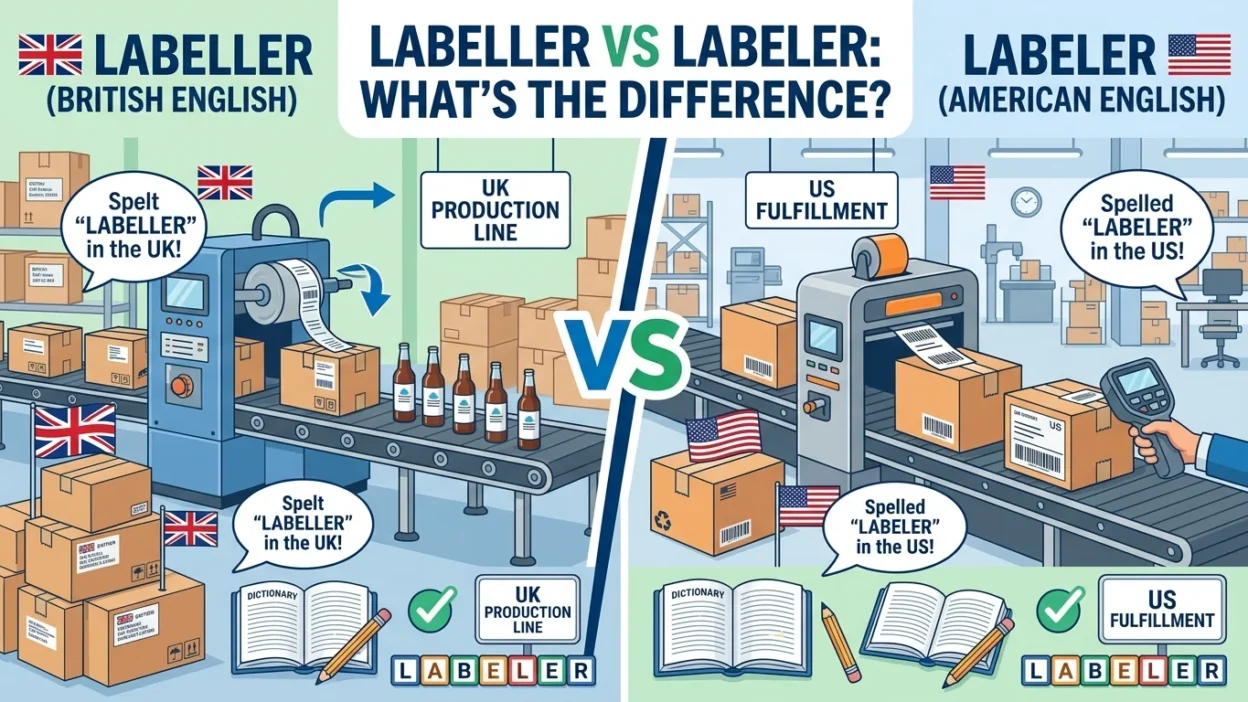
The difference between labeller and labeler is mainly regional.
- Labeller is the preferred spelling in British English.
- Labeler is the preferred spelling in American English.
- Both words mean a person or machine that labels items.
- Neither spelling is more correct than the other; the choice depends on your audience.
What Does “Labeller” Mean?
Labeller is a noun used mainly in British English. It refers to a person, device, or machine that attaches labels to products, packages, files, or other items.
It is commonly used in:
- Manufacturing
- Warehousing
- Retail
- Food packaging
- Shipping
- Office organization
Examples
- The factory installed a new labeller on the production line.
- Every warehouse uses an automatic labeller.
- She works as a product labeller.
- The bottle labeller increased production speed.
In British English, this is the standard spelling.
What Does “Labeler” Mean?
Labeler has exactly the same meaning as labeller, but it is the preferred spelling in American English.
It can refer to either a person or a machine that applies labels.
Examples
- The company purchased a new labeler.
- The warehouse uses an automatic labeler.
- The handheld labeler prints barcode stickers.
- Every package passes through the labeler before shipping.
The meaning is identical to labeller.
Labeller vs Labeler: Key Differences
The only real difference is spelling preference.
| Feature | Labeller | Labeler |
|---|---|---|
| Meaning | Person or machine that labels | Person or machine that labels |
| Preferred Region | British English | American English |
| Pronunciation | Same | Same |
| Grammar | Noun | Noun |
| Meaning Difference | None | None |
Both spellings are correct depending on the variety of English you use.
Why Are There Two Spellings?
The difference comes from spelling conventions.
British English often doubles the final l before adding certain suffixes.
Examples include:
- Traveller
- Jewellery
- Counsellor (in some contexts)
- Labeller
American English often simplifies the spelling.
Examples include:
- Traveler
- Jewelry
- Counselor
- Labeler
These spelling differences are common throughout English.
When Should You Use Labeller?
Use labeller when writing for:
- British audiences
- UK businesses
- Australian publications
- New Zealand readers
- International organizations that follow British English
Examples
- The automated labeller reduced packaging errors.
- We installed a faster labeller.
- Every labeller must be calibrated regularly.
- The bottle labeller handles thousands of products each hour.
When Should You Use Labeler?
Use labeler when writing for:
- American audiences
- US companies
- American schools
- US technical documentation
- North American publications
Examples
- The labeler prints shipping labels.
- Our warehouse uses a barcode labeler.
- The automatic labeler improved efficiency.
- The operator cleaned the labeler.
This spelling sounds more natural to American readers.
Labeller vs Labeler in Business
Both spellings appear in manufacturing and logistics.
British English
- Bottle labeller
- Package labeller
- Product labeller
- Industrial labeller
American English
- Bottle labeler
- Package labeler
- Product labeler
- Industrial labeler
The equipment remains the same; only the spelling changes.
Examples in Everyday English
Here are side-by-side examples.
Using Labeller
- The labeller stopped working.
- We replaced the warehouse labeller.
- The labeller printed clear labels.
- The technician repaired the labeller.
Using Labeler
- The labeler jammed this morning.
- The company upgraded its labeler.
- The labeler printed thousands of stickers.
- The office bought a portable labeler.
The meaning remains identical.
Common Mistakes to Avoid
Many learners make simple spelling mistakes.
1. Mixing British and American Spellings
Incorrect:
- The labeller printed labels for the American company, while another section consistently uses labeler.
Correct:
Choose one spelling style and use it consistently throughout the document.
2. Thinking One Spelling Is Wrong
Both spellings are correct.
The choice depends on whether you’re using British or American English.
3. Confusing the Word with the Verb “Label”
Remember:
- Label is the verb.
- Labeller/Labeler is the noun referring to the person or machine.
Labeller vs Labeler in Technology
Modern businesses commonly use these words for labeling equipment.
Examples include:
- Barcode labeler
- Bottle labeler
- Shipping labeler
- Price labeler
- Product labeler
- Label printing machine
British publications simply replace labeler with labeller.
American vs British English
This is where the difference matters most.
American English
Preferred spelling:
- Labeler
Examples:
- Barcode labeler
- Price labeler
- Product labeler
British English
Preferred spelling:
- Labeller
Examples:
- Barcode labeller
- Bottle labeller
- Product labeller
Both spellings are accepted internationally, provided you remain consistent.
Tips for Remembering the Difference
These simple tricks can help.
- If you’re writing for the United States, use labeler.
- If you’re writing for the United Kingdom, use labeller.
- Remember that British English often doubles the l.
- American English usually simplifies the spelling.
- Keep the same spelling throughout your document.
Consistency is more important than choosing one over the other.
Quick Comparison Table
| Situation | Preferred Spelling |
|---|---|
| British English | Labeller |
| American English | Labeler |
| UK manufacturing | Labeller |
| US manufacturing | Labeler |
| Australian English | Labeller |
| American business writing | Labeler |
| British technical manuals | Labeller |
| International audience | Either (stay consistent) |
Frequently Asked Questions
What is the difference between labeller and labeler?
There is no difference in meaning. Labeller is the British English spelling, while labeler is the American English spelling.
Which spelling is correct: labeller or labeler?
Both spellings are correct. The appropriate choice depends on whether you are following British or American English conventions.
Is labeller used in British English?
Yes. Labeller is the standard spelling in British English and is commonly used in the UK, Australia, and New Zealand.
Is labeler used in American English?
Yes. Labeler is the preferred spelling in American English.
Do labeller and labeler mean different things?
No. Both words refer to a person or machine that applies labels.
Which spelling should I use for international readers?
Either spelling is acceptable, but choose one style and use it consistently throughout your writing.
Why does British English use labeller?
British English often doubles the final l before adding suffixes, resulting in spellings such as labeller, traveller, and jeweller.
Summary
Understanding labeller vs labeler is straightforward once you know the regional spelling rules. Both words have exactly the same meaning and refer to a person or machine that applies labels. The only difference is that labeller is the preferred spelling in British English, while labeler is standard in American English. Neither version is more correct than the other, as long as it matches the variety of English you’re using.
When writing for a specific audience, choose the spelling that fits their language conventions and remain consistent throughout your document. Whether you’re creating technical manuals, business reports, product descriptions, or everyday content, using the appropriate spelling helps your writing appear polished, professional, and reader friendly.