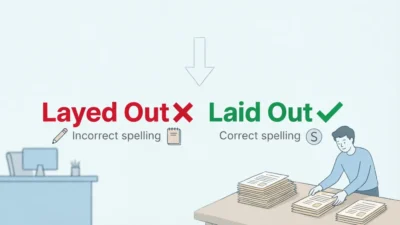

If you’ve ever written layed and hesitated, you’re not alone. This is one of the most common grammar mistakes in English, especially because the verbs “lay” and “lie” already feel confusing. Many people assume layed is the past tense but that assumption leads to incorrect writing.
The good news? Once you understand the simple rule behind it, you’ll never mix them up again. Whether you’re writing an email, a story, or professional content, using the correct form helps your message sound clear and polished.
Quick Answer
“Laid” is the correct past tense of “lay.”
“Layed” is incorrect and not a standard English word.
What Does “Lay” Mean?
The verb lay means to put or place something down. It usually requires an object—something that is being placed.
Examples:
- Please lay the book on the table.
- She lays her phone next to her bed every night.
Now, when you talk about the past, you use laid:
- She laid the book on the table yesterday.
Why “Laid” Is Correct
“Lay” is an irregular verb, which means it doesn’t follow the typical “-ed” pattern for past tense.
Here’s how it works:
- Present: lay
- Past: laid
- Past participle: laid
So:
- lay → laid ✔
- lay → layed ❌
This is similar to other irregular verbs like:
- say → said
- pay → paid
Why “Layed” Is Incorrect
“Layed” might seem logical because many verbs form their past tense by adding “-ed.” However, English has many irregular verbs that don’t follow this rule.
Using “layed” can:
- Make your writing look incorrect
- Confuse readers
- Reduce credibility in formal contexts
Even though you might see “layed” online, it’s considered a mistake in proper English.
Examples in Sentences
Correct Usage (Laid)
- He laid the keys on the table.
- The hen has laid eggs.
- She carefully laid the baby in the crib.
Incorrect Usage (Layed)
- He layed the keys on the table. ❌
- The hen has layed eggs. ❌
Understanding the Confusion: Lay vs Lie
Part of the confusion comes from mixing up lay and lie, which have different meanings.
- Lay = to put something down (needs an object)
- Lie = to recline or rest (does not need an object)
Examples:
- I lay the book down.
- I lie on the couch.
Now look at their past forms:
- Lay → laid
- Lie → lay
Yes, it gets tricky:
- Yesterday, I lay on the couch (from “lie”)
- Yesterday, I laid the book down (from “lay”)
Comparison Table: Layed vs Laid
| Feature | Laid ✅ | Layed ❌ |
|---|---|---|
| Correct spelling | Yes | No |
| Standard English | Accepted worldwide | Not recognized |
| Grammar type | Irregular verb (past) | Incorrect form |
| Usage in writing | Formal and informal | Should be avoided |
| Based on rule | Lay → Laid | Incorrect pattern |
Common Mistakes to Avoid
Even experienced writers can get tripped up here. Watch out for these:
- ❌ Writing layed instead of laid
- ❌ Confusing lay and lie
- ❌ Using lay incorrectly in past tense
Quick Tip
If you mean “put something down,” the past tense is always laid.
American vs British English
There is no difference between American English and British English in this case.
Both use:
- Laid as the correct past tense
- Layed as incorrect
However, usage frequency may differ slightly in informal speech, but the grammar rule remains the same across regions.
Related Forms and Usage
To fully understand how “laid” works, here are some related forms:
- Lay (present): I lay the book down.
- Laid (past): I laid the book down.
- Laid (past participle): I have laid the book down.
And for comparison:
- Lie (present): I lie down.
- Lay (past): I lay down yesterday.
- Lain (past participle): I have lain down.
Why Getting This Right Matters
Correct grammar isn’t just about rules—it’s about clear communication.
Using “laid” correctly:
- Improves readability
- Shows attention to detail
- Builds trust with your audience
Whether you’re writing professionally or casually, small corrections like this make a big difference.
FAQs
Is “layed” ever correct in English?
No, “layed” is not correct in standard English. The correct past tense is “laid.”
What is the past tense of lay?
The past tense of “lay” is “laid.”
Why do people say layed instead of laid?
Because many verbs use “-ed” for past tense, people assume “layed” follows the same pattern.
What is the difference between lay and lie?
“Lay” means to put something down and needs an object, while “lie” means to rest and does not need an object.
Can I use laid in formal writing?
Yes, “laid” is correct and appropriate in both formal and informal writing.
Is there any regional difference in using laid?
No, both American and British English use “laid” as the correct form.
How can I remember laid vs layed?
Remember that “lay” is irregular—so its past form is “laid,” not “layed.”
Final Summary
The difference between layed and laid is simple once you understand the rule. “Laid” is the correct past tense of “lay,” while “layed” is an incorrect form that should never be used in proper English. Even though “layed” may seem logical, it doesn’t follow the rules of irregular verbs.
Mastering this distinction not only improves your grammar but also boosts your confidence in writing. Whether you’re writing emails, essays, or everyday messages, choosing “laid” ensures your communication is accurate and professional.

Dani Morrison is a dedicated language writer and spelling expert at Spelword.com, where she focuses on helping readers understand common English spelling mistakes and confusing word pairs. With a passion for clear communication, Dani creates easy-to-follow guides that simplify complex grammar and spelling rules for everyday use.