Have you ever typed inpatient when you meant impatient, or vice versa? You’re not alone. These two words look remarkably similar, differing by just one letter, yet their meanings are completely different. Because they sound somewhat alike and appear frequently in everyday writing, many people accidentally mix them up.
Understanding the difference between inpatient vs impatient is important for clear communication. One word is commonly used in healthcare settings, while the other describes a person’s feelings or behavior. In this guide, you’ll learn exactly what each word means, how to use them correctly, common mistakes to avoid, and simple tricks to remember the difference.
Quick Answer
The difference between inpatient and impatient is simple:
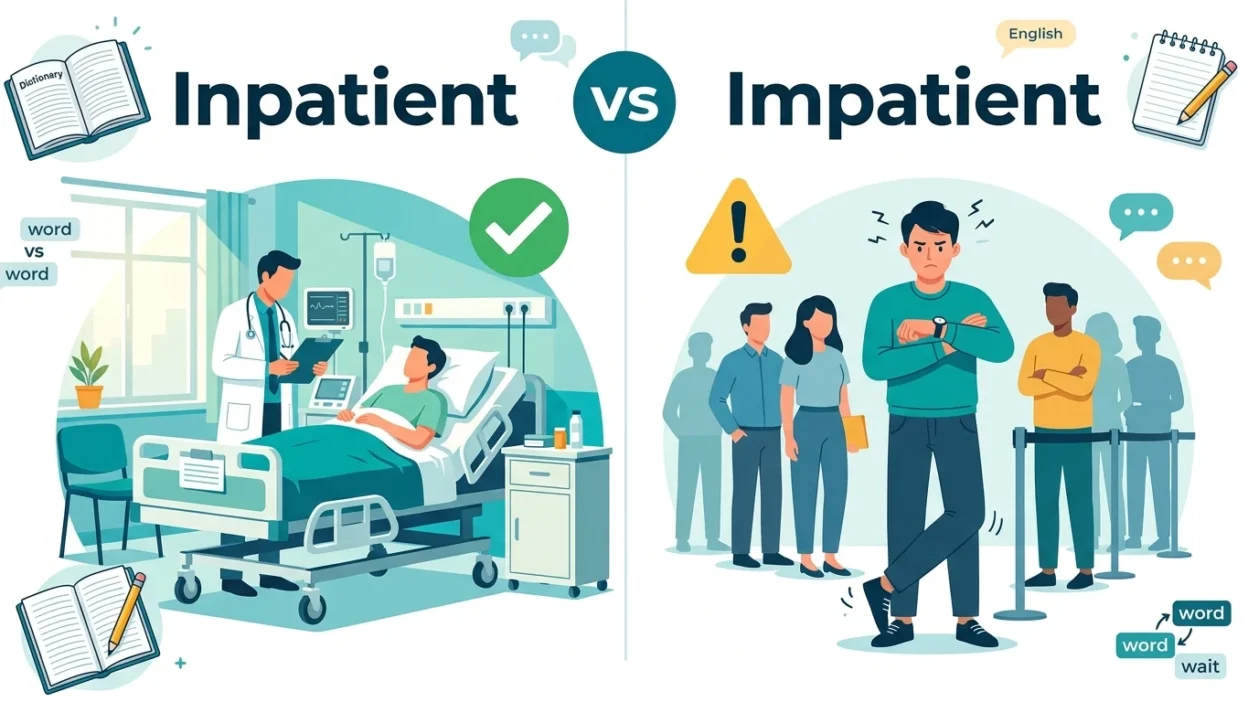
- Inpatient refers to a person who stays in a hospital or healthcare facility for treatment.
- Impatient describes someone who becomes annoyed, restless, or frustrated while waiting.
Examples
✅ The doctor examined the inpatient before surgery.
✅ She became impatient while waiting in line.
A quick way to remember:
- Inpatient = Hospital patient
- Impatient = Unable to wait calmly
What Does “Inpatient” Mean?
The word inpatient is a noun or adjective used in healthcare.
An inpatient is a patient who is admitted to a hospital and stays overnight or longer for treatment and monitoring.
Definition of Inpatient
An individual receiving medical care while staying in a hospital or healthcare facility.
Examples of Inpatient
- The inpatient recovered well after surgery.
- The hospital admitted several new inpatients this week.
- She received specialized care as an inpatient.
- The doctor reviewed the inpatient’s medical records.
In healthcare settings, inpatient always relates to hospital admission and treatment.
What Does “Impatient” Mean?
The word impatient is an adjective that describes a person who struggles to wait calmly.
Someone who is impatient often feels irritated, restless, or eager when things take longer than expected.
Definition of Impatient
Unable or unwilling to wait patiently.
Examples of Impatient
- The children became impatient during the long trip.
- He grew impatient while waiting for the results.
- She was impatient to start her new job.
- Customers became impatient because of the delay.
Unlike inpatient, this word has nothing to do with hospitals.
Inpatient vs Impatient: Comparison Table
| Feature | Inpatient | Impatient |
|---|---|---|
| Part of Speech | Noun or adjective | Adjective |
| Meaning | Hospital patient | Unable to wait calmly |
| Medical Term | Yes | No |
| Emotional State | No | Yes |
| Common Context | Healthcare | Everyday situations |
| Example | The inpatient stayed overnight. | He became impatient waiting. |
Although they look similar, their meanings are entirely unrelated.
How to Use “Inpatient” Correctly
Because inpatient is primarily a medical term, you’ll most often see it in healthcare discussions.
In Healthcare Facilities
- The inpatient was monitored overnight.
- The hospital’s inpatient unit was full.
In Medical Reports
- The physician examined the inpatient daily.
- The treatment plan was adjusted for the inpatient.
As an Adjective
- The hospital expanded its inpatient services.
- The clinic specializes in inpatient care.
In all these examples, the word relates directly to patients receiving treatment while staying in a healthcare facility.
How to Use “Impatient” Correctly
Impatient describes emotions, attitudes, or behavior.
Expressing Frustration
- She became impatient with the slow internet connection.
- They were impatient during the meeting.
Expressing Eagerness
- He was impatient to begin the project.
- The children were impatient to open their gifts.
Describing Personality Traits
- Some people are naturally more impatient than others.
- An impatient customer complained loudly.
The word focuses on a person’s reaction to waiting or delays.
Common Mistakes with Inpatient and Impatient
Because the words differ by only one letter, confusion is common.
Mistake 1: Using Inpatient Instead of Impatient
❌ I became inpatient while waiting for the bus.
✅ I became impatient while waiting for the bus.
The sentence describes a feeling, so impatient is correct.
Mistake 2: Using Impatient Instead of Inpatient
❌ The impatient was discharged from the hospital.
✅ The inpatient was discharged from the hospital.
This sentence refers to a hospital patient, making inpatient the correct choice.
Mistake 3: Assuming Both Words Are Related
Although they look alike, they have entirely different origins and meanings.
- Inpatient relates to healthcare.
- Impatient relates to emotions and behavior.
Easy Memory Tricks
Simple memory aids can help you avoid mistakes.
Remembering Inpatient
Think of:
In + Patient = In the hospital
The patient stays “in” the hospital.
Remembering Impatient
Think of:
Impatient = Irritated while waiting
The word often describes frustration or restlessness.
Quick Test
Ask yourself:
“Am I talking about a hospital patient?”
- Yes → Use inpatient
- No → Use impatient
This method works almost every time.
Inpatient vs Outpatient
When discussing healthcare, you’ll often hear inpatient and outpatient together.
Inpatient
- Stays overnight or longer
- Receives continuous monitoring
- Requires hospital admission
Outpatient
- Receives treatment without staying overnight
- Returns home after care
- Does not require admission
Examples
- The surgery required inpatient care.
- The procedure was completed on an outpatient basis.
Understanding this distinction can further reinforce the meaning of inpatient.
Synonyms for Inpatient
Depending on context, related terms include:
- Hospital patient
- Admitted patient
- Resident patient
- Medical patient
Examples
- The hospital patient responded well to treatment.
- The admitted patient required observation.
These terms may occasionally substitute for inpatient, depending on context.
Synonyms for Impatient
Several words share a similar meaning with impatient.
Common Synonyms
- Restless
- Irritated
- Frustrated
- Eager
- Anxious
- Agitated
Examples
- She grew restless during the delay.
- The customer became frustrated with the slow service.
These alternatives can add variety to your writing.
Real-World Examples
Medical Context
- The inpatient remained under observation for three days.
- The hospital expanded its inpatient department.
Everyday Context
- I became impatient waiting for the package.
- The audience grew impatient during the technical difficulties.
The contrast becomes clear when you see the words used in real situations.
American vs British English
When comparing inpatient vs impatient, there is no significant difference between American and British English.
Inpatient
Both American and British English use inpatient to describe a hospital patient who stays for treatment.
Impatient
Both varieties use impatient to describe someone who struggles to wait calmly.
Spelling and Meaning
- American English: Inpatient, Impatient
- British English: Inpatient, Impatient
The spelling, pronunciation, and meanings remain essentially the same.
Why Understanding the Difference Matters
Mixing up these words can create confusion, especially in professional writing.
For example:
- A medical report using impatient instead of inpatient could change the meaning entirely.
- A personal story using inpatient instead of impatient may sound confusing or unintentionally humorous.
Choosing the correct word improves:
- Writing accuracy
- Professional communication
- Healthcare documentation
- Academic writing
- Everyday clarity
Frequently Asked Questions
What is the difference between inpatient and impatient?
Inpatient refers to a hospital patient, while impatient describes someone who dislikes waiting.
Is inpatient a medical term?
Yes. It is commonly used in healthcare to describe patients admitted to a hospital.
What does impatient mean?
It means feeling restless, annoyed, or frustrated because of waiting or delays.
Can inpatient be used outside healthcare?
Rarely. The word is almost always connected to medical treatment and hospital care.
Is impatient a noun or adjective?
Impatient is an adjective that describes a person’s feelings or behavior.
What is the opposite of impatient?
The opposite is patient, which means able to wait calmly.
What is the opposite of inpatient?
In healthcare, the opposite is usually outpatient.
Why are inpatient and impatient confused?
They look and sound similar, but their meanings are completely different.
Summary
The distinction between inpatient vs impatient is straightforward once you understand their meanings. Inpatient refers to someone who stays in a hospital or healthcare facility for treatment, while impatient describes a person who feels frustrated, restless, or eager when faced with waiting.
Although these words differ by only one letter, they belong to completely different contexts. One is a medical term, and the other describes an emotional state. Learning the difference helps improve clarity, prevents embarrassing mistakes, and ensures your writing communicates exactly what you intend.

William Harved is a passionate language enthusiast and digital writer specializing in English spelling, grammar clarity, and common writing mistakes. As the primary author of Spelword.com, he focuses on helping readers understand confusing word pairs, correct spelling errors, and improve everyday communication.