
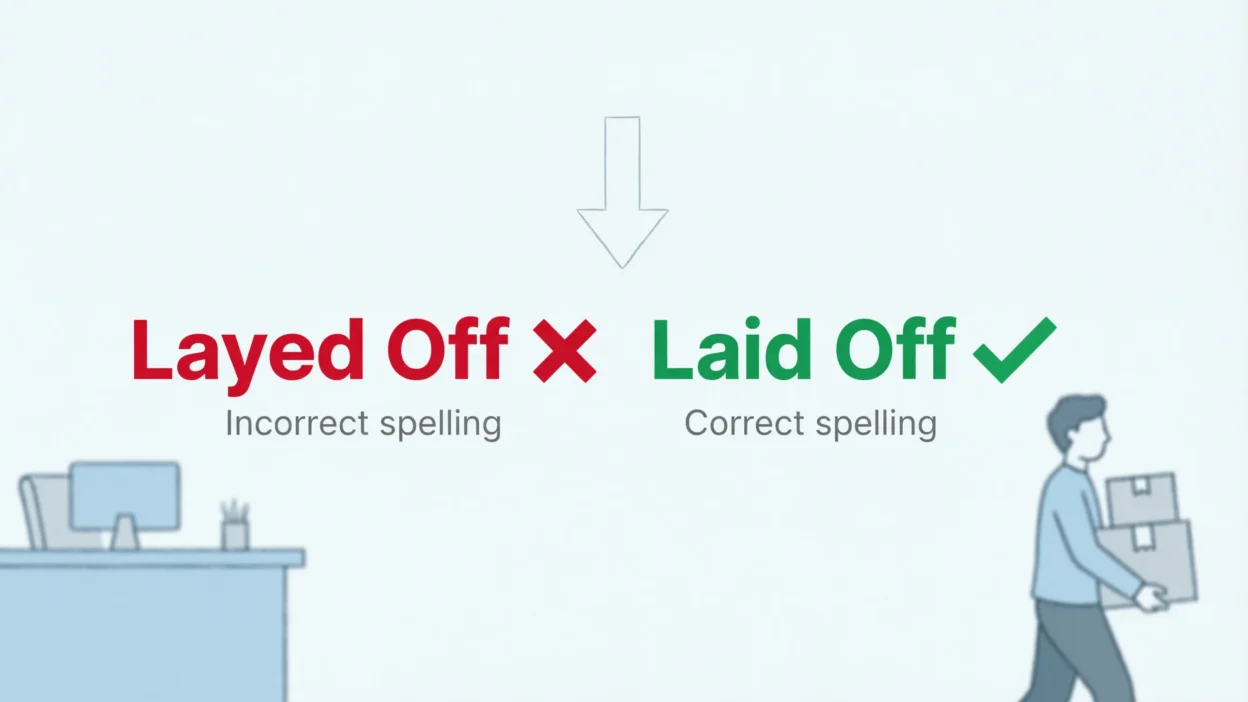
It’s a phrase you often hear in news, workplaces, and everyday conversations but when it comes to writing it down, many people hesitate: layed off or laid off? The difference may seem small, but using the correct form is important, especially in professional or sensitive contexts.
If you’ve ever been unsure which version is right, you’re not alone. In this guide, we’ll break down layed off vs laid off in a clear, supportive way so you can understand the correct usage, avoid common mistakes, and write with confidence.
Quick Answer: Layed Off vs Laid Off
- Laid off is the correct and standard phrase.
- Layed off is incorrect and should not be used.
What Does “Laid Off” Mean?
The phrase laid off is the past tense of lay off, a phrasal verb commonly used in employment contexts.
Definition:
To terminate someone’s employment, usually due to business reasons rather than performance.
Examples:
- The company laid off several employees last month.
- She was laid off due to budget cuts.
- Many workers were laid off during the economic downturn.
It can also have other meanings depending on context, such as:
- To stop doing something temporarily
- To refrain from something
But in most cases, it refers to job loss.
Is “Layed Off” a Real Phrase?
No, layed off is not correct in standard English. It is a common mistake caused by confusion with verb forms.
Why does this happen?
- People assume lay follows regular past tense rules
- They add “-ed” → layed
- But lay is an irregular verb, so its past tense is laid, not layed
So, even though layed might look logical, it’s incorrect.
Layed Off vs Laid Off: Key Differences
| Feature | Laid Off | Layed Off |
|---|---|---|
| Correct usage | ✅ Yes | ❌ No |
| Meaning | Job termination or pause | No meaning in English |
| Grammar | Past tense of “lay off” | Incorrect verb form |
| Usage | Formal and informal writing | Should not be used |
Understanding the Verb “Lay”
To fully understand the phrase, it helps to know how the verb lay works.
Verb forms:
- Present: lay
- Past: laid
- Past participle: laid
This is why:
- Correct: The company laid off workers.
- Incorrect: The company layed off workers.
Examples of “Laid Off” in Different Contexts
In the workplace:
- The firm laid off employees due to restructuring.
In news reports:
In conversation:
In broader usage:
- She decided to lay off sugar for a while.
Common Mistakes to Avoid
Even though the rule is simple, these mistakes are very common:
2. Treating “lay” as a regular verb
Not all verbs follow the “-ed” rule—lay is irregular.
3. Confusing “lay” and “lie”
These verbs often create confusion due to similar forms.
4. Skipping proofreading
Typos like layed can slip through if you’re not careful.
Easy Ways to Remember the Correct Form
Here are a few helpful tricks:
- Think: lay → laid (not layed)
- Connect it with common phrases:
- laid off
- laid back
- Practice using it in sentences
The more you use it correctly, the more natural it will feel.
American vs British English Differences
There is no difference between American and British English in this case:
- Both use laid off as the correct phrase
- Layed off is incorrect everywhere
This makes it easy to apply consistently in any context.
Why Correct Usage Matters
Using the correct phrase is especially important because of its sensitive meaning.
- Professionalism: Important in workplace communication
- Respect: Job-related topics require careful wording
- Credibility: Proper grammar builds trust
Frequently Asked Questions (FAQs)
No, layed off is not correct.
What does laid off mean?
It usually means someone has lost their job due to business reasons.
Is there a difference between laid off and fired?
Yes, laid off usually relates to business reasons, while fired often involves performance issues.
How can I remember the correct form?
Remember: lay → laid, not layed.
Is the usage the same in British English?
Yes, both British and American English use laid off.
Summary
The difference between layed off vs laid off is simple but essential.
By understanding irregular verb patterns and practicing correct usage, you can avoid this common mistake. Clear, accurate language not only improves your writing but also ensures your message is respectful and professional, especially in important contexts.

William Harved is a passionate language enthusiast and digital writer specializing in English spelling, grammar clarity, and common writing mistakes. As the primary author of Spelword.com, he focuses on helping readers understand confusing word pairs, correct spelling errors, and improve everyday communication.