Have you ever paused while writing and wondered whether to use farther or further? You’re not alone. These two words are among the most commonly confused terms in English because they are closely related in meaning and are often used interchangeably in everyday conversation.
However, understanding the difference between farther vs further can make your writing clearer and more precise. Whether you’re writing an email, essay, blog post, or business document, knowing when to use each word will help you communicate with confidence. This guide explains the meanings, usage rules, examples, and common mistakes so you can choose the right word every time.
Quick Answer
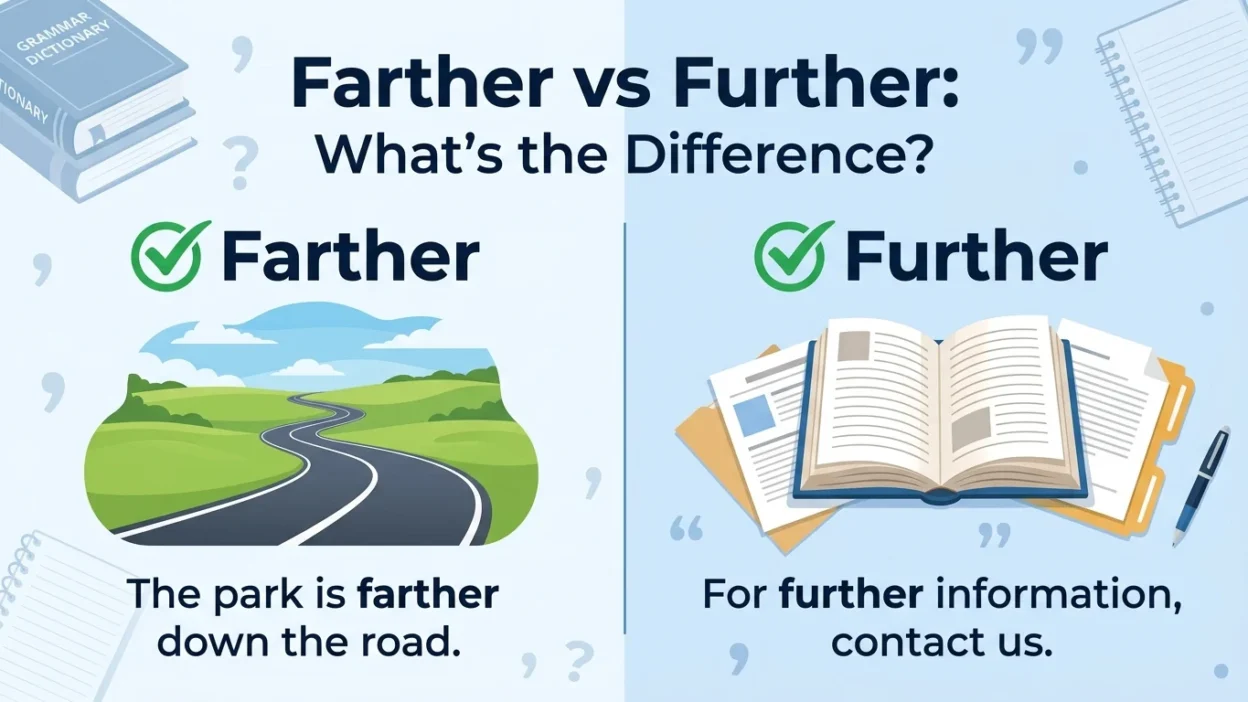
The traditional rule is simple:
- Farther refers to a physical distance.
- Further refers to a figurative distance, degree, time, or additional information.
Examples:
✅ The park is farther down the road.
✅ For further details, contact customer support.
While modern English sometimes uses further for both meanings, understanding the distinction can improve accuracy and style.
What Does “Farther” Mean?
Farther is generally used when talking about measurable physical distance.
Think of it as something you can physically travel, walk, drive, or see on a map.
Examples:
- The gas station is farther than I expected.
- We walked farther than planned.
- Their house is farther from the city center.
- She threw the ball farther than anyone else.
In each example, the word refers to an actual physical distance.
What Does “Further” Mean?
Further usually refers to a figurative or non-physical extension. It often means:
- Additional
- More advanced
- Beyond the current point
- Greater degree
- Extra information
Examples:
- We need further discussion before deciding.
- For further assistance, call the help desk.
- His research went further than previous studies.
- She declined to comment further.
Here, the word relates to ideas, progress, or additional information rather than measurable distance.
Farther vs Further: Comparison Table
| Feature | Farther | Further |
|---|---|---|
| Physical distance | ✔ Yes | Sometimes |
| Figurative distance | ✘ Rarely | ✔ Yes |
| Additional information | ✘ No | ✔ Yes |
| Advancement or progress | ✘ No | ✔ Yes |
| Traditional grammar preference | Physical distance | Abstract concepts |
| Common in modern English | Yes | Very common |
The Traditional Rule Explained
Many grammar experts teach this easy distinction:
Use Farther for Physical Distance
If you can measure it in miles, meters, feet, or kilometers, use farther.
Examples:
- The hotel is farther from the airport.
- We drove farther into the countryside.
- She jumped farther than her competitors.
Use Further for Figurative Distance
If you’re talking about ideas, progress, or something abstract, use further.
Examples:
- Further investigation is needed.
- We should discuss this further.
- The company plans further expansion.
This rule helps many writers remember the difference quickly.
Why Do People Confuse Farther and Further?
The confusion exists because the two words share similar origins and meanings.
In everyday speech, many native English speakers use further for both physical and figurative distances.
For example:
- The store is further down the street.
- The store is farther down the street.
Both may sound natural to many readers.
However, following the traditional distinction can make your writing more precise and polished.
Examples of Farther in Sentences
Here are some examples showing the correct use of farther.
Travel and Movement
- We traveled farther than expected.
- The beach is farther from town.
- They moved farther north last year.
Sports and Competition
- She threw the javelin farther than anyone else.
- His golf shot went farther than mine.
- The athlete ran farther during training.
Location
- The nearest restaurant is farther away than I thought.
- Our destination is farther down the highway.
- The cabin sits farther into the forest.
Examples of Further in Sentences
Here are examples of further used correctly.
Additional Information
- Please contact us for further details.
- Further information will be provided later.
- The website contains further resources.
Advancement
- Scientists conducted further research.
- The project requires further development.
- She pursued further education abroad.
Continuing an Action
- He refused to discuss the matter further.
- The meeting continued further into the evening.
- We need to examine the issue further.
Common Mistakes With Farther and Further
Mistake 1: Using Farther for Additional Information
❌ For farther information, visit our website.
✅ For further information, visit our website.
Mistake 2: Using Further for Measurable Distance
While often accepted, some style guides prefer:
❌ The lake is further away than the river.
✅ The lake is farther away than the river.
Mistake 3: Using Farther for Progress
❌ The company needs farther improvement.
✅ The company needs further improvement.
Mistake 4: Mixing Both Without Purpose
Consistency matters. If you’re following the traditional distinction, apply it throughout your writing.
Modern Usage: Are They Interchangeable?
In modern English, especially informal writing, further is increasingly used for both physical and figurative meanings.
Examples:
- The station is further down the road.
- The station is farther down the road.
Most readers will understand either version.
However, many editors and grammar professionals still prefer:
- Farther for measurable distance
- Further for everything else
Following this guideline often results in clearer writing.
Farther and Further as Adverbs
Both words can function as adverbs.
Examples with farther:
- We walked farther.
- The road extends farther east.
Examples with further:
- Let’s investigate further.
- The discussion went further than expected.
The same basic distinction usually applies.
Farther and Further as Adjectives
Both can also function as adjectives.
Examples:
Farther
- The farther shore looked beautiful.
- We reached the farther end of the bridge.
Further
- Further explanation is necessary.
- Further changes may occur.
Again, further is much more common for abstract ideas.
American vs British English
American English generally follows the traditional distinction more closely:
- Farther = physical distance
- Further = figurative distance or additional information
British English often uses further for both meanings, especially in everyday communication.
Examples:
American English:
- The town is farther away.
- We need further evidence.
British English:
- The town is further away.
- We need further evidence.
Despite this difference, both varieties understand and accept further in many contexts.
Easy Memory Trick
A simple trick can help:
Farther contains the word “far.”
If you’re talking about something physically far away, choose farther.
Examples:
- Farther down the road
- Farther from home
- Farther across the field
For everything involving ideas, information, progress, or continuation, choose further.
Examples:
- Further explanation
- Further research
- Further discussion
When to Use Farther
Use farther when:
- Discussing measurable physical distance
- Referring to locations
- Talking about travel
- Comparing actual distances
Examples:
- The airport is farther away.
- We hiked farther than expected.
- The mountain is farther north.
When to Use Further
Use further when:
- Referring to additional information
- Describing progress
- Discussing abstract concepts
- Talking about advancement or continuation
Examples:
- Further study is needed.
- We need further clarification.
- The discussion continued further.
Frequently Asked Questions
What is the difference between farther and further?
Traditionally, farther refers to physical distance, while further refers to figurative distance, advancement, or additional information.
Is farther always about distance?
Yes, in traditional grammar, farther is used for measurable physical distance.
Can further refer to physical distance?
Yes. Modern English often uses further for physical distance, especially in British English.
Which word is more common?
Further is generally more common because it has a wider range of meanings.
Is it farther away or further away?
Both are used, but many style guides prefer farther away for physical distance.
Do Americans and British people use these words differently?
Yes. American English often follows the traditional distinction more strictly, while British English commonly uses further for both meanings.
Should I worry about the difference?
Not excessively. Most readers understand both words, but using them correctly can improve clarity and professionalism.
What is the easiest way to remember the difference?
Think of far inside farther. If it’s about physical distance, choose farther.
Summary
Understanding farther vs further becomes much easier once you remember the traditional distinction. Farther is typically used for measurable physical distance, while further is used for abstract ideas, additional information, advancement, and continuation. Although modern English sometimes allows overlap, following this guideline can make your writing clearer and more precise.
In everyday communication, many people use further in a broader range of situations, especially in British English. However, using farther for physical distance and further for figurative meanings remains a helpful rule that many editors, teachers, and professional writers continue to recommend.

Dani Morrison is a dedicated language writer and spelling expert at Spelword.com, where she focuses on helping readers understand common English spelling mistakes and confusing word pairs. With a passion for clear communication, Dani creates easy-to-follow guides that simplify complex grammar and spelling rules for everyday use.