If you’ve ever paused while writing because you couldn’t decide between afterward and afterwards, you’re not alone. These two words look almost identical and have the same meaning, yet many English learners and even native speakers wonder which one is correct.
The good news is that both afterward and afterwards are correct. The difference is not about grammar or meaning but mainly about regional preference. This guide explains the difference, when to use each form, provides examples, highlights common mistakes, and helps you choose the best option for your audience.
Quick Answer
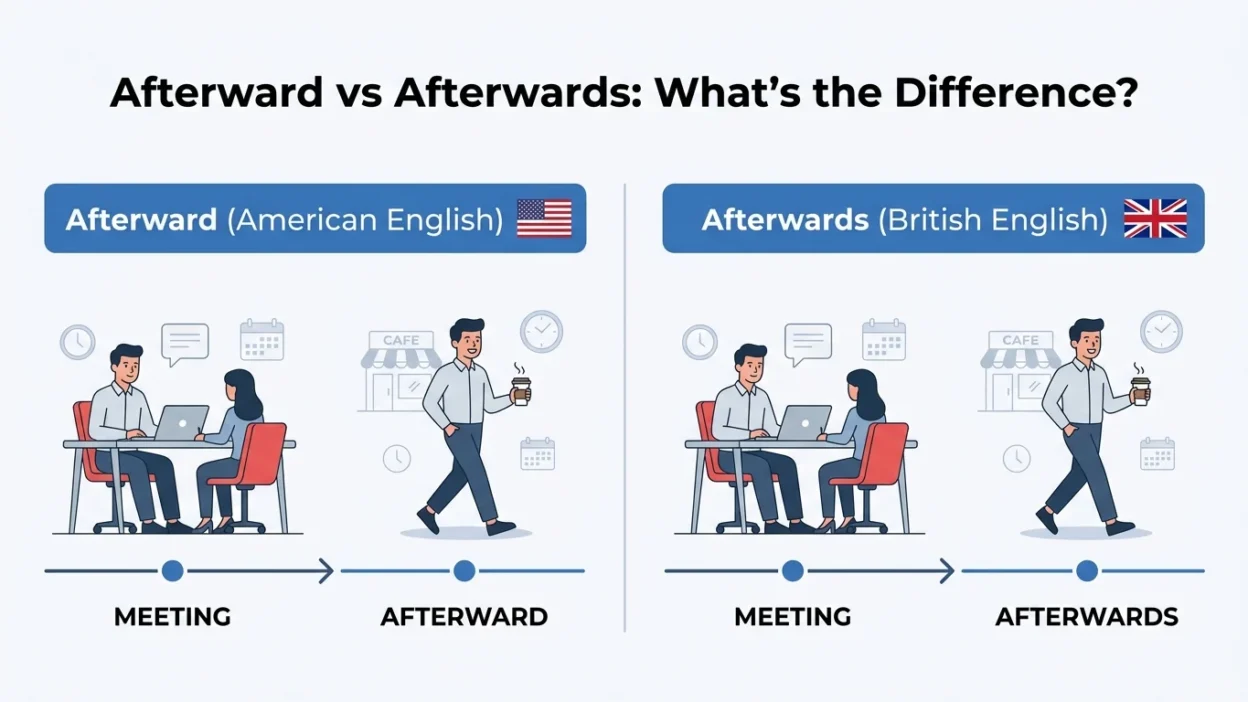
Afterward and afterwards both mean at a later time or after something has happened.
The only real difference is usage:
- Afterward is more common in American English.
- Afterwards is more common in British English.
Examples:
- ✅ We went out for dinner afterward. (American English)
- ✅ We went out for dinner afterwards. (British English)
Both forms are grammatically correct and interchangeable.
What Does “Afterward” Mean?
Afterward is an adverb meaning later, subsequently, or after that.
It describes something that happens following another event.
It is especially common in American English writing and speech.
Examples of “Afterward”
- We watched a movie and went for ice cream afterward.
- She thanked everyone afterward.
- The meeting ended, and we talked afterward.
- He called me afterward to explain.
- They celebrated afterward.
In every example, afterward refers to something happening later.
What Does “Afterwards” Mean?
Afterwards has exactly the same meaning as afterward.
It is simply the preferred form in British English and many other English-speaking countries.
Examples of “Afterwards”
- We had coffee afterwards.
- She apologized afterwards.
- They met again afterwards.
- The children played outside afterwards.
- We discussed the results afterwards.
The meaning is identical to afterward.
Afterward vs Afterwards: Key Differences
| Feature | Afterward | Afterwards |
|---|---|---|
| Meaning | At a later time | At a later time |
| Part of Speech | Adverb | Adverb |
| Grammar | Correct | Correct |
| American English | Preferred | Less common |
| British English | Less common | Preferred |
The difference is based on regional style rather than meaning.
When Should You Use “Afterward”?
Use afterward when writing primarily for an American audience or when following American English style guides.
It commonly appears in:
- Academic writing
- Business communication
- Newspapers
- Websites
- Everyday conversation
- Professional documents
Example Sentences
- We met afterward to discuss the project.
- He smiled afterward.
- The coach spoke to the players afterward.
- I felt much better afterward.
- They visited the museum afterward.
When Should You Use “Afterwards”?
Use afterwards when writing for readers who use British English or other varieties that commonly include the final -s.
It appears frequently in:
- British newspapers
- UK educational materials
- Australian publications
- New Zealand writing
- International English
Example Sentences
- We had lunch afterwards.
- She called me afterwards.
- They stayed for a while afterwards.
- Everyone relaxed afterwards.
- He explained everything afterwards.
Side-by-Side Examples
These examples show that both words have the same meaning.
- We went shopping afterward.
- We went shopping afterwards.
- She apologized afterward.
- She apologized afterwards.
- They met again afterward.
- They met again afterwards.
The only difference is the variety of English being used.
Common Mistakes to Avoid
These are some of the most common mistakes.
Mixing Both Forms in One Article
Choose either afterward or afterwards and use it consistently throughout your writing.
Thinking One Form Is Incorrect
Both are standard English words.
Neither is more grammatically correct than the other.
Choosing the Wrong Style for Your Audience
If you’re writing for an American audience, afterward usually sounds more natural.
If you’re writing for a British audience, afterwards is often preferred.
Confusing “Afterward” with “After”
These words are related but have different functions.
- After usually introduces a noun or clause.
- Afterward and afterwards function as adverbs.
Examples:
- We went home after dinner.
- We went home afterward.
Easy Memory Trick
Here’s a simple way to remember.
Afterward = American
Think of afterward as the shorter form preferred in American English.
Afterwards = British
Think of afterwards as the version that ends with -s, commonly used in British English.
An easy reminder:
- American → afterward
- British → afterwards
Common Phrases with “Afterward”
You’ll often hear these expressions.
- Shortly afterward
- Soon afterward
- Immediately afterward
- Years afterward
- Not long afterward
- Shortly afterward, we left
Example
Shortly afterward, everyone returned home.
Common Phrases with “Afterwards”
These expressions are also common.
- Soon afterwards
- Immediately afterwards
- Shortly afterwards
- Many years afterwards
- Afterwards, they celebrated
- Long afterwards
Example
Immediately afterwards, the audience applauded.
American vs British English
This is where the primary difference appears.
American English
American English strongly prefers afterward.
Example:
- We talked afterward.
British English
British English generally prefers afterwards.
Example:
- We talked afterwards.
Both forms are understood in both varieties, but using the preferred regional version makes your writing sound more natural.
Practice Sentences
Choose the word that best matches the style.
- We had dinner ______.
- ✅ Afterward (American)
- ✅ Afterwards (British)
- She called me ______ to explain.
- ✅ Afterward
- ✅ Afterwards
- They celebrated ______ the ceremony.
- ✅ Afterward
- ✅ Afterwards
- We met again ______.
- ✅ Afterward
- ✅ Afterwards
- Everyone relaxed ______.
- ✅ Afterward
- ✅ Afterwards
FAQs
What is the difference between afterward and afterwards?
There is no difference in meaning. Afterward is more common in American English, while afterwards is preferred in British English.
Is afterward grammatically correct?
Yes. Afterward is a standard English adverb and is widely used, especially in the United States.
Is afterwards grammatically correct?
Yes. Afterwards is also correct and is commonly used in the United Kingdom and many other English-speaking countries.
Which form should I use in American English?
Afterward is generally the preferred form in American English.
Which form should I use in British English?
Afterwards is usually preferred in British English.
Can I use both forms in the same article?
It’s better to choose one form and use it consistently throughout your writing.
Do afterward and afterwards have different meanings?
No. They have identical meanings and differ only in regional preference.
Summary
Understanding afterward vs afterwards is surprisingly simple because both words share the same meaning. They both function as adverbs meaning “later” or “after that.” The only meaningful distinction is regional usage. Afterward is the preferred choice in American English, while afterwards is more common in British English and several other English speaking regions.
Because the meanings are identical, your choice should depend on your audience and writing style rather than grammar. Whether you’re writing an academic paper, business email, blog post, or everyday message, using the version that matches your intended readers will make your writing sound more natural and consistent.

William Harved is a passionate language enthusiast and digital writer specializing in English spelling, grammar clarity, and common writing mistakes. As the primary author of Spelword.com, he focuses on helping readers understand confusing word pairs, correct spelling errors, and improve everyday communication.