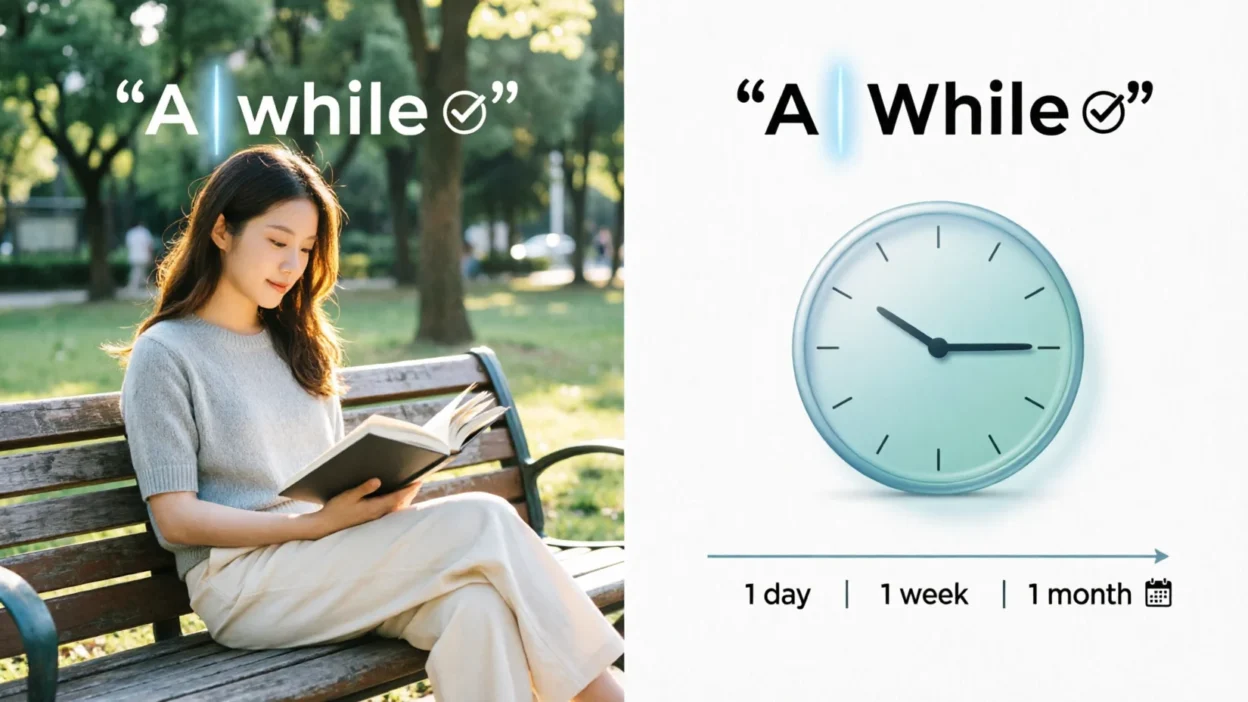
The English language contains many word pairs that look almost identical but serve different grammatical purposes. One of the most common examples is awhile vs a while. Since both expressions relate to time and are pronounced similarly, many writers struggle to decide which one belongs in a sentence.
If you’ve ever wondered whether to write stay awhile or stay a while, you’re not alone. The distinction is actually quite simple once you understand how each form functions. Learning the difference can make your writing more accurate, natural, and professional.
Quick Answer
- Awhile = an adverb meaning “for a short time”
- A while = a noun phrase meaning “a period of time”
Simple examples:
- Please stay awhile.
- We waited for a while.
What Does “Awhile” Mean?
The word awhile is an adverb.
It means:
For a short period of time.
Because it is an adverb, it modifies a verb and describes how long an action lasts.
Examples:
- Sit and relax awhile.
- Stay awhile before leaving.
- Let’s talk awhile.
In these sentences, awhile directly modifies the action.
What Does “A While” Mean?
The phrase a while is a noun phrase.
It means:
A period of time.
Unlike awhile, it often follows a preposition such as:
- For
- In
- After
Examples:
- We talked for a while.
- I haven’t seen her in a while.
- It took a while to finish.
Here, the phrase functions as a noun rather than an adverb.
Awhile vs A While: Key Differences
| Term | Part of Speech | Meaning |
|---|---|---|
| Awhile ✅ | Adverb | For a short time |
| A while ✅ | Noun phrase | A period of time |
Why These Terms Are Confusing
The confusion happens because:
- They sound almost identical
- Both refer to time
- Their meanings are closely related
- Many people learn them through speech rather than grammar rules
Compare:
- Stay awhile. ✅
- Stay for a while. ✅
Both sentences are correct, but the grammar structure differs.
Understanding “Awhile” as an Adverb
Directly Modifies a Verb
The word awhile usually follows a verb.
Examples:
- Rest awhile.
- Wait awhile.
- Sit awhile.
Notice that no preposition is needed before awhile.
Meaning
In each case, the word means:
For a short period.
Understanding “A While” as a Noun Phrase
Refers to a Time Period
The phrase a while acts as a thing—a period of time.
Examples:
- We stayed for a while.
- It has been a while since we met.
Often Used with Prepositions
Common patterns include:
- For a while
- In a while
- After a while
Common Mistakes to Avoid
1. Using “Awhile” After a Preposition
Incorrect:
- ❌ We waited for awhile.
Correct:
- ✔️ We waited for a while.
Since “for” requires a noun phrase, use a while.
2. Using “A While” Without Need
Incorrect:
- ❌ Stay a while.
While accepted in modern English, many grammar guides prefer:
- ✔️ Stay awhile.
3. Forgetting the Grammar Rule
Remember:
- No preposition = often awhile
- Preposition present = usually a while
Easy Trick to Remember the Difference
A simple memory trick is:
👉 If you can add “for,” use “a while.”
Example:
- We waited for a while. ✅
👉 If no preposition is needed, use “awhile.”
Example:
- Stay awhile. ✅
This rule works in most situations.
American vs British English
There is very little difference between American and British English regarding these expressions.
American English
- Awhile
- A while
British English
- Awhile
- A while
Both forms are accepted and follow the same grammatical rules.
Examples of “Awhile” in Sentences
Everyday Examples
- Come in and stay awhile.
- Relax awhile before dinner.
Friendly Conversation
- Let’s sit here awhile.
- Talk with me awhile.
Writing Examples
- The travelers rested awhile before continuing.
Examples of “A While” in Sentences
Everyday Examples
- We talked for a while.
- She waited a while before responding.
Time Expressions
- It has been a while since graduation.
- The repair took a while.
Formal Examples
- Discussions continued for a while after the meeting.
Can Both Be Correct in Some Cases?
Yes.
Example:
- Stay awhile. ✅
- Stay a while. ✅
Both forms are commonly accepted today.
However:
- Awhile is traditionally viewed as the adverb.
- A while emphasizes the period of time.
The difference is often subtle in modern English.
Similar Grammar Confusions
English contains many similar word pairs.
Examples:
| Word Pair | Difference |
|---|---|
| Awhile vs A while | Adverb vs noun phrase |
| Everyday vs Every day | Adjective vs phrase |
| Anytime vs Any time | Adverb vs noun phrase |
| Onto vs On to | Preposition vs phrase |
Recognizing these patterns helps strengthen grammar skills.
Synonyms for “Awhile”
Depending on context:
- Briefly
- Temporarily
- Momentarily
- Shortly
Example:
- Rest awhile.
- Rest briefly.
Synonyms for “A While”
Depending on context:
- Some time
- A period
- A short time
- Several minutes
Example:
- We waited a while.
- We waited some time.
Why Correct Usage Matters
Using the correct form improves:
- Grammar accuracy
- Writing professionalism
- Reader understanding
- Communication clarity
- SEO quality
Small grammar choices help create polished and trustworthy content.
Awhile vs A While in Professional Writing
Professional writers often pay close attention to this distinction because:
- It improves readability
- It demonstrates language knowledge
- It prevents grammatical inconsistencies
While readers will usually understand either form, correct usage makes writing appear more polished.
FAQs
What is the difference between awhile and a while?
“Awhile” is an adverb meaning “for a short time,” while “a while” is a noun phrase meaning “a period of time.”
Is it for awhile or for a while?
“For a while” is correct because the preposition “for” requires a noun phrase.
Can I say stay awhile?
Yes. “Stay awhile” is grammatically correct and commonly used.
Is stay a while also correct?
Yes. Modern English commonly accepts both expressions, although “stay awhile” is traditionally preferred.
Which form is more formal?
Both forms are acceptable, but their usage depends on grammar rather than formality.
Is there a British vs American difference?
No significant difference exists. Both varieties use the same grammar rules.
Why do people confuse awhile and a while?
They sound nearly identical and both refer to time.
How can I remember the difference?
If the sentence includes a preposition like “for,” use “a while.” Otherwise, “awhile” is often correct.
Summary
Understanding awhile vs a while becomes much easier when you focus on grammar rather than pronunciation. Awhile is an adverb meaning “for a short time,” while a while is a noun phrase referring to a period of time. Although the meanings are closely related, each serves a different grammatical purpose.
Because the two forms sound so similar, they are frequently confused. However, recognizing whether your sentence needs an adverb or a noun phrase will help you choose the correct form confidently. Mastering distinctions like this can make your writing clearer, smoother, and more professional.