If you’ve seen both licensed and licenced in books, websites, or official documents, you may have wondered whether one is incorrect or if both spellings are acceptable. Since they differ by only one letter, it’s easy to become confused especially if you’re writing for an international audience.
The good news is that both licensed and licenced are real words. However, the correct spelling depends largely on whether you’re using American or British English. In this guide, you’ll learn the difference between licensed vs licenced, when to use each spelling, examples, common mistakes, and helpful tips to ensure your writing is accurate.
Quick Answer
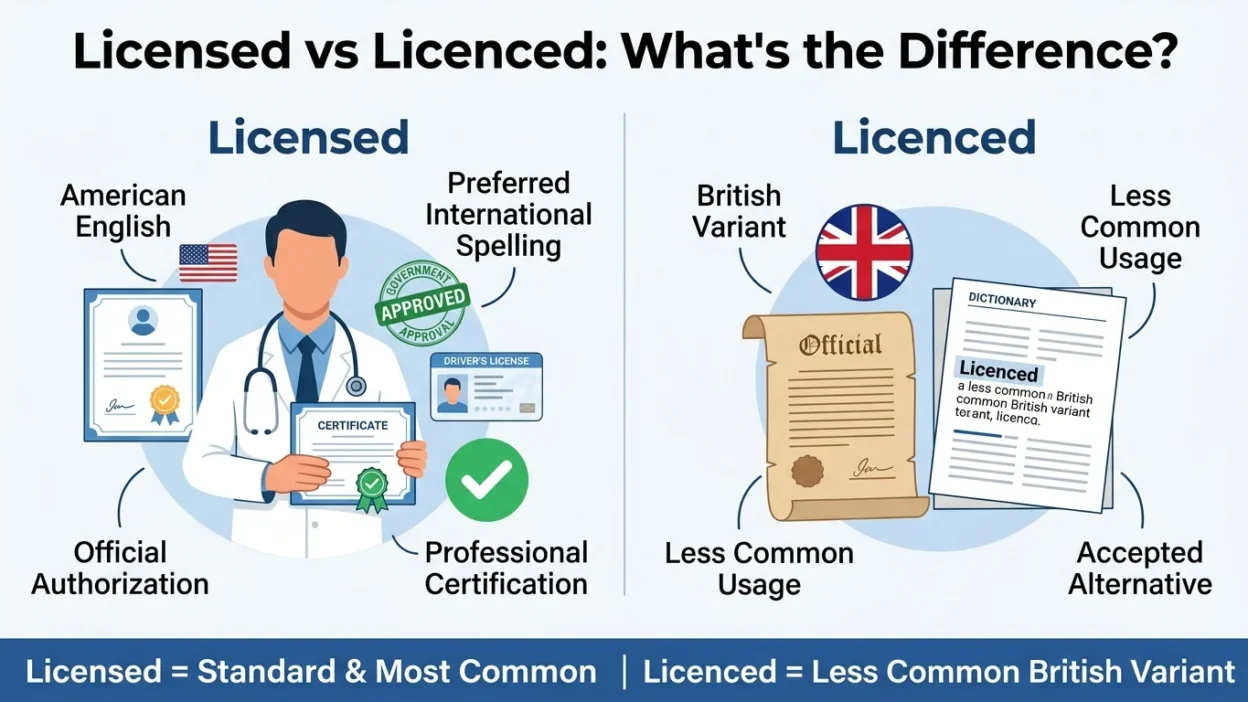
The difference between licensed vs licenced is mainly regional spelling.
- Licensed is the standard spelling in American English and is also widely used as the preferred past tense and adjective in British English.
- Licenced is an accepted but much less common British English variant of the past tense and adjective.
Examples:
- She is a licensed pharmacist. ✅
- The company is licensed to operate. ✅
- The software was licenced by the organization. ✅ (Less common, mainly British usage)
If you’re unsure which spelling to choose, licensed is the safest and most widely accepted option.
What Does “Licensed” Mean?
Licensed is the past tense and past participle of the verb license in American English. It is also commonly used as an adjective meaning officially authorized or permitted.
Examples
- She is a licensed doctor.
- The company is licensed to sell insurance.
- They licensed the software to another business.
- He became a licensed pilot.
- The contractor is fully licensed.
In each example, licensed indicates official permission or legal authorization.
What Does “Licenced” Mean?
Licenced is an alternative British English spelling of the past tense and past participle of licence (used as a verb in some British English contexts).
Although it appears in some British publications, it is much less common than licensed.
Examples
- The business was licenced by the local authority.
- The broadcaster licenced the program overseas.
- The company was properly licenced.
These examples are grammatically acceptable in certain British English contexts, but many modern publishers still prefer licensed.
Licensed vs Licenced: Comparison Table
| Feature | Licensed | Licenced |
|---|---|---|
| Meaning | Officially authorized; past tense of license | Same meaning |
| American English | Standard spelling | Rarely used |
| British English | Common and widely accepted | Accepted but less common |
| Part of Speech | Adjective and verb | Adjective and verb |
| Recommended for International Writing | Yes | Usually no |
Understanding “License” and “Licence”
The confusion becomes easier to understand when you look at the base words.
American English
- License = Noun
- License = Verb
Examples:
- He has a driver’s license.
- The state will license the company.
British English
British English often distinguishes between the noun and the verb.
- Licence = Noun
- License = Verb
Examples:
- She has a driving licence.
- The council will license the restaurant.
Because the verb is license, many British style guides also prefer licensed as the past tense and adjective.
When Should You Use “Licensed”?
Use licensed in nearly all situations, especially if you’re writing for:
- American readers
- International audiences
- Business communication
- Academic writing
- Professional documents
- Websites
- Marketing materials
Examples
- A licensed electrician completed the work.
- The software is licensed under an open-source agreement.
- The business is fully licensed.
- She became a licensed therapist.
- The city licensed several new vendors.
This spelling is recognized worldwide and is the safest choice.
When Might You See “Licenced”?
Although uncommon, licenced may appear in:
- Older British publications
- Historical documents
- Some government records
- Certain regional publications
If you’re quoting an original source, preserve the original spelling.
Otherwise, many editors recommend using licensed.
Real-Life Examples
Let’s compare both spellings.
Business
Common:
- The company is licensed to operate internationally.
Less common:
- The company is licenced to operate internationally.
Healthcare
Correct:
- She is a licensed nurse.
Rare:
- She is a licenced nurse.
Software
Correct:
- The application is licensed under a commercial agreement.
Also acceptable in some British contexts:
- The application is licenced under a commercial agreement.
Common Mistakes People Make
Here are some frequent errors.
Mixing American and British Spellings
Incorrect:
- Driving licence
- Licensed software
- Colour
- Organization
Mixing spelling systems in the same document may reduce consistency.
Choose either American or British English and use it throughout.
Assuming “Licenced” Is the Standard Spelling
Many learners think licenced is the preferred British spelling.
In reality, licensed is still far more common in modern British writing.
Confusing the Noun and the Verb
British English:
Correct:
- Driving licence (noun)
- To license (verb)
Understanding this distinction prevents many spelling mistakes.
Easy Trick to Remember the Difference
Here’s a simple memory aid.
If you’re writing internationally, simply choose:
Licensed
It is:
- Standard in American English.
- Widely accepted in British English.
- Preferred by many publishers.
- Common in legal and business writing.
Remember:
- Licence is mainly a British noun.
- Licensed is generally the preferred adjective and verb form.
American vs British English Differences
This is where the biggest distinction appears.
American English
- License (noun)
- License (verb)
- Licensed (past tense/adjective)
Examples:
- Driver’s license
- Licensed physician
British English
- Licence (noun)
- License (verb)
- Licensed (most common past tense/adjective)
- Licenced (accepted but less common alternative)
For global audiences, licensed is almost always the better choice.
Why Choosing the Right Spelling Matters
Correct spelling improves professionalism and credibility.
For example:
Job advertisements often require:
- Licensed engineer
- Licensed electrician
- Licensed pharmacist
Using the expected spelling helps your writing appear polished and trustworthy.
If you’re publishing online, consistency also improves readability and user confidence.
FAQs
What is the difference between licensed and licenced?
The meanings are the same. The difference is spelling preference, with licensed being the standard and more widely used form.
Is licenced a real word?
Yes. Licenced is an accepted British English variant, although it is much less common than licensed.
Which spelling is correct in American English?
Licensed is the only standard spelling in American English.
Which spelling is preferred in British English?
Although licenced is accepted, licensed is more commonly used for the verb and adjective. British English typically uses licence as the noun.
Should I use licensed in business writing?
Yes. Licensed is the preferred spelling for business, legal, academic, and international communication.
Is licensed an adjective?
Yes. It describes someone or something that has official permission or authorization.
What is the British spelling of license?
In British English, licence is the noun, while license is the verb.
Which spelling is best for international readers?
Licensed is the safest and most widely recognized choice.
Summary
Understanding licensed vs licenced is mainly about recognizing regional spelling preferences rather than differences in meaning. Both words refer to someone or something that has received official permission or authorization. However, licensed is the standard spelling in American English and is also the preferred form for the verb and adjective in most modern British English writing. Licenced remains an accepted but much less common British variant.
If you’re writing for an international audience, creating professional documents, or publishing online, licensed is usually the best choice. It is familiar to readers worldwide, aligns with most modern style guides, and helps keep your writing clear, consistent, and professional.

William Harved is a passionate language enthusiast and digital writer specializing in English spelling, grammar clarity, and common writing mistakes. As the primary author of Spelword.com, he focuses on helping readers understand confusing word pairs, correct spelling errors, and improve everyday communication.