Have you ever paused while writing and wondered whether to use apologizes or apologies? You’re not alone. These two words look almost identical, but they have different meanings and grammatical roles. Choosing the wrong one can make your writing sound awkward or incorrect.
In this guide, you’ll learn the difference between apologizes vs apologies, when to use each one, common mistakes to avoid, and plenty of examples to help you remember the correct usage. By the end, you’ll feel confident using both words in everyday conversations and writing.
Quick Answer
The difference between apologizes and apologies is simple:
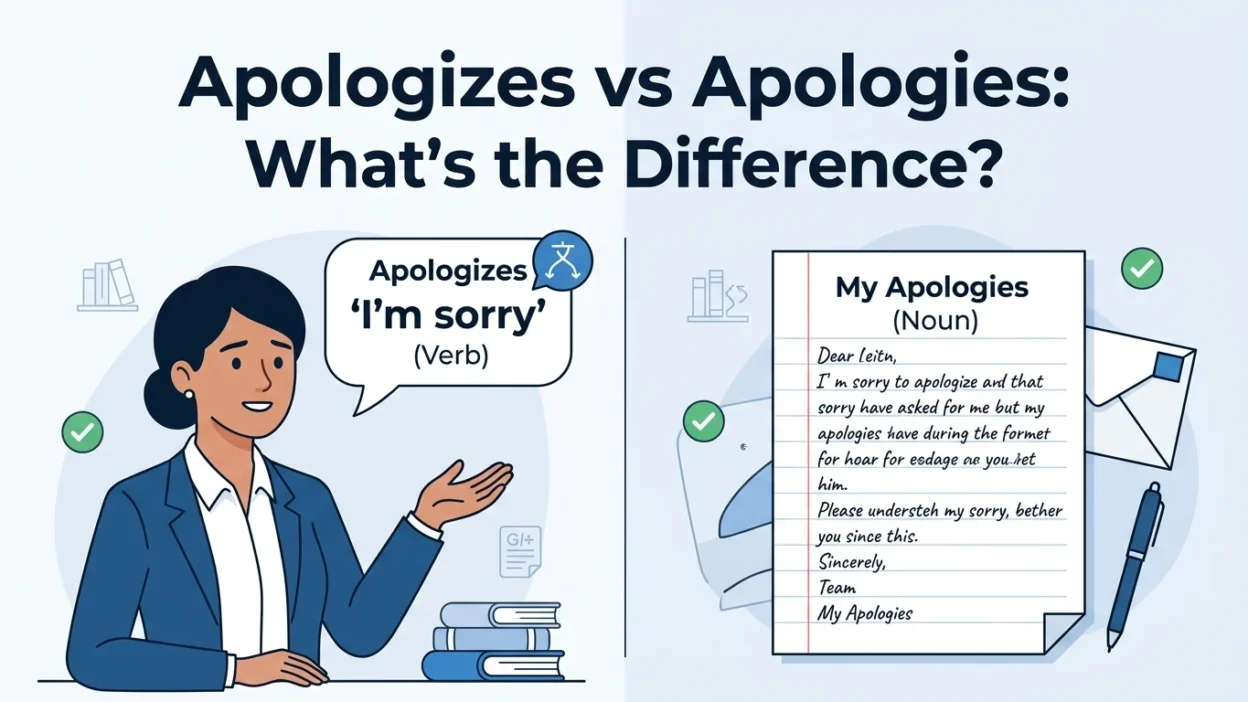
- Apologizes is a verb. It means someone expresses regret or says sorry.
- Apologies is a plural noun. It refers to more than one apology or is commonly used in the phrase “My apologies.”
Examples:
- She apologizes for arriving late. ✅
- Please accept my apologies for the misunderstanding. ✅
What Does “Apologizes” Mean?
Apologizes is the third-person singular form of the verb apologize.
It describes the action of expressing regret, admitting a mistake, or asking for forgiveness.
Examples
- He apologizes whenever he makes a mistake.
- The company apologizes for the shipping delay.
- She apologizes sincerely after hurting someone’s feelings.
- My brother always apologizes if he forgets something important.
Whenever you see apologizes, remember that it is describing an action.
What Does “Apologies” Mean?
Apologies is the plural form of the noun apology.
It refers to multiple expressions of regret or is often used as a polite expression by itself.
Examples
- Please accept my apologies.
- Our sincere apologies for the inconvenience.
- He offered several apologies during the meeting.
- My apologies for the delayed response.
Unlike apologizes, this word names a thing rather than an action.
Apologizes vs Apologies: Key Differences
| Feature | Apologizes | Apologies |
|---|---|---|
| Part of Speech | Verb | Noun (Plural) |
| Meaning | Expresses regret | Expressions of regret |
| Shows | Action | Thing or idea |
| Example | She apologizes immediately. | My apologies for the mistake. |
| Used With | Subject performing an action | Possessive words like my, our, sincere |
How to Remember the Difference
A simple trick is this:
- If someone is doing the act of saying sorry, use apologizes.
- If you’re referring to the actual apology, use apologies.
Think about these examples:
- The manager apologizes to customers.
- The manager sends his apologies.
One describes an action. The other names the apology itself.
Examples in Everyday Sentences
Using “Apologizes”
- She always apologizes after speaking too quickly.
- The teacher apologizes for the confusion.
- My neighbor apologizes whenever his dog barks loudly.
- He apologizes even when the mistake isn’t his.
- The airline apologizes for the canceled flight.
Using “Apologies”
- My apologies for the interruption.
- Please accept our apologies.
- The email included sincere apologies.
- He sent written apologies to everyone involved.
- Their apologies were accepted.
Common Mistakes People Make
Many learners confuse these words because they share the same root.
Mistake 1: Using the noun instead of the verb
❌ She apologies for being late.
✅ She apologizes for being late.
Mistake 2: Using the verb instead of the noun
❌ Please accept my apologizes.
✅ Please accept my apologies.
Mistake 3: Confusing grammar
Remember that verbs describe actions, while nouns refer to people, places, things, or ideas.
Which Word Should You Use?
Ask yourself one simple question:
Is someone performing the action of saying sorry?
If yes, choose apologizes.
Are you referring to the apology itself?
If yes, choose apologies.
This quick check works almost every time.
American vs British English
There is very little difference between American and British English in the use of these words.
The only spelling variation is the base verb:
- American English commonly uses apologize.
- British English also accepts apologise.
As a result:
- American English: He apologizes.
- British English: He apologises.
However, the noun apologies is spelled exactly the same in both varieties of English.
Common Expressions Using “Apologies”
You’ll often hear these polite phrases:
- My apologies.
- Our sincere apologies.
- Please accept my apologies.
- With my apologies.
- Deepest apologies.
- Offer an apology.
- Extend apologies.
- Public apologies.
These expressions are common in business emails, customer service, and formal communication.
Tips to Avoid Confusion
- Remember that apologizes is always a verb.
- Apologies is always a noun.
- If you can replace the word with says sorry, choose apologizes.
- If you can replace it with expression of regret, choose apologies.
- Read the sentence aloud. Usually, the correct choice becomes obvious.
Practice Sentences
Choose the correct word.
- She ______ for forgetting the meeting.
Answer: apologizes
- Please accept my sincere ______.
Answer: apologies
- The spokesperson ______ during the press conference.
Answer: apologizes
- We offer our deepest ______ to the affected families.
Answer: apologies
- He immediately ______ after realizing the mistake.
Answer: apologizes
Why the Difference Matters
Using the correct word improves both spoken and written communication. In professional emails, academic writing, customer service, and everyday conversations, confusing apologizes and apologies can make sentences sound unnatural.
Frequently Asked Questions (FAQs)
Is “apologizes” a noun or a verb?
It is a verb. It describes the action of expressing regret or saying sorry.
Is “apologies” singular or plural?
It is the plural form of the noun apology, although it is commonly used in polite expressions like “My apologies.”
Can I say “My apologizes”?
No. The correct expression is My apologies.
Which is correct: “He apologizes” or “He apologies”?
He apologizes is correct because the sentence needs a verb.
Is “Please accept my apologies” grammatically correct?
Yes. It is a polite and commonly used expression in both formal and informal English.
Why do people confuse apologizes and apologies?
They look similar and come from the same root word, but one is a verb and the other is a noun.
Does British English use “apologizes”?
British English usually spells the verb as apologises, while American English uses apologizes. The noun apologies remains the same.
Summary
Understanding apologizes vs apologies becomes much easier once you remember their grammatical roles. Apologizes is a verb that describes the act of expressing regret, while apologies is a noun referring to one or more expressions of regret. Although they share the same root word, they cannot be used interchangeably.
Using the correct word makes your writing clearer, more professional, and grammatically accurate. Whether you’re writing an email, preparing a report, or simply having a conversation, knowing when to use apologizes and apologies will help you communicate with confidence and avoid one of the most common English grammar mistakes.

Dani Morrison is a dedicated language writer and spelling expert at Spelword.com, where she focuses on helping readers understand common English spelling mistakes and confusing word pairs. With a passion for clear communication, Dani creates easy-to-follow guides that simplify complex grammar and spelling rules for everyday use.