Have you ever wondered whether you should write remarks or notes in a report, meeting summary, school assignment, or official document? Although these words are sometimes used interchangeably, they have different meanings and purposes. Understanding the distinction can help you communicate more clearly in both professional and everyday writing.
The good news is that the difference between remarks and notes is easy to understand. Once you know how each word is used, you’ll be able to choose the right one with confidence. This guide explains their meanings, examples, key differences, common mistakes, and when each term is the better choice.
Quick Answer
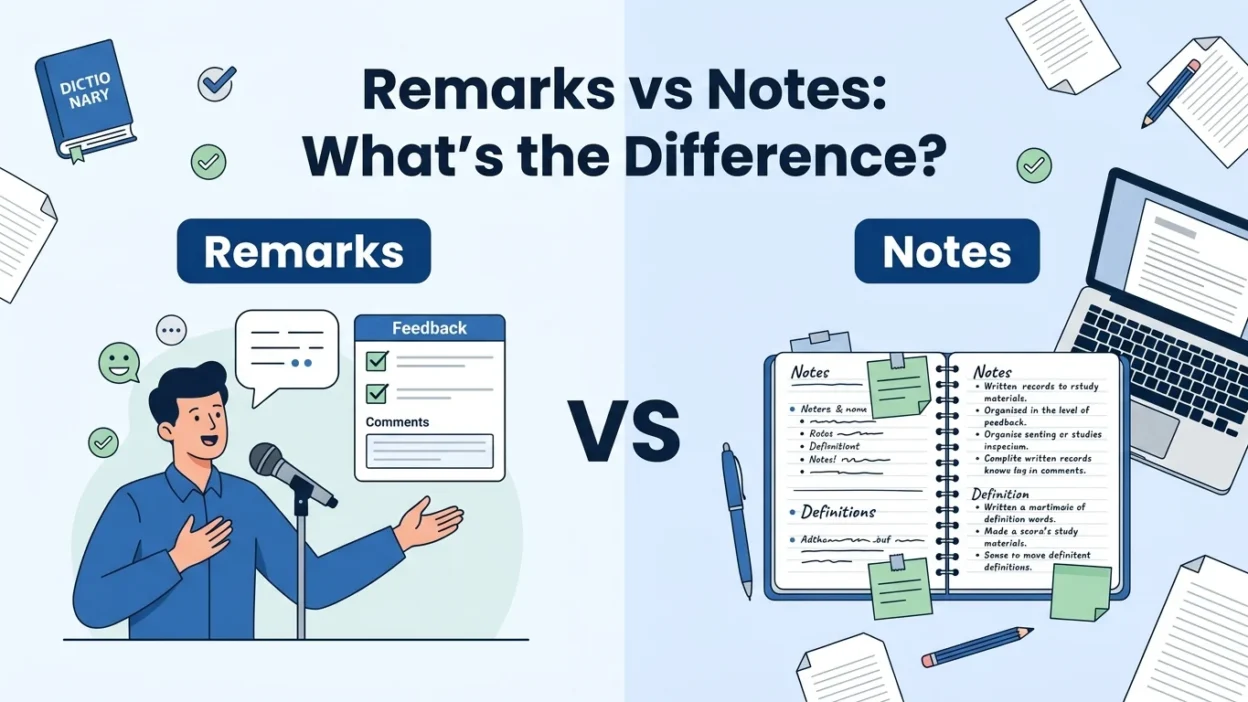
The difference between remarks and notes is based on their purpose.
- Remarks are spoken or written comments, observations, or opinions.
- Notes are brief written records used to remember or organize information.
- Remarks often express feedback or commentary.
- Notes mainly help record facts, ideas, or important details.
What Does “Remarks” Mean?
Remarks refers to comments, observations, statements, or opinions made about a person, event, topic, or situation. Remarks may be spoken or written and are often intended to explain, evaluate, or provide feedback.
You will commonly see remarks in:
- Performance evaluations
- School report cards
- Business meetings
- Public speeches
- Official reports
- Feedback forms
Examples
- The teacher wrote positive remarks on the student’s report card.
- His opening remarks welcomed everyone to the conference.
- The manager’s remarks motivated the entire team.
- Please read the examiner’s remarks carefully.
In these examples, remarks are comments rather than detailed records.
What Does “Notes” Mean?
Notes are short written records created to remember information or summarize important points. They help organize ideas and make it easier to review information later.
You will often use notes for:
- Classroom lectures
- Business meetings
- Personal reminders
- Research projects
- Interviews
- Study sessions
Examples
- I took detailed notes during the lecture.
- Her meeting notes were very organized.
- Please review your notes before the exam.
- He wrote a few notes to remember the instructions.
Unlike remarks, notes usually focus on recording information rather than expressing opinions.
Remarks vs Notes: Key Differences
Although both involve information, their purposes are different.
| Feature | Remarks | Notes |
|---|---|---|
| Meaning | Comments or observations | Brief written records |
| Purpose | Give feedback or opinions | Record information |
| Format | Spoken or written | Usually written |
| Tone | Can be personal or evaluative | Usually factual and objective |
| Common Use | Reports, speeches, evaluations | Meetings, lectures, study materials |
Understanding this distinction helps you select the correct word for each situation.
When Should You Use Remarks?
Use remarks whenever you want to provide comments, observations, or feedback.
Common situations include:
- Employee evaluations
- School report cards
- Conference speeches
- Customer feedback
- Official documents
- Presentations
Examples
- The supervisor added encouraging remarks.
- Her closing remarks thanked the audience.
- The doctor’s remarks reassured the patient.
- The reviewer included constructive remarks.
In each case, remarks communicate opinions or observations.
When Should You Use Notes?
Use notes whenever you’re recording important information for future reference.
Common situations include:
- Studying
- Meeting summaries
- Interviews
- Research
- Project planning
- Personal reminders
Examples
- She shared her lecture notes with classmates.
- I made notes during the client meeting.
- My research notes filled several pages.
- Keep your notes organized.
These examples show notes being used to preserve information.
Remarks vs Notes in Professional Writing
Business professionals use both words, but for different reasons.
Remarks
Professional remarks often include:
- Feedback
- Evaluations
- Observations
- Recommendations
Example:
- Manager’s remarks
- Auditor’s remarks
- Reviewer remarks
Notes
Professional notes often include:
- Meeting summaries
- Project updates
- Action items
- Client information
Example:
- Meeting notes
- Project notes
- Interview notes
Using the correct term makes workplace communication more precise.
Remarks vs Notes in Education
Students and teachers regularly use both terms.
Remarks
Teachers write remarks such as:
- Excellent progress.
- Needs improvement.
- Participates actively.
- Shows leadership.
Notes
Students write notes like:
- Important formulas
- Vocabulary words
- Lecture summaries
- Homework reminders
The purpose is completely different even though both contain written information.
Examples in Everyday English
Here are side-by-side examples.
Using Remarks
- The speaker’s remarks inspired everyone.
- The judge made a few final remarks.
- The teacher’s remarks were encouraging.
- Read the examiner’s remarks before making corrections.
Using Notes
- I forgot my chemistry notes.
- Please compare your notes with mine.
- She keeps detailed travel notes.
- His meeting notes were easy to understand.
Common Mistakes to Avoid
These words are often confused because both involve communication.
1. Using Remarks Instead of Notes
Incorrect:
- I studied my lecture remarks.
Correct:
- I studied my lecture notes.
Lecture information is recorded as notes.
2. Using Notes Instead of Remarks
Incorrect:
- The principal gave opening notes.
Correct:
- The principal gave opening remarks.
Speeches begin with remarks, not notes.
3. Assuming They Mean the Same Thing
Although both involve information, their purposes differ.
- Remarks communicate opinions or comments.
- Notes preserve information.
American vs British English
There is very little difference between American and British English in the use of remarks and notes.
Both varieties use:
- Remarks for comments and observations.
- Notes for written records and summaries.
Some educational systems may have different report card formats, but the meanings remain the same.
Tips for Remembering the Difference
These simple tricks can help.
- Remarks = comments.
- Notes = records.
- If someone is expressing an opinion, choose remarks.
- If someone is writing information to remember later, choose notes.
- Think of meeting notes, but opening remarks.
These memory tips make choosing the correct word much easier.
Quick Comparison Table
| Situation | Correct Word |
|---|---|
| Speech introduction | Remarks |
| Teacher feedback | Remarks |
| Employee evaluation | Remarks |
| Public comments | Remarks |
| Lecture summary | Notes |
| Meeting record | Notes |
| Study material | Notes |
| Personal reminder | Notes |
Frequently Asked Questions
What is the main difference between remarks and notes?
Remarks are comments or observations, while notes are written records used to remember important information.
Can remarks and notes be used interchangeably?
Not usually. Although both involve communication, they serve different purposes and are not interchangeable in many contexts.
Are remarks always spoken?
No. Remarks may be spoken or written. For example, report cards often contain written remarks.
Are notes always written?
In most cases, yes. Notes are usually written to help organize or remember information.
Which word should I use for meeting records?
Use notes because they summarize discussions, decisions, and action items.
What are opening remarks?
Opening remarks are introductory comments made at the beginning of a speech, meeting, or event.
Do British and American English use these words differently?
No. Both varieties of English use remarks and notes in essentially the same way.
Summary
Understanding remarks vs notes becomes much easier once you focus on their purpose. Remarks are comments, observations, or opinions that provide feedback, introduce a speech, or evaluate someone’s work. Notes, on the other hand, are short written records designed to capture facts, ideas, reminders, or summaries for future reference. While both involve communication, they serve different functions in everyday and professional English.
Choosing the correct word helps make your writing more accurate and effective. Whether you’re preparing meeting records, studying for an exam, writing a report, or giving a presentation, knowing when to use remarks and when to use notes ensures your message is clear and professional.

William Harved is a passionate language enthusiast and digital writer specializing in English spelling, grammar clarity, and common writing mistakes. As the primary author of Spelword.com, he focuses on helping readers understand confusing word pairs, correct spelling errors, and improve everyday communication.