English spelling can be confusing, especially when two words look almost identical. One of the most commonly searched grammar questions is payed vs paid. Many writers wonder whether “payed” is simply an alternative spelling of “paid” or if both words have different meanings.
If you’ve ever written a sentence like “I payed the bill” and questioned whether it was correct, you’re not alone. Understanding the difference between these two words can help you avoid common writing mistakes and improve your grammar in both professional and everyday communication.
Quick Answer
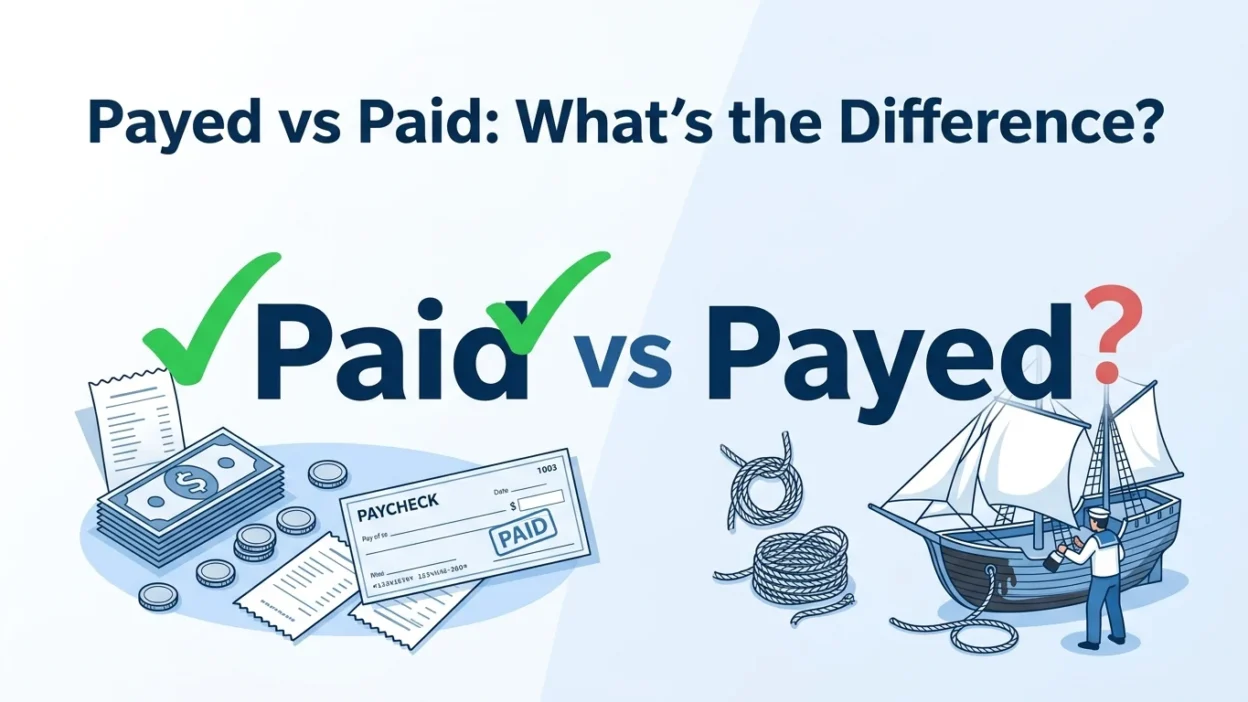
Paid is the correct past tense and past participle of the verb pay when referring to giving money, settling a debt, receiving wages, or making a payment.
Payed is a real word, but it is only used in specific nautical and maritime contexts involving ropes, ships, and sealing decks.
For most situations, paid is the word you should use.
Payed vs Paid: The Main Difference
Although both words exist in English, they are not interchangeable.
| Word | Meaning | Common Usage |
|---|---|---|
| Paid | Past tense of “pay” | Money, wages, bills, debts, purchases |
| Payed | Maritime term | Ships, ropes, and nautical applications |
Because “paid” is used in everyday language, most people rarely encounter the specialized term “payed.”
What Does “Paid” Mean?
Paid is the standard past tense and past participle form of the verb pay.
It refers to giving money for something, receiving compensation, settling obligations, or rewarding someone for services.
Examples of Paid
- I paid the electricity bill yesterday.
- She paid for dinner with her credit card.
- The company paid its employees on Friday.
- We paid attention during the presentation.
- He paid back the money he borrowed.
In each example, “paid” relates to payment, compensation, or fulfilling an obligation.
What Does “Payed” Mean?
Payed is a legitimate English word, but it has a very specialized meaning.
In maritime language, it refers to:
- Letting out rope, cable, or chain.
- Coating or sealing a ship’s deck or seams with tar, pitch, or waterproof material.
Examples of Payed
- The sailors payed out the anchor chain.
- The crew payed the deck seams before departure.
- The rope was carefully payed out from the vessel.
Unless you’re discussing ships, sailing, or nautical equipment, you probably won’t need this word.
Why Do People Confuse Payed and Paid?
The confusion comes from a common English pattern.
Most verbs form the past tense by adding -ed:
- Walk → Walked
- Jump → Jumped
- Play → Played
Because of this rule, many people assume that:
- Pay → Payed
However, pay is an irregular verb. Its correct past tense is paid, not payed.
Similar irregular verbs include:
- Say → Said
- Lay → Laid
- Make → Made
These words do not follow the standard “-ed” pattern.
Is “I Payed the Bill” Correct?
No.
When referring to money or payment, the sentence should be:
✅ I paid the bill.
❌ I payed the bill.
The second sentence is considered a spelling error in standard English.
Examples of Paid in Sentences
Here are some everyday examples showing the correct usage:
- She paid cash for the new laptop.
- They paid their taxes on time.
- I paid the subscription fee this morning.
- The customer paid immediately.
- We paid extra for faster shipping.
- He paid a compliment to his colleague.
- The investment paid off in the long run.
These examples represent the vast majority of situations where the word is needed.
Examples of Payed in Sentences
Because “payed” is uncommon, examples are usually found in maritime writing.
- The crew payed out the mooring line.
- Workers payed the hull with waterproof sealant.
- The sailors slowly payed out more rope.
Outside nautical contexts, using “payed” will almost always be incorrect.
Common Mistakes to Avoid
Mistake 1: Using Payed for Money
❌ I payed my rent yesterday.
✅ I paid my rent yesterday.
Mistake 2: Assuming All Verbs Follow the Same Pattern
Many learners believe adding “-ed” always creates the past tense.
However, English contains many irregular verbs that have unique forms.
Mistake 3: Trusting Autocorrect Too Much
Some spelling tools may not flag “payed” because it is technically a valid word.
Always consider the context before choosing the spelling.
Simple Trick to Remember the Difference
A quick memory tip is:
If money is involved, use paid.
Think of the word:
Paid = Payment
Both words are strongly connected in meaning and spelling.
Use payed only when discussing ropes, ships, or nautical activities.
Payed vs Paid in American and British English
There is no significant difference between American and British English regarding these words.
Both varieties of English follow the same rule:
- Paid is the correct past tense of pay.
- Payed is reserved for nautical meanings.
Whether you’re writing for readers in the United States, the United Kingdom, Canada, Australia, or elsewhere, the rule remains the same.
When Should You Use Paid?
Use paid when talking about:
- Bills
- Salaries
- Purchases
- Fees
- Debts
- Compensation
- Rewards
- Attention
- Respect
Examples
- The employer paid everyone on schedule.
- She paid her tuition fees.
- They paid close attention to the instructions.
- We paid our mortgage this month.
When Should You Use Payed?
Use payed only when referring to:
- Paying out rope or cable
- Releasing chains
- Waterproofing ships
- Sealing decks and hulls
Examples
- The sailors payed out the line.
- The shipwright payed the seams with tar.
These uses are uncommon in modern everyday writing.
Payed vs Paid: Side-by-Side Comparison
| Feature | Paid | Payed |
|---|---|---|
| Standard past tense of pay | Yes | No |
| Related to money | Yes | No |
| Used in everyday writing | Yes | Rarely |
| Accepted in business writing | Yes | No |
| Nautical meaning | No | Yes |
| Common in modern English | Very common | Very rare |
Why “Paid” Matters in Professional Writing
Using the correct spelling helps maintain credibility in emails, reports, academic papers, and business documents.
Mistakenly writing “payed” instead of “paid” may distract readers and create the impression of poor proofreading.
Because “paid” is one of the most frequently used irregular verb forms in English, mastering it can immediately improve your writing accuracy.
FAQs
Is paid or payed correct?
Paid is correct when referring to giving money, receiving wages, or making payments. Payed is only correct in nautical contexts.
Why is paid spelled differently from payed?
The verb pay is irregular. Instead of forming the past tense with “-ed,” it changes to paid.
Is “I payed for dinner” wrong?
Yes. The correct sentence is “I paid for dinner.”
Is payed a real word?
Yes. It is a legitimate English word used in maritime language involving ropes, cables, and ship maintenance.
Do Americans use payed?
Only in nautical contexts. For ordinary situations involving money, Americans use paid.
Do British people use payed?
Like American English, British English uses paid for payments and payed only for specialized maritime meanings.
What is the past tense of pay?
The past tense and past participle of pay is paid.
How can I remember the correct spelling?
Remember the phrase: “Payment means paid.” If money is involved, use paid.
Summary
The difference between payed vs paid is straightforward once you know the rule. Paid is the correct past tense and past participle of the verb pay when discussing money, wages, bills, debts, purchases, or compensation. It is the form used in everyday English and professional writing.
Payed, while technically a real word, belongs almost exclusively to nautical language. It refers to paying out rope, chain, or cable and to sealing parts of a ship with waterproof material. For nearly all writing situations, choosing paid will be the correct decision and help you avoid a common grammar mistake.

Dani Morrison is a dedicated language writer and spelling expert at Spelword.com, where she focuses on helping readers understand common English spelling mistakes and confusing word pairs. With a passion for clear communication, Dani creates easy-to-follow guides that simplify complex grammar and spelling rules for everyday use.