Have you ever stopped while writing and wondered whether indecisive or undecisive is the correct word? You’re not alone. These two terms look very similar, and many English learners and even native speakers mistakenly assume they can be used interchangeably. However, only one of them is considered standard English.
In this guide, you’ll learn the difference between indecisive vs undecisive, discover which word dictionaries recognize, see real life examples, avoid common grammar mistakes, and gain confidence in using the correct term in both writing and conversation.
Quick Answer
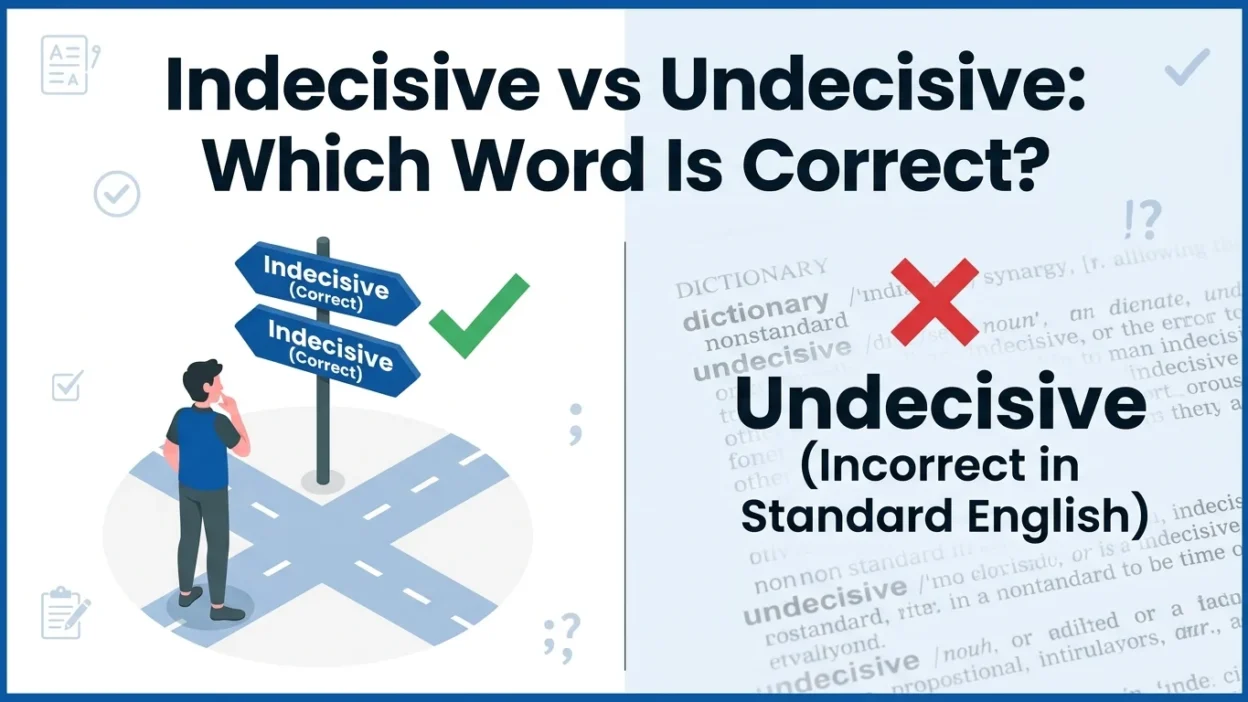
The correct word is indecisive.
- Indecisive is the standard English adjective that describes someone who has difficulty making decisions.
- Undecisive is generally considered nonstandard or incorrect in modern English and should be avoided in formal and everyday writing.
Examples:
- She is indecisive when choosing a restaurant. ✅
- He is undecisive about the plan. ❌ (Use indecisive instead.)
What Does “Indecisive” Mean?
Indecisive is an adjective used to describe a person who struggles to make decisions or frequently changes their mind. It can also describe actions, situations, or outcomes that do not clearly settle an issue.
Examples
- Maria is indecisive when buying new clothes.
- The manager remained indecisive throughout the meeting.
- His indecisive nature often delays important projects.
- The election produced an indecisive result.
In every example, indecisive refers to uncertainty or an inability to make a firm choice.
What Does “Undecisive” Mean?
Technically, undecisive has appeared occasionally in historical writing, but it is not accepted as standard English today. Most modern dictionaries either do not include it or label it as rare or incorrect.
In contemporary English, you should use indecisive instead.
Incorrect Examples
- She is undecisive about her career.
- The coach seemed undecisive before the game.
Correct Versions
- She is indecisive about her career.
- The coach seemed indecisive before the game.
Using indecisive will make your writing sound natural and grammatically correct.
Indecisive vs Undecisive: Comparison Table
| Feature | Indecisive | Undecisive |
|---|---|---|
| Part of Speech | Adjective | Nonstandard adjective |
| Standard English | Yes | No |
| Meaning | Unable to make decisions | Rare and generally considered incorrect |
| Dictionary Recognition | Widely accepted | Rarely recognized |
| Recommended Usage | Always use | Avoid in modern English |
Why Is “Indecisive” Correct?
The adjective indecisive comes from the word decide, with the prefix in-, meaning “not.”
English has developed indecisive as the accepted form over many years. Although the prefix un- often creates opposites, English does not normally use undecisive.
Just because a word seems logical doesn’t mean it is accepted by standard grammar.
Examples of “Indecisive” in Everyday Sentences
Here are common examples you’ll hear or read.
- My brother is indecisive about which university to attend.
- She became indecisive after hearing everyone’s opinions.
- His indecisive behavior frustrated the entire team.
- The customer remained indecisive between two phones.
- I can be indecisive when ordering food.
These examples demonstrate how naturally indecisive fits into everyday English.
Common Mistakes to Avoid
Many writers accidentally choose the wrong word because both appear logical.
Mistake 1: Using “Undecisive”
❌ She is undecisive.
✅ She is indecisive.
Mistake 2: Assuming Both Words Are Correct
Some people believe both forms are acceptable.
This is incorrect.
Only indecisive is considered standard English.
Mistake 3: Using “Undecisive” in Professional Writing
Avoid using undecisive in:
- Academic essays
- Business emails
- Reports
- Job applications
- Professional presentations
Editors and grammar checkers will typically flag it as incorrect.
How to Remember the Correct Word
A simple memory trick is:
Think of these familiar words:
- Incomplete
- Inaccurate
- Invisible
- Indirect
- Indecisive
Notice how many adjectives begin with in- rather than un-.
If you’re talking about someone who cannot make a decision, always choose indecisive.
Similar Words You May Confuse
Several English words have similar meanings but slightly different uses.
| Word | Meaning |
|---|---|
| Indecisive | Unable to make decisions |
| Hesitant | Slow because of uncertainty |
| Uncertain | Not sure about something |
| Doubtful | Feeling unsure |
| Wavering | Frequently changing opinions |
Each has its own nuance, but indecisive specifically refers to difficulty making decisions.
American vs British English
There is no spelling difference between American and British English.
Both varieties use:
- Indecisive ✅
Neither variety considers undecisive to be standard usage.
Whether you’re writing for readers in the United States, the United Kingdom, Canada, Australia, or elsewhere, indecisive is the correct choice.
Why Do People Say “Undecisive”?
The mistake happens because English often uses the prefix un- to create opposites.
For example:
- Happy → Unhappy
- Clear → Unclear
- Fair → Unfair
People naturally assume the opposite of decisive should be undecisive.
However, English follows historical patterns rather than strict rules in every case, so the accepted opposite is indecisive.
Practice Sentences
Choose the correct word.
- She was ______ about accepting the new job.
Answer: indecisive
- His ______ personality made planning difficult.
Answer: indecisive
- The customer remained ______ for several minutes.
Answer: indecisive
- The committee seemed ______ during the discussion.
Answer: indecisive
- Which spelling is correct?
Answer: indecisive
Frequently Asked Questions (FAQs)
Is undecisive a real word?
It has appeared occasionally in historical texts, but it is not accepted as standard modern English. Use indecisive instead.
Which is correct: indecisive or undecisive?
Indecisive is the correct and widely accepted word.
Why do people use undecisive?
People often assume the opposite of decisive should use the prefix un-, but English standard usage prefers indecisive.
Can I use undecisive in academic writing?
No. Academic and professional writing should always use indecisive.
Is indecisive a negative word?
Not always. It simply describes someone who finds it difficult to make decisions, although it may sometimes imply hesitation.
Does British English use undecisive?
No. Both British and American English recognize indecisive as the correct form.
What is the opposite of decisive?
The standard opposite is indecisive.
Summary
Understanding indecisive vs undecisive is straightforward once you know which word standard English accepts. Indecisive is the correct adjective used to describe someone who has difficulty making decisions or situations that lack a clear outcome. It is recognized by dictionaries, style guides, and grammar experts around the world.
Although undecisive may seem logical because of the prefix un, it is considered nonstandard in modern English and should generally be avoided. Choosing indecisive ensures your writing remains accurate, professional, and easy for readers to understand.

William Harved is a passionate language enthusiast and digital writer specializing in English spelling, grammar clarity, and common writing mistakes. As the primary author of Spelword.com, he focuses on helping readers understand confusing word pairs, correct spelling errors, and improve everyday communication.