English has many words with similar meanings, but choosing the right one can make your writing more precise and natural. One pair that often causes confusion is abstain vs refrain. Both words involve deliberately choosing not to do something, yet they are not always interchangeable.
If you’ve ever wondered whether you should abstain or refrain from an action, you’re not alone. While the two words share a similar idea of self-control or avoidance, they are used in different contexts and carry slightly different meanings. This guide explains the differences, provides examples, highlights common mistakes, and helps you know exactly when to use each word.
Quick Answer
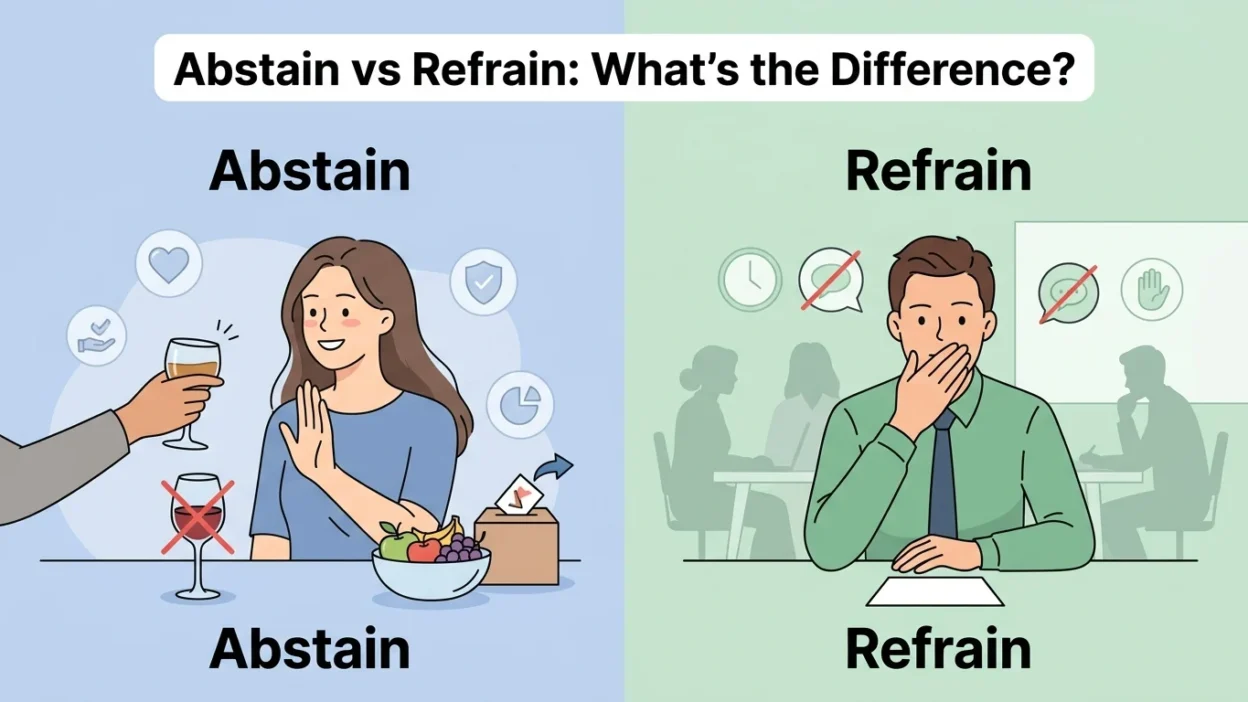
Abstain means to intentionally avoid or refuse to do something, especially for moral, religious, legal, or official reasons.
Refrain means to deliberately stop yourself from doing or saying something, often because it is wise, polite, or appropriate.
- ✅ She decided to abstain from drinking alcohol.
- ✅ Please refrain from talking during the presentation.
A simple way to remember the difference is:
- Abstain = avoid by choice or principle
- Refrain = hold yourself back from an action
What Does “Abstain” Mean?
Abstain is a verb that means to voluntarily avoid doing something. It often suggests self-discipline, personal choice, or following a rule or principle.
The word is commonly used in discussions about health, religion, politics, law, and voting.
Examples of “Abstain”
- Many people abstain from alcohol for health reasons.
- He decided to abstain from voting.
- During the festival, participants abstain from eating meat.
- Doctors advised her to abstain from smoking.
- Some religions encourage followers to abstain from certain foods.
In each example, the person intentionally avoids an action.
What Does “Refrain” Mean?
Refrain is also a verb. It means to consciously hold yourself back from doing or saying something.
It often appears in formal instructions, polite requests, workplace communication, and everyday conversation.
Examples of “Refrain”
- Please refrain from using your phone during the meeting.
- She managed to refrain from laughing.
- We ask visitors to refrain from feeding the animals.
- He struggled to refrain from commenting.
- Kindly refrain from making unnecessary noise.
Here, refrain focuses on exercising self-control in a specific situation.
Abstain vs Refrain: Key Differences
| Feature | Abstain | Refrain |
|---|---|---|
| Part of Speech | Verb | Verb |
| Main Meaning | Voluntarily avoid something | Hold yourself back from doing something |
| Common Contexts | Health, religion, voting, ethics | Behavior, speech, etiquette, instructions |
| Focus | Long-term or principled avoidance | Immediate self-control |
| Example | Abstain from alcohol | Refrain from speaking |
Although both involve avoiding an action, the reason and context often differ.
When Should You Use “Abstain”?
Use abstain when someone deliberately avoids an activity because of personal beliefs, rules, health, religion, ethics, or official responsibilities.
Common expressions include:
- Abstain from alcohol
- Abstain from smoking
- Abstain from voting
- Abstain from meat
- Abstain from gambling
Example Sentences
- She chose to abstain from caffeine during pregnancy.
- Several members decided to abstain from the vote.
- He continues to abstain from unhealthy foods.
- Athletes may abstain from alcohol before competitions.
- They agreed to abstain from discussing confidential matters.
When Should You Use “Refrain”?
Use refrain when asking someone not to do or say something or when describing self-restraint in a particular moment.
Common expressions include:
- Refrain from speaking
- Refrain from commenting
- Refrain from shouting
- Refrain from interrupting
- Refrain from touching
Example Sentences
- Please refrain from taking photographs.
- He had to refrain from expressing his opinion.
- Visitors should refrain from entering restricted areas.
- She tried to refrain from complaining.
- We encourage everyone to refrain from littering.
Side-by-Side Examples
These examples show the difference more clearly.
- He decided to abstain from alcohol for a month.
- He tried to refrain from ordering another drink.
- She abstained from voting.
- She refrained from discussing politics.
- Many people abstain from meat during religious holidays.
- Please refrain from eating inside the library.
Notice that abstain usually refers to avoiding something entirely or over a period of time, while refrain often refers to controlling yourself in a specific situation.
Common Mistakes to Avoid
These mistakes frequently appear in English writing.
Incorrect: Please abstain from talking during the movie.
⚠️ Better: Please refrain from talking during the movie.
This is a behavioral request, so refrain is more natural.
Incorrect: He refrained from alcohol for ten years.
⚠️ Better: He abstained from alcohol for ten years.
Long-term avoidance fits abstain better.
Incorrect: She abstained from laughing.
⚠️ Better: She refrained from laughing.
Holding back laughter in the moment calls for refrain.
Easy Memory Trick
Here’s a simple way to remember the difference.
Abstain = Avoid
Think of abstain whenever someone chooses not to participate because of beliefs, health, rules, or long-term commitment.
Refrain = Resist
Think of refrain whenever someone resists doing or saying something in the moment.
A simple formula is:
- Abstain = avoid by principle
- Refrain = stop yourself right now
Common Phrases with “Abstain”
You’ll often hear these expressions.
- Abstain from alcohol
- Abstain from smoking
- Abstain from voting
- Abstain from eating meat
- Abstain from unhealthy habits
Example
Many participants abstained from sugary drinks throughout the challenge.
Common Phrases with “Refrain”
These are common in formal English.
- Refrain from speaking
- Refrain from shouting
- Refrain from commenting
- Refrain from interrupting
- Refrain from touching
Example
Passengers should refrain from blocking emergency exits.
American vs British English
There is no significant difference between American and British English in the meanings or usage of abstain and refrain.
Both varieties use:
- Abstain for voluntary avoidance based on principle or choice.
- Refrain for self-control or polite instructions.
Examples:
- American English: Please refrain from smoking.
- British English: Please refrain from smoking.
- American English: Many people abstain from alcohol.
- British English: Many people abstain from alcohol.
Only pronunciation may differ slightly between accents.
Practice Sentences
Choose the correct word.
- Several members decided to ______ from voting.
- ✅ Abstain
- Please ______ from making loud noises.
- ✅ Refrain
- He chose to ______ from smoking.
- ✅ Abstain
- Visitors should ______ from feeding the animals.
- ✅ Refrain
- She decided to ______ from eating sweets during Lent.
- ✅ Abstain
FAQs
What is the difference between abstain and refrain?
Abstain means voluntarily avoiding something, often for moral, religious, health, or official reasons. Refrain means holding yourself back from doing or saying something, usually in a specific situation.
Can abstain and refrain be used interchangeably?
Sometimes they can, but not always. Abstain is better for long-term or principled avoidance, while refrain is preferred for temporary self-control or polite instructions.
Which word is used for voting?
Abstain is the correct choice when someone chooses not to vote.
Why do signs often say “Please refrain from”?
Because refrain is commonly used in polite requests asking people not to perform a specific action.
Is abstain more formal than refrain?
Both words are formal, but abstain is especially common in legal, religious, political, and health-related contexts.
Can you abstain from speaking?
Although it is grammatically possible, refrain from speaking is much more natural in everyday English.
Is there a difference between American and British English?
No. Both American and British English use abstain and refrain in the same way.
Summary
Understanding abstain vs refrain is easier when you focus on the reason behind avoiding an action. Abstain usually describes voluntarily avoiding something because of principles, health, religion, ethics, or official responsibilities. Refrain, on the other hand, emphasizes self control in a particular situation, especially when someone chooses not to speak, act, or respond.
Although the two words are related, they are not always interchangeable. Choosing abstain for long term or principled avoidance and refrain for immediate self restraint will make your English more precise, natural, and effective in both writing and conversation.

William Harved is a passionate language enthusiast and digital writer specializing in English spelling, grammar clarity, and common writing mistakes. As the primary author of Spelword.com, he focuses on helping readers understand confusing word pairs, correct spelling errors, and improve everyday communication.