If you’ve ever seen the phrases per se and per say, you may have wondered whether they mean the same thing or if one of them is simply a spelling mistake. This confusion is incredibly common because both phrases sound identical when spoken. However, only one of them is considered correct in standard English.
Understanding the difference between per se vs per say can improve your writing, help you avoid embarrassing mistakes, and ensure your message is clear. Whether you’re writing an email, an essay, a blog post, or a social media update, knowing which form to use will make your writing more polished and professional.
Quick Answer
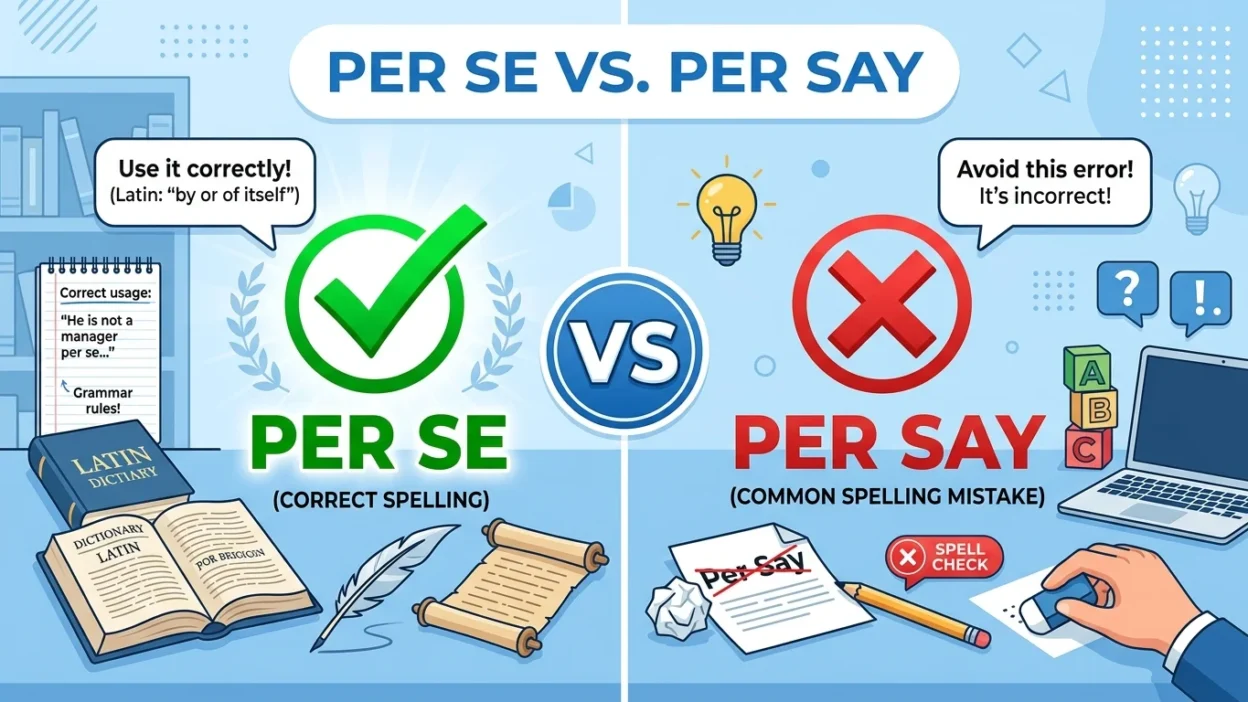
- ✅ Per se is the correct expression.
- ❌ Per say is a common misspelling of per se.
- Per se is a Latin phrase meaning by itself, intrinsically, or in and of itself.
Example
- Correct: The movie wasn’t bad per se, but it was too long.
- Incorrect: The movie wasn’t bad per say, but it was too long.
If you’re unsure which version to use, remember that per se is always correct in standard English.
What Does “Per Se” Mean?
Per se is a Latin phrase that has been adopted into English. It literally means “by itself” or “in itself.”
Writers and speakers use per se when they want to focus on the essential nature of something rather than its related circumstances or effects.
Examples of Per Se
- The idea isn’t wrong per se, but it needs improvement.
- Money isn’t evil per se.
- The product isn’t expensive per se; it’s simply higher quality.
- Working remotely isn’t difficult per se, but it requires discipline.
In each example, the speaker is making a distinction between something’s inherent nature and other factors surrounding it.
What Does “Per Say” Mean?
The phrase per say has no recognized meaning in standard English.
It is simply a misspelling of per se that occurs because the two expressions sound the same when spoken aloud.
Why People Write “Per Say”
Many people learn the expression through conversation rather than reading. Since they hear the pronunciation before seeing the spelling, they naturally assume it is written as per say.
This type of error is sometimes called an eggcorn—a mistake that sounds correct but is actually based on incorrect spelling.
Example
❌ The project wasn’t successful per say.
✅ The project wasn’t successful per se.
Per Se vs Per Say: Side-by-Side Comparison
| Per Se | Per Say |
|---|---|
| Correct spelling | InCorrect spelling |
| Latin phrase | Misspelling |
| Means “by itself” or “in itself” | Has no standard meaning |
| Accepted in formal writing | Considered an error |
| Found in dictionaries | Not recognized as correct usage |
The comparison is straightforward: per se is always the correct form.
How to Use Per Se Correctly
The phrase per se is typically used to clarify that something is not inherently good, bad, right, or wrong.
Common Sentence Pattern
Many sentences follow this structure:
“Not X per se, but…”
Examples
- The issue isn’t the cost per se; it’s the lack of value.
- The problem isn’t technology per se.
- The criticism wasn’t directed at him per se.
- The food wasn’t unhealthy per se.
This construction helps create a subtle distinction in meaning.
Examples of Per Se in Everyday Writing
Business Writing
- The strategy isn’t flawed per se, but it may need adjustments.
- Remote work isn’t the issue per se.
Academic Writing
- The theory isn’t incorrect per se.
- The method isn’t ineffective per se, though other approaches may work better.
Casual Conversation
- I’m not tired per se; I just need a break.
- The restaurant wasn’t bad per se, but I’ve had better meals.
Professional Communication
- The proposal isn’t unrealistic per se.
- The timeline isn’t impossible per se, but it is ambitious.
Common Mistakes with Per Se and Per Say
Since the phrases sound identical, mistakes happen frequently.
Mistake 1: Writing Per Say
❌ The plan wasn’t risky per say.
✅ The plan wasn’t risky per se.
This is the most common error.
Mistake 2: Using Per Se Unnecessarily
Some writers use per se simply to sound formal.
❌ I went to the store per se.
✅ I went to the store.
The phrase should only be used when making a distinction about something’s inherent nature.
Mistake 3: Confusing Meaning
❌ The teacher explained the lesson per se.
✅ The teacher explained the lesson clearly.
Not every sentence benefits from adding per se.
Where Did Per Se Come From?
The phrase comes directly from Latin.
In Latin, per se means:
- By itself
- In itself
- Through itself
Over time, English adopted the phrase because it expresses a concept that can be difficult to convey as precisely with a single English expression.
Today, it remains common in:
- Legal writing
- Academic writing
- Journalism
- Business communication
- Everyday conversation
Is Per Se Formal or Informal?
The phrase works in both formal and informal settings.
Formal Examples
- The evidence isn’t conclusive per se.
- The policy isn’t discriminatory per se.
Informal Examples
- I’m not upset per se.
- The movie wasn’t boring per se.
Although it originates from Latin, most English speakers recognize and understand the expression.
American vs British English
The phrase per se is used in both American and British English.
Importantly, the spelling remains exactly the same in both varieties.
American English
- The policy isn’t unfair per se.
- The product isn’t defective per se.
British English
- The policy isn’t unfair per se.
- The product isn’t defective per se.
There is no regional spelling variation.
Why Do So Many People Write “Per Say”?
The mistake occurs because English contains many words that are learned through speech before reading.
When people hear:
“per say”
they naturally assume the second word is say because it matches the pronunciation.
However, the actual spelling comes from Latin:
per se
This makes it similar to other commonly misspelled expressions that sound different from how they are written.
Tips for Remembering the Correct Spelling
A simple memory trick can help.
Think of “Se” as “Self”
Since per se means by itself, connect se with self.
- Per se = by itself
- Per se = in itself
This mental association makes the correct spelling easier to remember.
Remember It’s Latin
If you see per say, ask yourself:
“Does this look like an English phrase?”
Since the expression comes from Latin, the spelling per se makes more sense.
Frequently Asked Questions
Is per se or per say correct?
Per se is correct. Per say is a common misspelling.
What does per se mean?
It means by itself, in itself, or intrinsically.
Is per say a real phrase?
No. It is generally considered a spelling mistake of per se.
Why do people write per say?
Because per se and per say sound identical when spoken.
Can I use per se in formal writing?
Yes. It is widely accepted in academic, legal, business, and professional writing.
Is per se Latin?
Yes. The phrase comes directly from Latin.
Do British and American English spell it differently?
No. Both use the spelling per se.
When should I use per se?
Use it when referring to something’s essential nature rather than surrounding circumstances.
Summary
Understanding per se vs per say is simple once you know the origin of the phrase. Per se is the correct spelling and means by itself, in itself, or intrinsically. It is a Latin expression that has become a standard part of English and is commonly used in both formal and informal writing.
Per say, on the other hand, is a misspelling that results from the phrase’s pronunciation. Although many people write it this way, it is not considered correct English. By remembering that the phrase comes from Latin and means by itself, you’ll be able to use per se confidently and accurately in your writing.

William Harved is a passionate language enthusiast and digital writer specializing in English spelling, grammar clarity, and common writing mistakes. As the primary author of Spelword.com, he focuses on helping readers understand confusing word pairs, correct spelling errors, and improve everyday communication.