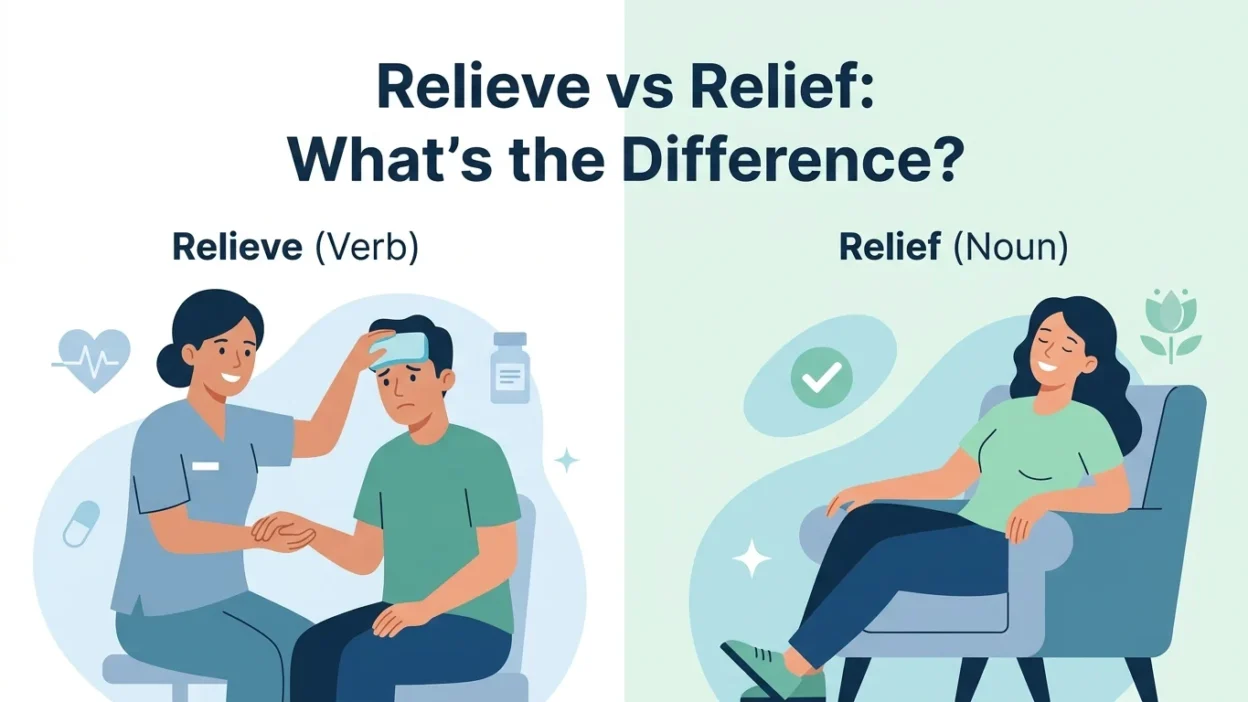
Many English learners and even native speakers sometimes confuse relieve vs relief because the words are closely related. They both deal with making pain, stress, or discomfort better, but they belong to different parts of speech and cannot be used interchangeably.
Understanding the difference between relieve and relief will help you write and speak more naturally. In this guide, you’ll learn their meanings, correct usage, common mistakes, examples, and simple tips to remember the difference with confidence.
Quick Answer
Relieve is a verb that means to reduce pain, stress, or difficulty.
Relief is a noun that refers to the feeling of comfort or the reduction of pain, stress, or difficulty.
- ✅ The medicine will relieve your headache.
- ✅ I felt great relief after hearing the good news.
The easiest way to remember the difference is this:
- Relieve = an action
- Relief = the result or feeling
What Does “Relieve” Mean?
Relieve is a verb. It describes the act of making someone feel better by reducing pain, stress, pressure, worry, or discomfort.
It can also mean replacing someone in a duty or responsibility.
Examples of “Relieve”
- The medicine helped relieve her back pain.
- A short vacation can relieve stress.
- Drinking water may relieve dehydration.
- The manager came to relieve the security guard.
- Deep breathing exercises can relieve anxiety.
In every example, relieve describes an action.
What Does “Relief” Mean?
Relief is a noun. It refers to the comfort or improvement experienced after pain, stress, fear, or difficulty decreases.
It may also describe aid provided during emergencies or financial assistance.
Examples of “Relief”
- She felt immediate relief after the treatment.
- The rain brought relief from the heat.
- Everyone sighed with relief when the child was found.
- Disaster relief arrived quickly after the flood.
- The massage provided welcome relief from muscle pain.
In each sentence, relief names the feeling or result rather than the action.
Relieve vs Relief: Key Differences
| Feature | Relieve | Relief |
|---|---|---|
| Part of Speech | Verb | Noun |
| Meaning | To reduce pain or stress | The comfort after pain or stress is reduced |
| Describes | An action | A feeling, condition, or result |
| Example | The medicine will relieve pain. | The medicine gave me relief. |
| Question Answered | What happens? | What is experienced? |
When Should You Use “Relieve”?
Use relieve whenever you are talking about performing an action that makes a situation better.
Common situations include:
- Relieve pain
- Relieve stress
- Relieve pressure
- Relieve anxiety
- Relieve symptoms
- Relieve discomfort
- Relieve tension
Example Sentences
- This cream helps relieve itching.
- Music can relieve emotional stress.
- Stretching may relieve muscle stiffness.
- The doctor prescribed medicine to relieve the symptoms.
- Volunteers worked to relieve suffering after the disaster.
When Should You Use “Relief”?
Use relief when referring to the comfort, improvement, or assistance itself.
Common expressions include:
- Feel relief
- A sense of relief
- Pain relief
- Stress relief
- Tax relief
- Relief efforts
- Relief fund
Example Sentences
- I felt enormous relief after finishing the exam.
- The medicine provided quick relief.
- The community received disaster relief.
- Exercise offers natural stress relief.
- Everyone expressed relief after the rescue.
Side-by-Side Examples
Seeing both words together makes the difference easier to understand.
- The medication will relieve your pain.
- The medication gave me relief.
- Talking to a friend can relieve stress.
- Talking to a friend brings relief.
- The doctor tried to relieve his symptoms.
- The patient experienced immediate relief.
Notice that relieve always describes what happens, while relief describes what someone experiences.
Common Mistakes to Avoid
These mistakes are common among English learners.
Incorrect: I need some relieve.
✅ Correct: I need some relief.
Because relief is the noun.
Incorrect: This medicine reliefs pain.
✅ Correct: This medicine relieves pain.
Here, relieve is the verb.
Incorrect: She felt relieve after the exam.
✅ Correct: She felt relief after the exam.
Feel is followed by the noun relief.
Incorrect: The massage gave me relieve.
✅ Correct: The massage gave me relief.
Again, the noun is required after “gave me.”
Simple Memory Trick
A simple trick can help you remember forever.
- Relieve ends with -eve, reminding you of doing something.
- Relief ends with -ief, reminding you of the feeling you receive afterward.
Think of it this way:
Action → Relieve
Result → Relief
Whenever you see someone making pain or stress smaller, use relieve.
Whenever you describe the comfort that follows, use relief.
Common Phrases Using Relieve
These are frequently used in everyday English.
- Relieve pain
- Relieve stress
- Relieve pressure
- Relieve anxiety
- Relieve symptoms
- Relieve suffering
- Relieve someone of responsibility
Example
The nurse helped relieve the patient’s discomfort.
Common Phrases Using Relief
You’ll often hear these expressions in conversations and writing.
- Pain relief
- Stress relief
- A sigh of relief
- Financial relief
- Tax relief
- Disaster relief
- Relief efforts
- Relief fund
Example
The charity organized relief efforts after the earthquake.
American vs British English
There is no difference between American and British English in the meanings or spellings of relieve and relief.
Both varieties use these words in exactly the same way.
Examples:
- American English: This medicine helps relieve pain.
- British English: This medicine helps relieve pain.
- American English: She felt great relief.
- British English: She felt great relief.
The pronunciation may vary slightly depending on accent, but the spelling, grammar, and usage remain identical.
Practice Sentences
Choose the correct word.
- The doctor prescribed medicine to ______ the pain.
- ✅ Relieve
- We all felt ______ after hearing the good news.
- ✅ Relief
- A warm bath can ______ sore muscles.
- ✅ Relieve
- She breathed a sigh of ______.
- ✅ Relief
- Volunteers worked to ______ the suffering of survivors.
- ✅ Relieve
FAQs
Is relieve a verb or noun?
Relieve is a verb. It means to reduce pain, stress, pressure, or discomfort.
Is relief a noun?
Yes. Relief is a noun that refers to comfort, improvement, or the reduction of pain or stress.
Can I say “I need relieve”?
No. The correct expression is “I need relief” because relief is the noun.
What is the difference between relieve and relief?
Relieve is the action of reducing pain or stress, while relief is the feeling or result after that action.
Is pain relief correct?
Yes. Pain relief” is a common and grammatically correct phrase referring to reduced pain or products that help reduce pain.
Can relieve be used for emotions?
Yes. You can relieve stress, anxiety, fear, worry, or emotional pressure.
Why do people confuse relieve and relief?
They come from the same word family and have similar meanings, but one is a verb and the other is a noun.
Summary
Understanding relieve vs relief is simple once you remember their grammatical roles. Relieve is always the verb that describes reducing pain, stress, pressure, or discomfort. Relief is the noun that refers to the comfort, improvement, or positive feeling that follows. Although they are closely connected in meaning, they cannot replace one another in a sentence.
Using these words correctly will make your English sound more natural and accurate. Whenever you describe an action, choose relieve. Whenever you describe the result or feeling after that action, choose relief. Keeping this distinction in mind will help you avoid common mistakes in both speaking and writing.

Dani Morrison is a dedicated language writer and spelling expert at Spelword.com, where she focuses on helping readers understand common English spelling mistakes and confusing word pairs. With a passion for clear communication, Dani creates easy-to-follow guides that simplify complex grammar and spelling rules for everyday use.