
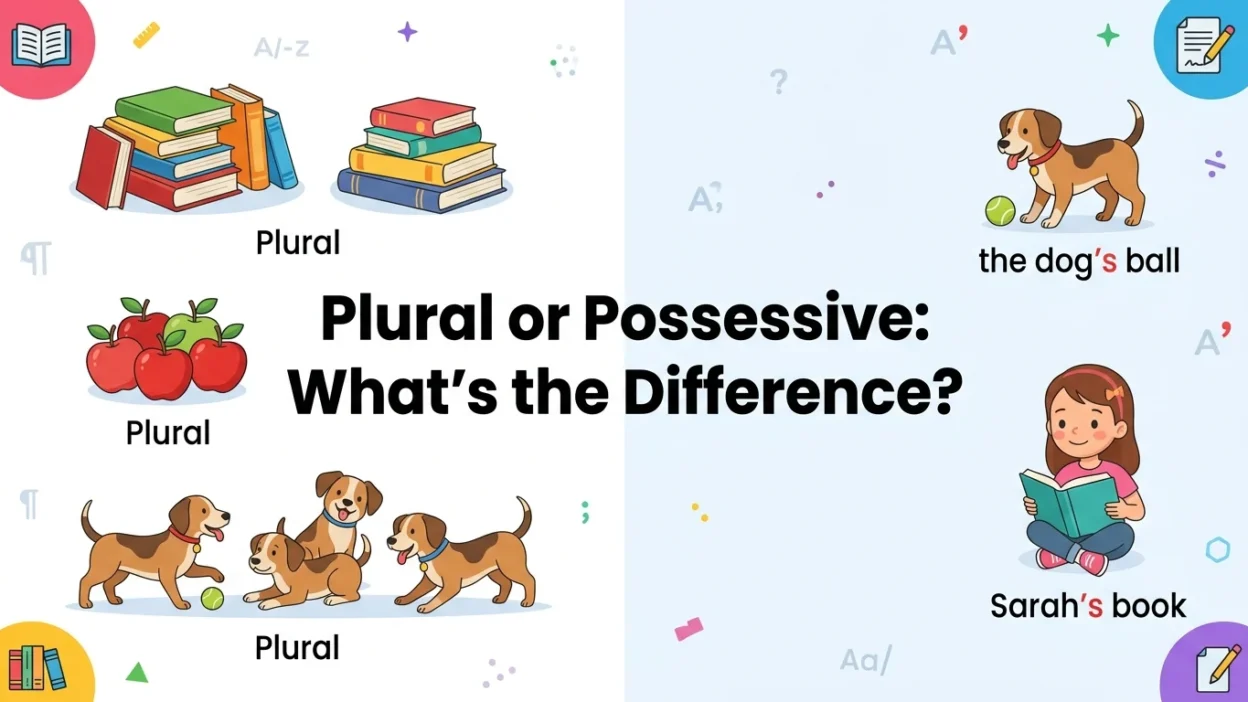
Have you ever wondered whether a word needs an s or an apostrophe + s? If so, you’re not alone. One of the most common grammar mistakes in English is confusing plural or possessive nouns. Since both often end with s, it’s easy to mix them up, especially when writing emails, essays, or social media posts.
The good news is that understanding the difference between plural and possessive forms is much simpler than it seems. Once you know a few basic rules, you’ll be able to write with greater confidence and avoid common punctuation mistakes. This guide explains everything in plain English with examples, comparison tables, and helpful tips.
Quick Answer
A plural noun refers to more than one person, place, thing, or idea.
A possessive noun shows ownership or a relationship between one noun and another, usually by adding an apostrophe.
Examples:
- Dogs are friendly. (Plural: more than one dog.)
- The dog’s toy is missing. (Possessive: the toy belongs to the dog.)
- The dogs’ toys are outside. (Plural possessive: the toys belong to multiple dogs.)
The key difference is simple:
- Plural = Quantity
- Possessive = Ownership
What Is a Plural Noun?
A plural noun names more than one person, place, animal, object, or idea. In most cases, you make a noun plural by adding -s or -es.
Examples of Plural Nouns
- One cat → Two cats
- One book → Three books
- One teacher → Five teachers
- One child → Two children
- One mouse → Two mice
Notice that plural nouns simply indicate there is more than one. They do not show ownership.
Example Sentences
- The students arrived early.
- Several birds flew across the sky.
- The cars are parked outside.
- My friends enjoy traveling.
- The flowers look beautiful.
What Is a Possessive Noun?
A possessive noun shows that someone or something owns or is connected to another noun.
Most singular nouns become possessive by adding ‘s.
Examples
- The girl’s backpack
- The teacher’s desk
- The cat’s tail
- The doctor’s office
- The company’s policy
In each example, the apostrophe shows ownership or association.
Example Sentences
- John’s bicycle is new.
- The baby’s blanket is soft.
- My sister’s room is clean.
- The author’s book became a bestseller.
- The dog’s collar is blue.
Plural vs Possessive: Comparison Table
| Feature | Plural | Possessive |
|---|---|---|
| Purpose | Shows more than one | Shows ownership or relationship |
| Apostrophe | No | Yes |
| Example | Books | Book’s |
| Meaning | Multiple books | One book belonging to someone |
| Example Sentence | The books are on the shelf. | The book’s cover is torn. |
How to Form Plural Nouns
Most English nouns become plural by following these simple rules.
Add -s
- Dog → Dogs
- Chair → Chairs
- Apple → Apples
Add -es
For nouns ending in s, x, z, ch, or sh.
Examples:
- Box → Boxes
- Dish → Dishes
- Bus → Buses
- Watch → Watches
Irregular Plurals
Some nouns change completely.
Examples:
- Child → Children
- Person → People
- Foot → Feet
- Tooth → Teeth
- Goose → Geese
These irregular forms do not follow the usual -s rule.
How to Form Possessive Nouns
Possessive nouns depend on whether the owner is singular or plural.
Singular Possessive
Add ‘s
Examples:
- Sarah’s laptop
- The cat’s food
- James’s jacket
- The baby’s toy
Plural Possessive
If the plural noun already ends in s, add only an apostrophe.
Examples:
- The teachers’ lounge
- The students’ books
- The players’ uniforms
- The dogs’ owner
Irregular Plural Possessive
If the plural noun does not end in s, add ‘s.
Examples:
- Children’s games
- Men’s clothing
- Women’s shoes
- People’s opinions
Common Mistakes with Plural and Possessive
Many writers accidentally misuse apostrophes.
Incorrect
- Apple’s for sale.
Correct
- Apples for sale.
Why?
There is no ownership. The word simply means more than one apple.
Incorrect
- The dogs bone.
Correct
- The dog’s bone.
The bone belongs to the dog.
Incorrect
- Teachers lounge
Correct
- Teachers’ lounge
The lounge belongs to multiple teachers.
Incorrect
- Childrens books
Correct
- Children’s books
The books belong to children.
Easy Tips to Remember the Difference
Here are a few simple tricks.
- If you mean more than one, use the plural form.
- If you mean belongs to someone or something, use the possessive form.
- Never use an apostrophe just because a word ends with s.
- Ask yourself, “Who owns this?”
- If nobody owns it, you probably need a plural noun instead.
Practice Examples
See if you can identify whether each word is plural or possessive.
| Sentence | Correct Form | Explanation |
|---|---|---|
| The boys are playing. | Boys | More than one boy |
| The boy’s bike is red. | Boy’s | One boy owns the bike |
| The boys’ coach arrived. | Boys’ | Multiple boys share the coach |
| The children are laughing. | Children | Plural noun |
| The children’s playground is new. | Children’s | Playground belongs to children |
When Can a Word Be Both Plural and Possessive?
Some words can be both plural and possessive depending on punctuation.
Consider these examples:
- Cats = More than one cat.
- Cat’s = Belonging to one cat.
- Cats’ = Belonging to multiple cats.
Another example:
- Teachers = More than one teacher.
- Teacher’s = One teacher owns something.
- Teachers’ = Multiple teachers own something.
This is why apostrophes are so important in English writing.
American vs British English
There is very little difference between American English and British English when it comes to plural and possessive nouns.
Both varieties follow the same grammar rules for apostrophes and plural forms.
For example:
American English
- The student’s notebook
- The students’ classroom
British English
- The student’s notebook
- The students’ classroom
The only occasional variation involves certain style guides for names ending in s, such as James’s versus James’. Both styles are accepted depending on the publishing guide being followed.
Why Is This Grammar Rule Important?
Using the correct plural or possessive form improves clarity and professionalism.
Incorrect apostrophes can:
- Change the meaning of a sentence.
- Confuse readers.
- Make formal writing appear careless.
- Reduce credibility in academic or business communication.
Learning these simple rules helps you communicate more accurately in every type of writing.
Frequently Asked Questions
What is the difference between plural and possessive?
A plural noun shows more than one person or thing, while a possessive noun shows ownership or a relationship.
Does a plural noun always need an apostrophe?
No. Most plural nouns do not use an apostrophe. Apostrophes are used to show possession, not simply to make words plural.
How do I know if I need an apostrophe?
Ask yourself whether the noun owns something. If it does, use a possessive form. If it simply means more than one, use the plural form.
What is a plural possessive noun?
A plural possessive noun shows that multiple people or things own something. For example, students’ books means the books belong to several students.
Is children’s plural or possessive?
Children is the plural form. Children’s is the possessive form because it shows ownership.
Why is “apples” correct but “apple’s” incorrect?
Apples simply means more than one apple. Apple’s would mean something belongs to one apple, which usually doesn’t make sense.
Are plural and possessive rules the same in American and British English?
Yes. Both American and British English follow almost identical rules for forming plural and possessive nouns.
What is the easiest way to remember plural vs possessive?
Remember this simple rule: plural means more than one, while possessive means ownership. Check whether the noun owns something before adding an apostrophe.
Summary
Understanding the difference between plural or possessive nouns is an essential grammar skill that makes your writing clearer and more accurate. Plural nouns simply indicate more than one person, place, or thing, while possessive nouns show ownership or a close relationship. Although both forms often end with s, the apostrophe makes all the difference.
Whenever you’re unsure, ask yourself one simple question: Is this word showing quantity or ownership? If it’s describing more than one, use the plural form. If it’s showing that something belongs to someone or something, use the possessive form. With a little practice, you’ll be able to use both forms correctly in everyday writing.

Dani Morrison is a dedicated language writer and spelling expert at Spelword.com, where she focuses on helping readers understand common English spelling mistakes and confusing word pairs. With a passion for clear communication, Dani creates easy-to-follow guides that simplify complex grammar and spelling rules for everyday use.