
If you’ve ever paused while writing because you couldn’t decide between lay and lie, you’re not alone. These two verbs are among the most confusing words in English because they have similar meanings, overlapping verb forms, and identical spellings in certain tenses. Even native English speakers mix them up.
In this guide, you’ll learn the difference between lay vs lie, understand their meanings, explore easy examples, discover the correct verb forms, avoid common mistakes, and gain confidence using both words in everyday conversations and professional writing.
Quick Answer
The difference between lay and lie is simple once you remember one key rule.
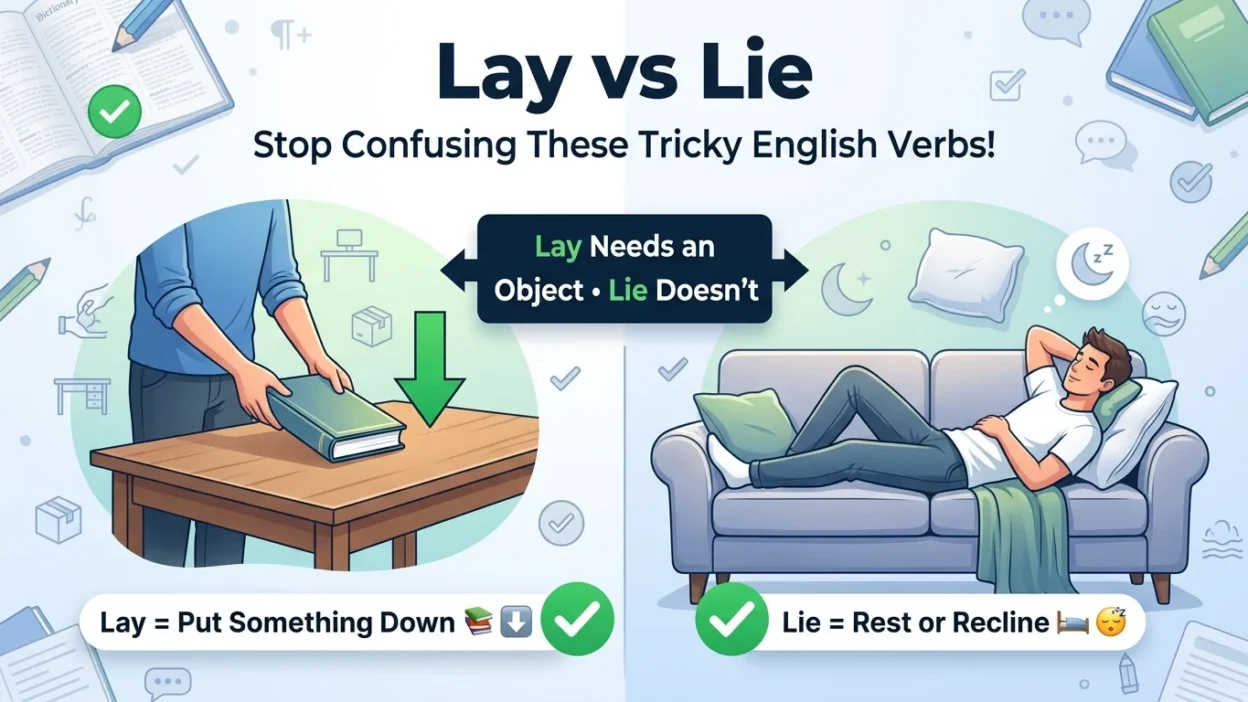
- Lay means to put or place something down. It requires a direct object, meaning you lay something.
- Lie means to recline, rest, or be in a flat position. It does not take a direct object.
Examples:
- Please lay the book on the table. ✅
- I’m going to lie down for a nap. ✅
A quick trick:
- Lay = Place something.
- Lie = Rest yourself.
What Does “Lay” Mean?
Lay is a transitive verb, which means it always needs an object.
Someone must place or put something somewhere.
Examples
- Please lay your keys on the counter.
- She laid the baby in the crib.
- They lay fresh flowers every morning.
- The chef carefully laid the ingredients on the plate.
- I will lay the documents on your desk.
Notice that something is being placed in every sentence.
What Does “Lie” Mean?
Lie is an intransitive verb.
It means to rest, recline, or remain in a horizontal position.
No object follows the verb.
Examples
- I need to lie down.
- The cat likes to lie in the sun.
- The book lies on the shelf.
- He lay on the sofa all afternoon.
- We usually lie on the beach during vacation.
The subject performs the action without acting upon another object.
Lay vs Lie: Comparison Table
| Feature | Lay | Lie |
|---|---|---|
| Meaning | Put or place something | Rest or recline |
| Verb Type | Transitive | Intransitive |
| Needs an Object? | Yes | No |
| Present Tense | Lay | Lie |
| Past Tense | Laid | Lay |
| Past Participle | Laid | Lain |
| Example | Lay the book down. | Lie on the bed. |
The Verb Forms You Need to Know
One reason these verbs cause confusion is that the past tense of lie is lay.
Here’s a helpful overview.
| Tense | Lay (Place Something) | Lie (Rest) |
|---|---|---|
| Base Form | Lay | Lie |
| Present | Lay | Lie |
| Past | Laid | Lay |
| Past Participle | Laid | Lain |
| Present Participle | Laying | Lying |
Examples
- Today I lay the blanket on the bed.
- Yesterday I laid the blanket there.
- Today I lie on the couch.
- Yesterday I lay on the couch.
- I have lain here all morning.
When Should You Use “Lay”?
Use lay whenever someone places or puts something somewhere.
Ask yourself:
What is being placed?
If you can identify an object, lay is the correct choice.
Examples
- Lay the phone on the table.
- Please lay the clothes on the chair.
- The workers laid bricks all day.
- She laid the painting against the wall.
- Lay your backpack beside the door.
Each sentence includes something being placed.
When Should You Use “Lie”?
Use lie when someone or something rests or reclines.
Nothing receives the action.
Examples
- I want to lie down.
- The dog lies near the fireplace.
- We lay on the grass yesterday.
- The papers lie untouched.
- He has lain awake for hours.
The subject simply rests.
Common Mistakes to Avoid
These verbs confuse many writers because their forms overlap.
Mistake 1: Saying “I’m Going to Lay Down”
❌ I’m going to lay down.
✅ I’m going to lie down.
Unless you’re placing yourself somewhere as an object, lie is correct.
Mistake 2: Forgetting the Object
❌ Please lie the book on the table.
✅ Please lay the book on the table.
The book is the object.
Therefore, lay is needed.
Mistake 3: Mixing Up the Past Tense
❌ Yesterday I laid on the beach.
✅ Yesterday I lay on the beach.
Remember:
- Lay → laid
- Lie → lay
Easy Trick to Remember the Difference
Here’s an easy memory trick.
Ask yourself:
Am I putting something somewhere?
Use lay.
Am I resting?
Use lie.
Think of this phrase:
Lay = Place
Both words contain four letters.
That simple connection helps many learners remember the rule.
Everyday Examples
Using “Lay”
- Lay the towel on the chair.
- She laid the baby down gently.
- We laid new flooring.
- Please lay your phone here.
- They laid the foundation yesterday.
Using “Lie”
- I’ll lie down after dinner.
- The children lay in the grass yesterday.
- The keys lie under the sofa.
- He has lain awake since dawn.
- The cat likes to lie by the window.
Common Expressions
These combinations appear frequently.
With “Lay”
- Lay the foundation
- Lay the table
- Lay eggs
- Lay blame
- Lay emphasis
- Lay flowers
With “Lie”
- Lie down
- Lie awake
- Lie still
- Lie flat
- Lie in bed
- Lie beneath
Learning these expressions helps you sound more natural.
American vs British English
There is no significant grammatical difference between American and British English in the use of lay and lie.
Both varieties follow the same grammar rules.
However, in casual conversation, many native speakers in both regions mistakenly use lay instead of lie, especially in expressions like “I’m going to lay down.”
Although this mistake is common in speech, formal writing still follows the standard grammatical distinction.
Practice Sentences
Choose the correct verb.
- Please ______ your jacket on the chair.
Answer: lay
- I want to ______ down for a while.
Answer: lie
- Yesterday we ______ on the beach.
Answer: lay
- She ______ the keys on the counter.
Answer: laid
- The dog likes to ______ near the fireplace.
Answer: lie
Frequently Asked Questions (FAQs)
What is the difference between lay and lie?
Lay means to place something and requires an object. Lie means to rest or recline and does not require an object.
Why is lay so confusing?
Because lay is the present tense of one verb and the past tense of another, many people confuse the forms.
Is it “lay down” or “lie down”?
If you’re resting yourself, the correct expression is lie down.
What is the past tense of lie?
The past tense of lie (to recline) is lay.
What is the past tense of lay?
The past tense of lay (to place something) is laid.
Is “I’m going to lay down” grammatically correct?
In standard English, I’m going to lie down is correct when referring to resting.
Is there any difference between American and British English?
No. Both varieties follow the same grammatical rules for lay and lie, although informal speech sometimes mixes them.
Summary
Understanding lay vs lie becomes much easier when you remember one simple distinction: lay always involves placing something somewhere, while lie refers to resting or reclining without a direct object. Although their verb forms overlap and create confusion, focusing on whether an object receives the action helps you choose the correct word every time.
Whether you’re writing an email, a school assignment, or professional content, using lay and lie correctly improves your grammar and makes your writing more polished. With practice and the simple memory tricks in this guide, you’ll avoid one of the most common verb mistakes in English.