Few English grammar topics confuse learners as much as laying vs lying. These two words look similar, sound alike, and are closely related, making them easy to mix up. Whether you’re writing an email, speaking in everyday conversation, or preparing for an English exam, understanding the difference is essential for clear communication.
The confusion comes from the fact that laying is a form of the verb lay, while lying is a form of the verb lie. Although both can describe physical positions or actions, they have different meanings and follow different grammar rules. This guide explains everything you need to know with simple definitions, examples, comparison tables, memory tricks, and common mistakes.
Quick Answer
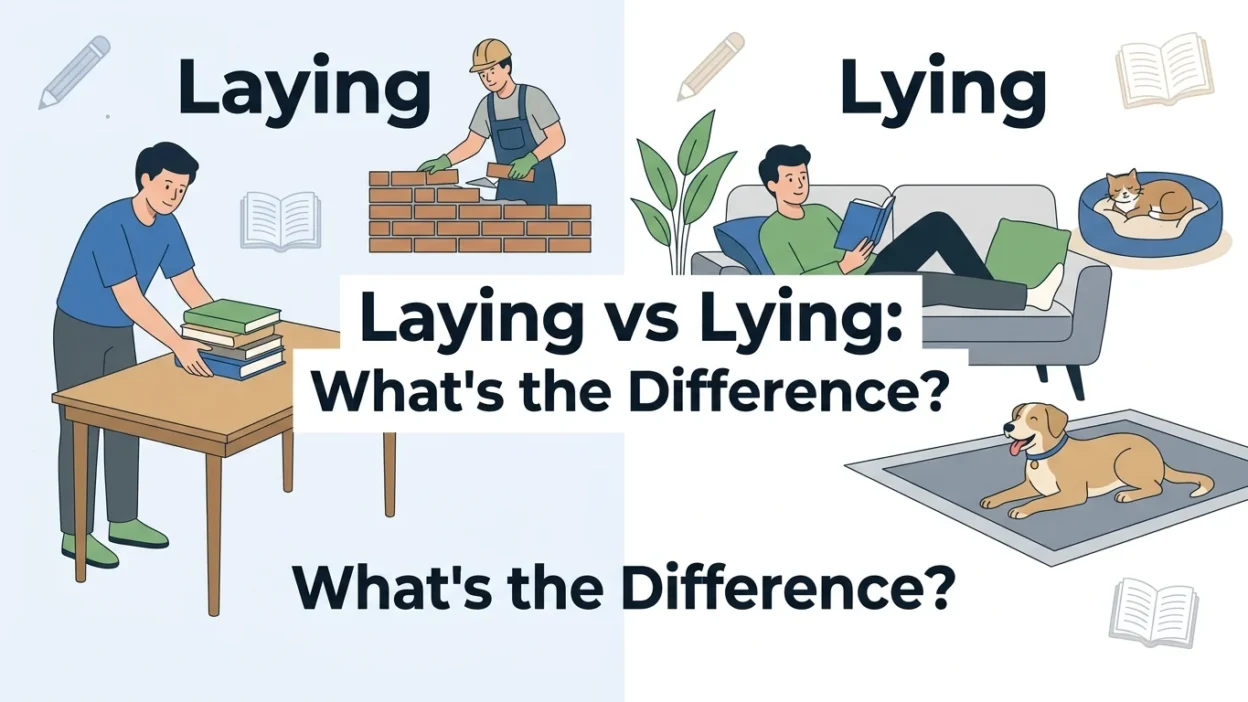
Laying is the present participle of lay, which means to put or place something down. It always requires a direct object—something is being placed.
Lying is the present participle of lie, which means to rest or recline in a horizontal position. It does not take a direct object.
Examples:
- ✅ She is laying the books on the table.
- ✅ The cat is lying on the sofa.
A simple way to remember is:
- Laying = placing something
- Lying = resting yourself
What Does “Laying” Mean?
Laying comes from the verb lay, which means to put or place something somewhere.
Because lay is a transitive verb, it always needs an object. In other words, someone must be laying something.
Examples of “Laying”
- She is laying the plates on the table.
- They are laying new flooring in the kitchen.
- The gardener is laying fresh grass.
- He spent the afternoon laying bricks.
- The chicken is laying eggs.
In each example, something is being placed or produced.
What Does “Lying” Mean?
Lying comes from the verb lie, meaning to recline, rest, or remain in a horizontal position.
Unlike lay, lie is an intransitive verb and does not require an object.
Examples of “Lying”
- The baby is lying peacefully in the crib.
- I am lying on the beach.
- The keys are lying on the desk.
- The dog is lying beside the fireplace.
- She enjoys lying in the hammock.
In these examples, the subject is resting rather than placing something.
Laying vs Lying: Key Differences
| Feature | Laying | Lying |
|---|---|---|
| Base Verb | Lay | Lie |
| Meaning | Putting or placing something | Resting in a horizontal position |
| Part of Speech | Present participle | Present participle |
| Requires an Object? | Yes | No |
| Example | Laying the blanket | Lying on the blanket |
This simple distinction makes choosing the correct word much easier.
Understanding “Lay” and “Lie”
The confusion often begins with the verbs themselves.
Lay
Meaning: To put or place something.
Verb forms:
- Base form: Lay
- Past tense: Laid
- Past participle: Laid
- Present participle: Laying
Example:
- I lay the book on the desk every morning.
- Yesterday, I laid the book there.
- I am laying the book there now.
Lie
Meaning: To recline or rest.
Verb forms:
- Base form: Lie
- Past tense: Lay
- Past participle: Lain
- Present participle: Lying
Example:
- I lie on the couch after work.
- Yesterday, I lay on the couch.
- I am lying on the couch now.
Notice that the past tense of lie is lay, which causes much of the confusion.
When Should You Use “Laying”?
Use laying whenever someone is placing or putting something somewhere.
Common situations include:
- Laying bricks
- Laying eggs
- Laying carpet
- Laying a foundation
- Laying documents on a desk
- Laying flowers on a grave
Example Sentences
- Workers are laying new pipes.
- She is laying the baby in the crib.
- The chef is laying the ingredients on the counter.
- Farmers are laying irrigation lines.
- They are laying fresh concrete.
When Should You Use “Lying”?
Use lying whenever someone or something is resting or reclining.
Common situations include:
- Lying in bed
- Lying on the sofa
- Lying on the beach
- Lying on the floor
- Lying quietly
- Lying under a tree
Example Sentences
- The children are lying on the grass.
- He is lying comfortably in bed.
- The notebook is lying on the chair.
- We spent the afternoon lying in the sun.
- The puppy is lying next to its owner.
Side-by-Side Examples
- She is laying the clothes on the bed.
- She is lying on the bed.
- They are laying tiles in the bathroom.
- The workers are lying on the ground during their break.
- The bird is laying eggs.
- The bird is lying in the nest.
The first sentence in each pair involves placing something, while the second describes resting.
Common Mistakes to Avoid
These are some of the most common errors.
Incorrect: I am laying on the couch.
✅ Correct: I am lying on the couch.
You are resting, not placing something.
Incorrect: She is lying the dishes on the table.
✅ Correct: She is laying the dishes on the table.
The dishes are being placed.
Incorrect: The dog is laying in the yard.
✅ Correct: The dog is lying in the yard.
The dog is resting.
Incorrect: He is lying the books on the shelf.
✅ Correct: He is laying the books on the shelf.
Books are objects being placed.
Easy Memory Trick
A simple trick can help you remember.
Laying = Place
Ask yourself:
“Am I putting something somewhere?”
If the answer is yes, use laying.
Lying = Rest
Ask yourself:
“Am I resting or reclining?”
If the answer is yes, use lying.
A quick reminder:
- Laying = placing
- Lying = resting
Common Expressions with “Laying”
These phrases are widely used.
- Laying the foundation
- Laying eggs
- Laying the table
- Laying carpet
- Laying bricks
- Laying flowers
Example
Workers are laying the foundation for the new building.
Common Expressions with “Lying”
These expressions are also common.
- Lying in bed
- Lying awake
- Lying on the floor
- Lying in the sun
- Lying down
- Lying quietly
Example
She spent the afternoon lying under a tree reading a book.
American vs British English
There is no major difference between American and British English in the grammatical rules for laying and lying.
Both varieties follow the same distinctions:
- Laying means placing something.
- Lying means resting or reclining.
Examples:
- American English: The dog is lying on the porch.
- British English: The dog is lying on the porch.
- American English: She is laying the plates on the table.
- British English: She is laying the plates on the table.
While pronunciation may vary slightly by accent, the grammar remains identical.
Practice Sentences
Choose the correct word.
- The cat is ______ on the sofa.
- ✅ Lying
- She is ______ the books on the shelf.
- ✅ Laying
- The baby is ______ in the crib.
- ✅ Lying
- Workers are ______ new tiles.
- ✅ Laying
- We are ______ on the beach.
- ✅ Lying
FAQs
What is the difference between laying and lying?
Laying means placing or putting something somewhere and requires an object. Lying means resting or reclining and does not require an object.
Why do people confuse laying and lying?
The confusion comes from the irregular verb forms. The past tense of lie is lay, which makes the two verbs easy to mix up.
Is “I am laying on the bed” correct?
No. The correct sentence is I am lying on the bed because you are resting, not placing something.
Is “The hen is laying eggs” correct?
Yes. The hen is producing eggs, so laying is the correct form.
How can I remember the difference?
Remember that laying involves placing something, while lying means resting or reclining.
Do American and British English use these words differently?
No. Both American and British English follow the same grammar rules for laying and lying.
Can objects be described as lying?
Yes. Objects can be described as lying somewhere when they are resting in a particular position, such as “The keys are lying on the table.”
Summary
Understanding laying vs lying becomes much easier when you remember one simple rule. Laying comes from the verb lay, which means to place or put something somewhere, so it always requires an object. Lying, on the other hand, comes from the verb lie, which means to rest or recline, and it does not require an object. Keeping this distinction in mind will help you avoid one of the most common grammar mistakes in English.
Although these words are closely related and often confused because of their irregular verb forms, using them correctly becomes natural with practice. Whenever you’re unsure, ask yourself whether something is being placed or simply resting. This quick check will guide you to the correct choice and make your writing clearer and more grammatically accurate.

William Harved is a passionate language enthusiast and digital writer specializing in English spelling, grammar clarity, and common writing mistakes. As the primary author of Spelword.com, he focuses on helping readers understand confusing word pairs, correct spelling errors, and improve everyday communication.