
If you’ve ever seen the phrases “laid off” and “layed off” and wondered which one is correct, you’re not alone. This is a common spelling mistake that appears frequently in emails, social media posts, job related discussions, and even professional writing.
The confusion usually comes from the verb “lay,” which has an irregular past tense. Because many English verbs form the past tense by adding “ed,” some people naturally assume that “layed off” must be correct. However, English grammar follows a different rule in this case.
In this guide, you’ll learn the difference between laid off vs layed off, discover the correct spelling, see practical examples, and avoid one of the most common workplace related writing mistakes.
Quick Answer
“Laid off” is correct.
“Layed off” is incorrect and not considered standard English.
✅ Correct: The company laid off 50 employees last month.
❌ Incorrect: The company layed off 50 employees last month.
Whenever you refer to job termination due to business reasons, workforce reductions, or restructuring, use “laid off.”
What Does “Laid Off” Mean?
The phrase “laid off” typically means that an employee has lost their job because of business-related reasons rather than personal performance issues.
Common reasons include:
- Company downsizing
- Budget cuts
- Economic challenges
- Organizational restructuring
- Reduced demand for products or services
Unlike being fired, being laid off usually does not imply wrongdoing by the employee.
Examples:
- Hundreds of workers were laid off during the recession.
- She was laid off after the company merged with a competitor.
- Several departments were affected when employees were laid off.
Why Is “Laid Off” Correct?
The answer comes from the verb lay.
Here is the correct verb pattern:
| Present Tense | Past Tense | Past Participle |
|---|---|---|
| Lay | Laid | Laid |
Because the past tense of lay is laid, the correct phrase becomes:
- Lay off → Laid off
Examples:
- Present: The company may lay off workers.
- Past: The company laid off workers.
- Past Participle: Workers have been laid off.
The form “layed” is not a standard English past tense and should be avoided.
Is “Layed Off” Ever Correct?
In standard English, “layed off” is incorrect.
Some people use it because they assume the verb follows a regular pattern:
- Play → Played
- Stay → Stayed
- Delay → Delayed
Following that pattern, they mistakenly write:
- Lay → Layed ❌
As a result, professional writers, editors, teachers, and dictionaries recognize only “laid off” as correct.
Comparison Table: Laid Off vs Layed Off
| Phrase | Correct? | Meaning | Example |
|---|---|---|---|
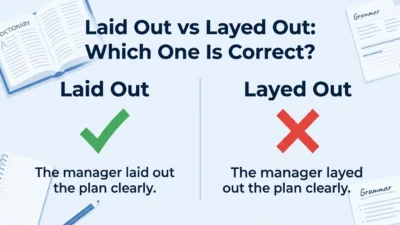
| Laid Off | ✅ Yes | Employment ended for business reasons | The company laid off several workers. |
| Layed Off | ❌ No | Incorrect spelling | He was layed off last year. |
Common Uses of “Laid Off”
The phrase appears frequently in workplace and business communication.
Workforce Reductions
- The company laid off 200 employees.
Economic Downturns
- Many workers were laid off during the financial crisis.
Corporate Restructuring
- Staff members were laid off following the merger.
Temporary Layoffs
Sometimes layoffs are temporary.
- Factory workers were laid off until production resumed.
Common Mistakes to Avoid
Many writers make similar errors when using this phrase.
Mistake 1: Using “Layed Off”
❌ She was layed off in January.
✅ She was laid off in January.
Mistake 2: Confusing “Laid Off” with “Fired”
Although both involve job loss, they are not identical.
- Laid off = business decision
- Fired = performance or conduct issue
Example:
- The company laid off workers due to budget cuts.
Mistake 3: Incorrect Verb Forms
❌ The company has layed off workers.
✅ The company has laid off workers.
Understanding “Lay” and “Lie”
Part of the confusion comes from the verbs lay and lie, which have unusual forms.
Lay
Means to place something down.
- Present: Lay
- Past: Laid
- Past Participle: Laid
Example:
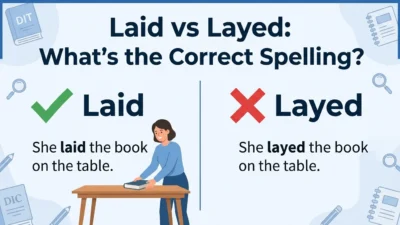
- She laid the book on the desk.
Lie
Means to recline or rest.
- Present: Lie
- Past: Lay
- Past Participle: Lain
Example:
- He lay on the couch yesterday.
Because these verbs overlap, many people become unsure which form is correct.
Professional Writing and Workplace Communication
If you’re writing:
- Resumes
- Cover letters
- Business reports
- HR documents
- News articles
- LinkedIn posts
Always use “laid off.”
Examples:
- The organization announced plans to lay off workers next quarter.
Using the correct spelling helps maintain professionalism and credibility.
American vs British English Differences
There is no difference between American and British English regarding this phrase.
Both forms of English use:
- Laid off ✅
- Layed off ❌
Whether you’re writing for audiences in the United States, the United Kingdom, Canada, Australia, or elsewhere, “laid off” is the accepted form.
Helpful Memory Trick
A simple way to remember the correct spelling:
Think of the verb pattern:
- Pay → Paid
- Say → Said
- Lay → Laid
Notice how all three use irregular spelling changes.
If you remember paid, you’ll find it easier to remember laid.
FAQs
Is it laid off or layed off?
The correct phrase is laid off. “Layed off” is a spelling mistake.
Why is layed off incorrect?
Because the past tense of “lay” is “laid,” not “layed.”
What does laid off mean?
It means an employee loses their job due to business reasons such as downsizing or restructuring.
Can I write layed off in informal writing?
No. Even in informal writing, “layed off” is considered incorrect.
Do American and British English use different spellings?
No. Both American and British English use “laid off.”
What is the present tense form?
The present tense is “lay off.”
Example: The company may lay off employees next year.
What is the past participle form?
The past participle is also “laid.”
Example: Hundreds of workers have been laid off.
Summary
The difference between laid off vs layed off is straightforward once you understand the verb forms. “Laid off” is the correct phrase because laid is the past tense and past participle of the verb lay.
Whether you’re discussing workforce reductions, writing a resume, updating your professional profile, or creating business content, always use “laid off.” This small spelling choice improves clarity, professionalism, and grammatical accuracy while ensuring your writing follows standard English conventions.

Dani Morrison is a dedicated language writer and spelling expert at Spelword.com, where she focuses on helping readers understand common English spelling mistakes and confusing word pairs. With a passion for clear communication, Dani creates easy-to-follow guides that simplify complex grammar and spelling rules for everyday use.