If you’ve ever paused while writing cavalry or Calvary, you’re not alone. These two words are among the most commonly confused in English because they sound similar, yet they have completely different meanings. Choosing the wrong one can unintentionally change the message you’re trying to convey.
The good news is that once you understand what each word means and where it’s used, remembering the difference becomes much easier. In this guide, you’ll learn the meaning of cavalry and Calvary, see real world examples, discover common mistakes to avoid, and pick up simple memory tricks to help you use each word correctly with confidence.
Quick Answer
The difference between cavalry and Calvary is simple:
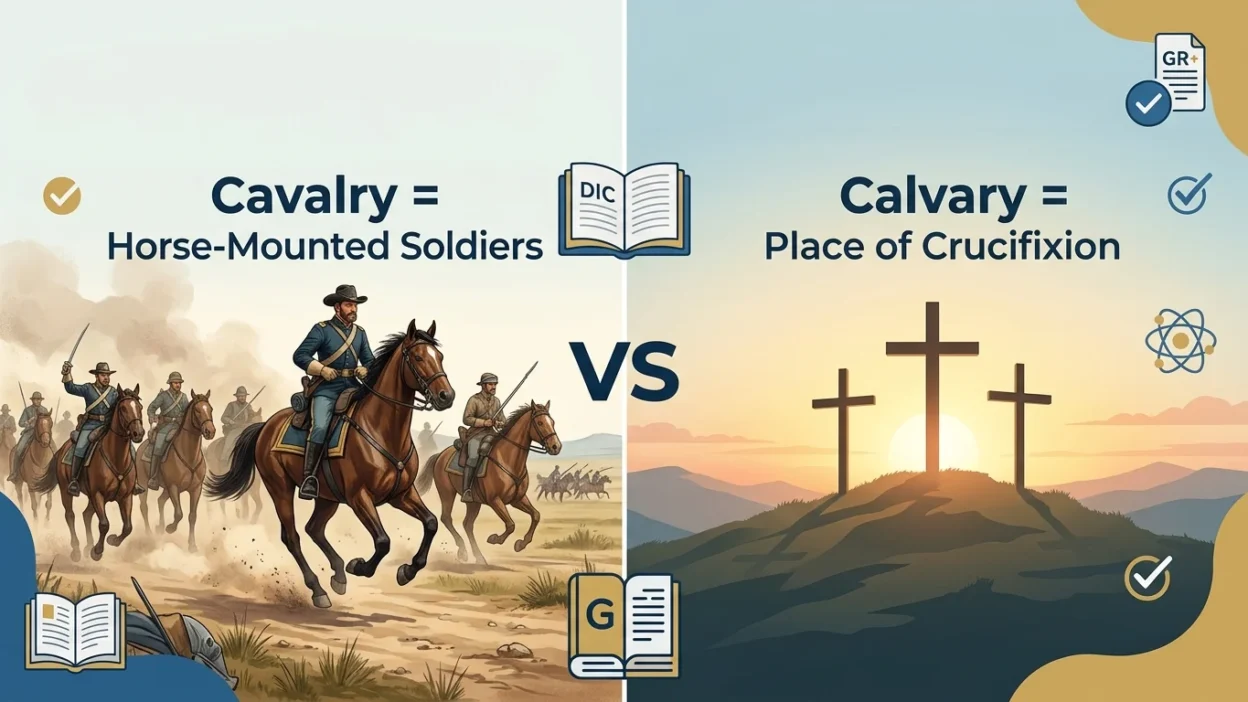
- Cavalry refers to soldiers who fought on horseback or modern military units descended from horse-mounted troops.
- Calvary refers to the hill outside Jerusalem where Jesus Christ was crucified. It can also symbolize great suffering or sacrifice.
Examples:
- The cavalry arrived just in time to save the village. ✅
- Christians remember Jesus’ sacrifice at Calvary. ✅
Although these words sound alike, they are not interchangeable.
What Does Cavalry Mean?
Cavalry is a noun that traditionally refers to soldiers who fought while riding horses. Before tanks and armored vehicles became common, cavalry units played an important role in military battles because they could move quickly across the battlefield.
Today, many armed forces still use the term cavalry for units that operate tanks, armored vehicles, or helicopters rather than horses.
Outside military contexts, cavalry is also used figuratively to describe help arriving just when it is needed.
Examples of Cavalry
- The cavalry charged across the battlefield.
- The general ordered the cavalry to defend the bridge.
- Air cavalry units supported the ground forces.
- Don’t worry—the cavalry is on its way.
- My friends became the cavalry when my car broke down.
In everyday conversation, the phrase “the cavalry is coming” usually means that help or reinforcements are arriving.
What Does Calvary Mean?
Calvary is a proper noun that refers to the place where Jesus Christ was crucified, also known as Golgotha in the Bible.
Because of its religious significance, Calvary is commonly mentioned in Christian teachings, worship, literature, and history.
The word can also be used figuratively to describe an experience of deep suffering, sacrifice, or hardship.
Examples of Calvary
- Pilgrims traveled to Calvary to reflect on the events of the crucifixion.
- The painting shows the scene at Calvary.
- The sermon focused on the meaning of Calvary.
- Caring for his family became his personal Calvary.
- The church choir sang about Calvary.
When referring to the biblical location, Calvary should always be capitalized.
Cavalry vs Calvary: Key Differences
Although the words sound similar, they belong to completely different subjects.
| Feature | Cavalry | Calvary |
|---|---|---|
| Meaning | Horse-mounted or modern military troops | Place where Jesus Christ was crucified |
| Part of Speech | Noun | Proper noun (sometimes figurative noun) |
| Context | Military | Christianity and religion |
| Figurative Meaning | Help or reinforcement | Suffering or sacrifice |
| Capitalization | Usually lowercase | Usually capitalized |
Remember that the meanings are entirely unrelated.
How to Use Cavalry Correctly
Use cavalry whenever you’re talking about military forces, rescue, or reinforcements.
It is appropriate in historical writing, military discussions, novels, and everyday expressions.
Correct Examples
- The cavalry attacked before sunrise.
- The cavalry crossed the river safely.
- We called in the cavalry for extra support.
- Reinforcements arrived like the cavalry.
- The cavalry protected the town.
How to Use Calvary Correctly
Use Calvary when referring to the biblical location or when describing profound sacrifice or suffering.
Correct Examples
- Many believers reflect on the events at Calvary during Easter.
- The church displayed artwork depicting Calvary.
- His difficult journey became his own Calvary.
- The story reaches its emotional climax at Calvary.
- Visitors prayed quietly at Calvary.
Common Expressions
Here are some familiar phrases using each word.
Expressions with Cavalry
- The cavalry is coming.
- Call in the cavalry.
- Ride in like the cavalry.
- Send the cavalry.
- Waiting for the cavalry.
These expressions all refer to receiving help or reinforcement.
Expressions with Calvary
- Road to Calvary.
- Journey to Calvary.
- Calvary sacrifice.
- Cross of Calvary.
- Calvary experience.
These expressions relate to Christian history or symbolize hardship and sacrifice.
Common Mistakes to Avoid
These words are easy to confuse because their pronunciation is similar.
1. Using Calvary Instead of Cavalry
Incorrect:
- The Calvary rescued the soldiers.
Correct:
- The cavalry rescued the soldiers.
Military troops are cavalry, not Calvary.
2. Using Cavalry Instead of Calvary
Incorrect:
- Jesus was crucified at cavalry.
Correct:
- Jesus was crucified at Calvary.
The biblical location is always Calvary.
3. Forgetting to Capitalize Calvary
Incorrect:
- Many people visited calvary.
Correct:
- Many people visited Calvary.
When referring to the biblical place, capitalize the word.
4. Assuming They Mean the Same Thing
Although they sound alike, these words have completely different origins and meanings.
Always think about the context before choosing one.
Easy Ways to Remember the Difference
Simple memory tricks can help prevent mistakes.
Trick 1: Cavalry = Army
The word cavalry contains the letter A, reminding you of the Army.
Trick 2: Calvary = Christ
Both Calvary and Christ begin with the letter C, making it easier to associate the word with Christianity.
Trick 3: Think About the Context
If you’re discussing:
- Soldiers → cavalry
- The crucifixion → Calvary
The topic usually tells you which word belongs.
Everyday Examples
Here are examples you may encounter in daily reading.
Military Context
- The cavalry surrounded the enemy.
- The cavalry defended the fort.
- Modern cavalry often uses armored vehicles.
Religious Context
- Thousands visit Calvary every year.
- The sermon described what happened at Calvary.
- The cross reminds believers of Calvary.
Figurative Context
- My coworkers became the cavalry when deadlines piled up.
- Recovering from the illness felt like a personal Calvary.
- The rescue team arrived like the cavalry.
American vs British English
There is no spelling or meaning difference between American and British English for cavalry and Calvary.
Both varieties of English use the same spellings, definitions, and grammar.
The only variation you may notice is pronunciation, which differs slightly depending on regional accents. Regardless of accent, the meanings remain exactly the same.
Why Are Cavalry and Calvary So Often Confused?
These words are classic examples of commonly confused English vocabulary.
There are several reasons people mix them up:
- They have similar spellings.
- Their pronunciation is nearly identical in many accents.
- Spell checkers may not catch the mistake because both are real words.
- Many people encounter one word far more often than the other.
Taking an extra moment to think about the context is the easiest way to avoid confusion.
FAQs
Is cavalry the same as Calvary?
No. Cavalry refers to military troops, while Calvary refers to the place where Jesus Christ was crucified or symbolizes suffering.
Which word means soldiers on horseback?
Cavalry is the correct word for horse-mounted soldiers and modern military units descended from them.
What does Calvary mean in the Bible?
Calvary is the hill outside Jerusalem where Jesus Christ was crucified according to the New Testament.
Why do people confuse cavalry and Calvary?
They look and sound very similar, but they have completely different meanings and origins.
Is Calvary always capitalized?
Yes. When referring to the biblical location, Calvary should be capitalized because it is a proper noun.
What does “the cavalry is coming” mean?
It is an idiomatic expression meaning that help or reinforcements are on the way.
Are cavalry units still used today?
Yes. Modern cavalry units typically use tanks, armored vehicles, or helicopters instead of horses.
Summary
Understanding the difference between cavalry and Calvary is essential because the two words belong to completely different contexts. Cavalry refers to horse mounted soldiers or modern military units and is also commonly used to describe help arriving just in time. Calvary, on the other hand, refers to the biblical site of Jesus Christ’s crucifixion and may also symbolize sacrifice or suffering.
The easiest way to remember the distinction is to think about the subject of your sentence. If you’re writing about soldiers, military history, or rescue, choose cavalry. If you’re referring to Christianity, the crucifixion, or symbolic hardship, choose Calvary. Keeping this simple rule in mind will help you avoid one of the most common word mix ups in English.

William Harved is a passionate language enthusiast and digital writer specializing in English spelling, grammar clarity, and common writing mistakes. As the primary author of Spelword.com, he focuses on helping readers understand confusing word pairs, correct spelling errors, and improve everyday communication.