
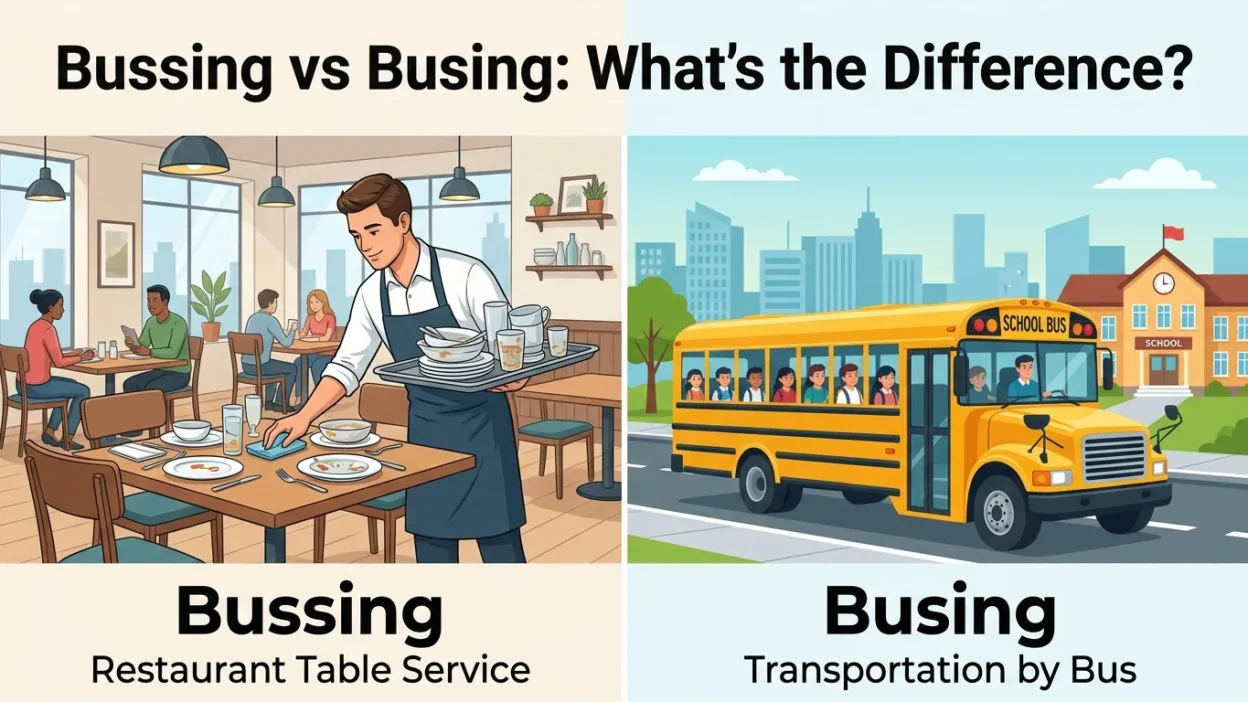
Have you ever come across the words bussing and busing and wondered whether one of them is a spelling mistake? You’re not alone. These two terms often confuse writers because both are accepted spellings in English, yet they are frequently used in different situations.
Understanding the difference between bussing vs busing can help you write more confidently and avoid common grammar and spelling mistakes. Whether you’re discussing school transportation, public transit, or restaurant duties, knowing which form fits the context will make your writing clearer and more professional.
Quick Answer
Both bussing and busing are correct spellings, but they are commonly used in different contexts.
- Busing usually refers to transporting people by bus.
- Bussing often refers to clearing tables in a restaurant.
Examples
- The district is busing students to nearby schools.
- The server spent the evening bussing tables.
While both spellings originate from the word bus, context often determines which version is preferred.
Understanding the Word “Bus”
Before comparing the two spellings, it helps to understand the root word.
A bus is a vehicle used to transport people from one place to another. Over time, the noun evolved into a verb meaning “to transport by bus.”
Another meaning developed in the hospitality industry, where workers remove dishes and clean tables after customers leave. This activity became known as bussing tables.
Because the same root word developed different uses, two spelling preferences emerged.
What Does Busing Mean?
Busing refers to transporting people by bus. This spelling is especially common in education, public transportation, and government-related contexts.
Many modern dictionaries and style guides favor busing because it follows a simplified spelling convention.
Examples of Busing
- The school is busing students from neighboring communities.
- The city is busing residents to emergency shelters.
- The company provides busing services for employees.
- Special education programs often include student busing.
- The district expanded its busing routes this year.
In nearly all transportation-related writing, busing is the preferred spelling.
What Does Bussing Mean?
Bussing is most commonly used in the restaurant and hospitality industries. It refers to clearing tables, removing dishes, and preparing dining areas for the next customers.
A person who performs this work is often called a busser.
Examples of Bussing
- She worked weekends bussing tables.
- Effective bussing improves restaurant efficiency.
- The manager assigned two employees to bussing duties.
- He earned extra income by bussing at a local café.
- Quick bussing helped reduce customer wait times.
In food service settings, bussing is generally the preferred spelling.
Bussing vs Busing: Comparison Table
| Feature | Bussing | Busing |
|---|---|---|
| Main Meaning | Clearing restaurant tables | Transporting people by bus |
| Common Industry | Hospitality and food service | Education and transportation |
| Accepted Spelling | Yes | Yes |
| Most Common Usage | Restaurant work | School and public transit |
| Example | Bussing tables | Busing students |
This distinction helps readers immediately understand your intended meaning.
Why Do Both Spellings Exist?
The existence of both spellings comes from English spelling conventions.
Normally, when a one-syllable word ends with a consonant after a short vowel, the final consonant is doubled before adding -ing. Following this rule, bus becomes bussing.
However, many publishers and style guides adopted the simplified form busing for transportation-related uses. Over time, this version became widely accepted and is now commonly seen in newspapers, educational materials, and official documents.
As a result, both spellings survive today, each serving slightly different purposes.
Common Uses of Busing
You will often see busing in situations involving transportation.
Educational Contexts
- Busing students between schools
- School transportation programs
- District transportation policies
Public Transportation
- Busing passengers during events
- Emergency evacuation services
- Shuttle transportation systems
Workplace Transportation
- Busing employees to job sites
- Corporate transportation programs
Because transportation is the primary meaning, readers usually expect the spelling busing in these situations.
Common Uses of Bussing
The spelling bussing appears most frequently in hospitality environments.
Restaurant Operations
- Clearing used dishes
- Cleaning tables
- Resetting dining areas
Hospitality Training
- Teaching dining room procedures
- Assigning restaurant responsibilities
Customer Service
- Maintaining clean seating areas
- Supporting waitstaff during busy hours
When discussing restaurant duties, bussing is often the clearer choice.
Common Mistakes With Bussing and Busing
Because both spellings are valid, mistakes usually happen when writers use the less common form for a specific context.
Mistake 1: Using Bussing for Transportation
Less Preferred:
- The district is bussing students across town.
Preferred:
- The district is busing students across town.
Mistake 2: Using Busing for Restaurant Work
Less Preferred:
- She spent the afternoon busing tables.
Preferred:
- She spent the afternoon bussing tables.
Mistake 3: Assuming One Version Is Incorrect
Many people believe only one spelling is correct. In reality, both are accepted, but context influences which one sounds more natural.
Easy Ways to Remember the Difference
If you struggle to remember which spelling to use, these simple memory tricks can help.
Busing = Bus Transportation
Think about buses carrying people.
Examples:
- Busing students
- Busing passengers
- Busing workers
Bussing = Service Work
The double s in bussing can remind you of service.
Examples:
- Bussing tables
- Bussing dishes
- Bussing restaurant areas
This association makes it easier to choose the correct spelling.
American vs British English
The difference between bussing and busing is most noticeable in American English.
American English
- Busing is strongly preferred for transportation.
- Bussing is commonly used in restaurants.
British English
British English generally follows similar usage patterns. However, some British publications may use either spelling depending on their editorial style guide.
In modern writing, busing remains the dominant choice when discussing transportation in both American and British English.
Which Spelling Should You Use?
The safest approach is to match the spelling to the context.
Use busing when discussing:
- School transportation
- Public transit
- Employee transportation
- Travel by bus
Use bussing when discussing:
- Restaurant operations
- Clearing tables
- Hospitality duties
- Dining room maintenance
Following this guideline helps avoid confusion and improves readability.
Examples in Real-Life Sentences
Here are some additional examples.
Busing
- The city is busing visitors to the stadium.
- The district expanded its busing program.
- Volunteers are busing supplies between locations.
- Emergency crews are busing residents to safety.
- Student busing costs increased this year.
Bussing
- He spent the summer bussing tables.
- Efficient bussing improves restaurant turnover.
- The employee was responsible for bussing and cleaning.
- Proper bussing creates a better dining experience.
- She learned serving and bussing responsibilities quickly.
FAQs
Is bussing or busing correct?
Both are correct spellings. Busing is usually preferred for transportation, while bussing is commonly used in restaurant settings.
What does busing mean?
Busing means transporting people by bus, such as students, employees, or passengers.
What does bussing mean?
Bussing refers to clearing tables, removing dishes, and helping maintain dining areas in restaurants.
Why are there two spellings?
The two spellings developed from different English spelling conventions and usage preferences over time.
Is bussing students wrong?
It is not technically wrong, but most modern style guides prefer busing when referring to transportation.
Is busing tables incorrect?
It is accepted by some dictionaries, but bussing tables is the more common and preferred expression.
Which spelling is more common?
Busing is more common overall because transportation-related usage appears frequently in schools, government documents, and news articles.
Do dictionaries recognize both spellings?
Yes. Major dictionaries generally recognize both bussing and busing as valid spellings.
Summary
The debate over bussing vs busing is less about right versus wrong and more about context. Both spellings are accepted in modern English, but busing is generally preferred when referring to transportation by bus. Schools, public transit agencies, government organizations, and news publications commonly use this spelling.
On the other hand, bussing is most often associated with restaurant work, particularly clearing tables and assisting dining room operations. Choosing the spelling that fits the situation helps readers understand your meaning immediately and gives your writing a polished, professional appearance.

Dani Morrison is a dedicated language writer and spelling expert at Spelword.com, where she focuses on helping readers understand common English spelling mistakes and confusing word pairs. With a passion for clear communication, Dani creates easy-to-follow guides that simplify complex grammar and spelling rules for everyday use.