Have you ever wondered whether whisky or whiskey is the correct spelling? If you’ve seen both versions on bottles, menus, or in articles, you’re not alone. Many people assume one is a misspelling of the other, but that’s not true. Both spellings are correct they simply reflect different traditions and origins.
Understanding the difference between whisky vs whiskey is useful whether you’re ordering a drink, writing about spirits, or simply satisfying your curiosity. In this guide, you’ll learn why the two spellings exist, where each one is used, and how to remember the difference with confidence.
Quick Answer
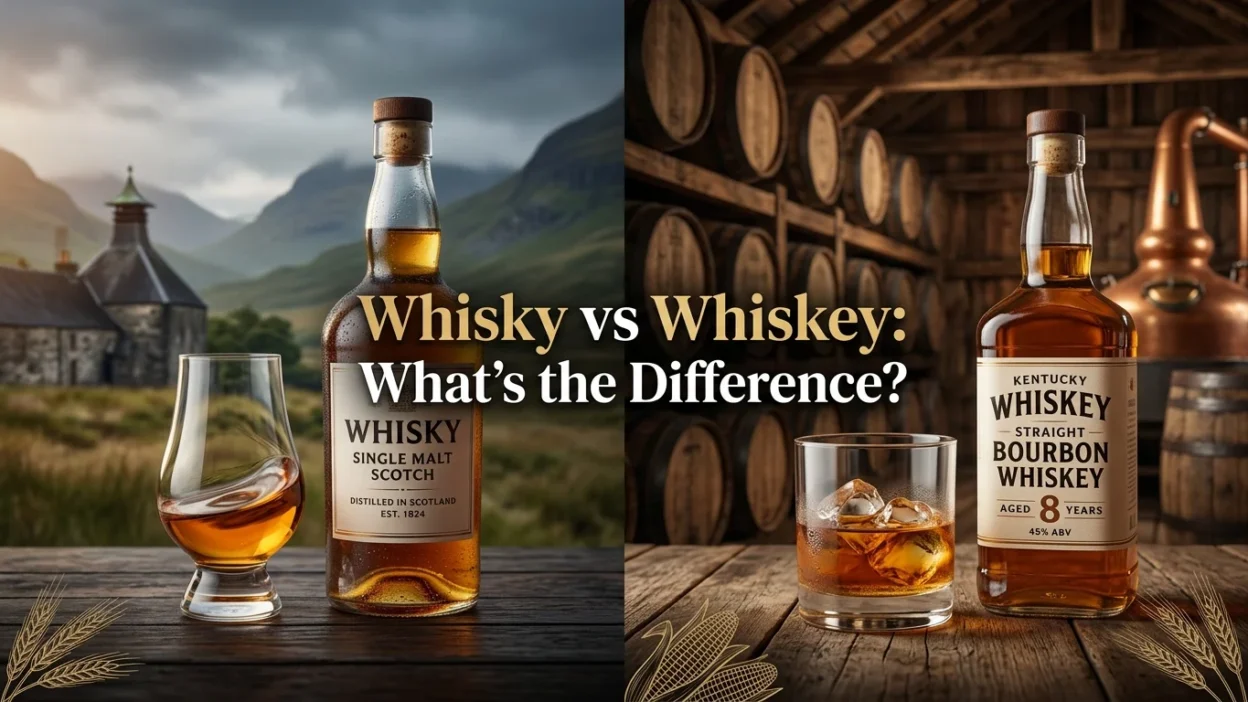
The difference between whisky and whiskey is mainly based on the country of origin.
- Whisky is the preferred spelling in Scotland, Canada, and Japan.
- Whiskey is the preferred spelling in Ireland and the United States.
- Neither spelling is more correct than the other. The right choice depends on the product’s origin or the style guide you are following.
What Does Whisky Mean?
Whisky is a distilled alcoholic beverage made from fermented grain mash. Different grains, such as barley, corn, rye, and wheat, may be used depending on the style and region.
The spelling whisky is traditionally associated with countries like Scotland, Canada, and Japan. Scottish distillers have used this spelling for centuries, and many countries that followed Scottish traditions adopted it as well.
Examples
- Scotland is famous for producing high-quality whisky.
- Japanese whisky has gained worldwide recognition.
- Canadian whisky is often known for its smooth taste.
What Does Whiskey Mean?
Whiskey refers to the same type of distilled spirit. The only noticeable difference is the spelling, which is commonly used in Ireland and the United States.
Irish producers added the letter “e” during the 19th century to distinguish their products from Scottish spirits. American distillers later adopted the Irish spelling because many early whiskey makers were of Irish descent.
Examples
- Kentucky is known for producing excellent whiskey.
- Irish whiskey has a rich and smooth character.
- He ordered a glass of American whiskey after dinner.
Whisky vs Whiskey: The Main Difference
Although both words describe the same type of alcoholic drink, their spelling usually reflects geographic tradition.
| Feature | Whisky | Whiskey |
|---|---|---|
| Preferred spelling | Scotland, Canada, Japan | Ireland, United States |
| Pronunciation | Same | Same |
| Meaning | Distilled grain spirit | Distilled grain spirit |
| Difference in product | None based on spelling alone | None based on spelling alone |
| Common examples | Scotch whisky, Japanese whisky | Irish whiskey, Bourbon whiskey |
The spelling does not automatically tell you how the drink tastes. Flavor depends on ingredients, production methods, aging, and regional traditions—not on whether the word includes the letter “e.”
Why Are There Two Different Spellings?
The two spellings developed because of historical traditions.
Scottish producers continued using whisky, while Irish distillers began using whiskey to distinguish their products during the late 1800s. When Irish immigrants settled in America, they brought their preferred spelling with them.
Today, these traditions remain part of each country’s identity.
Is There Any Difference in Taste?
No. The spelling alone does not determine taste.
For example:
- A Scottish whisky may taste smoky because of peat.
- A Japanese whisky may have delicate floral notes.
- An Irish whiskey is often smooth and light.
- An American whiskey may have sweet vanilla or caramel flavors.
Taste depends on:
- Grain ingredients
- Distillation process
- Aging barrels
- Climate
- Production methods
The spelling simply reflects where the product comes from.
American vs British English
Unlike many spelling differences between American and British English, whisky vs whiskey is not exactly a language rule.
Instead, the spelling follows national production traditions.
- In American English, whiskey is generally preferred because American brands use this spelling.
- In British English, you’ll often see whisky, especially when referring to Scottish products.
When writing generally about alcoholic beverages, many writers use the spelling that matches the drink’s country of origin.
Examples in Everyday Sentences
Here are some examples showing correct usage.
Whisky
- Scotland exports millions of bottles of whisky every year.
- She enjoys Japanese whisky with dinner.
- Canadian whisky is popular around the world.
Whiskey
- He bought a bottle of Irish whiskey.
- Tennessee whiskey has a unique production process.
- They toured several American whiskey distilleries.
How to Remember the Difference
A simple memory trick makes it easy.
- Countries with an “e” in their traditional spelling: Ireland and America → Whiskey
- Countries without the “e”: Scotland, Canada, Japan → Whisky
This isn’t a perfect language rule, but it works well in most situations.
Common Mistakes to Avoid
Many people confuse these spellings. Here are some common errors.
1. Thinking One Spelling Is Wrong
Both whisky and whiskey are correct.
2. Assuming the Taste Is Different
The spelling does not indicate flavor or quality.
3. Mixing Regional Spellings
If discussing Scotch products, use whisky.
If discussing Irish or American products, use whiskey.
4. Believing It Is an American vs British English Rule
This difference is based more on production traditions than standard spelling differences.
When Should You Use Whisky?
Use whisky when referring to:
- Scotch products
- Japanese spirits
- Canadian products
- General discussions following Scottish spelling traditions
Example
Scottish whisky remains one of the world’s most respected spirits.
When Should You Use Whiskey?
Use whiskey when referring to:
- Irish products
- American products
- Bourbon
- Tennessee whiskey
Example
Kentucky produces some of the world’s best whiskey.
Which Spelling Is Better?
Neither spelling is better.
Choose the spelling that matches the product or region.
For example:
- Scotch whisky ✅
- Irish whiskey ✅
- Japanese whisky ✅
- American whiskey ✅
Using the correct regional spelling shows attention to detail and respect for tradition.
FAQs
Is whisky and whiskey the same drink?
Yes. Both refer to the same type of distilled alcoholic beverage. The spelling mainly depends on the country of origin.
Why does Ireland use whiskey instead of whisky?
Irish producers adopted the spelling whiskey during the 19th century to distinguish their products from Scottish whisky.
Why does Scotland spell it whisky?
Scottish distillers have traditionally used the spelling whisky, and that tradition continues today.
Is bourbon whisky or whiskey?
Bourbon is an American spirit, so it is correctly spelled bourbon whiskey.
Is Scotch always spelled whisky?
Yes. Scotch is always written as Scotch whisky, without the letter “e.”
Does Japan use whisky or whiskey?
Japan follows Scottish tradition, so the preferred spelling is whisky.
Can I use either spelling in general writing?
Yes, but it is best to match the spelling to the product or country you are discussing.
Summary
The debate over whisky vs whiskey is not about right or wrong. Both spellings are correct and refer to the same type of distilled spirit. The main difference lies in tradition and geography. Scotland, Canada, and Japan prefer whisky, while Ireland and the United States use whiskey.
Knowing when to use each spelling helps you write more accurately and understand labels, menus, and articles with confidence. Whether you enjoy learning about language or simply want to identify the correct term, remembering the country of origin is the easiest way to choose the right spelling.

William Harved is a passionate language enthusiast and digital writer specializing in English spelling, grammar clarity, and common writing mistakes. As the primary author of Spelword.com, he focuses on helping readers understand confusing word pairs, correct spelling errors, and improve everyday communication.