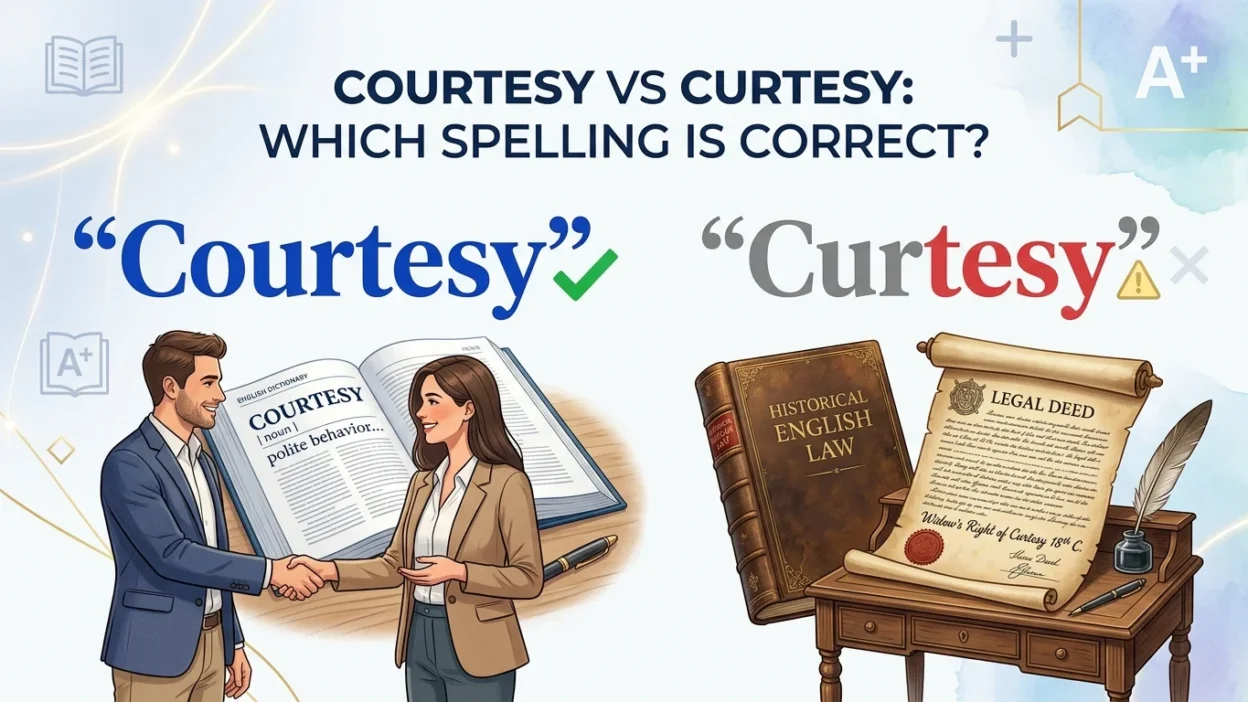
If you have ever wondered whether courtesy or curtesy is the correct spelling, you are certainly not alone. These words look remarkably similar, but they do not have the same meaning or usage. A single letter can make a big difference when you are writing an email, article, academic paper, or professional message.
The good news is that the distinction is easy to remember once you understand it. Courtesy is the standard and widely used word for polite behavior, respect, or a considerate action. Curtesy, on the other hand, is a rare historical term with a specialized legal meaning. In modern everyday English, courtesy is almost always the word you need.
Quick Answer
Courtesy is the correct spelling when you mean politeness, respect, good manners, or a considerate gesture.
Curtesy is a rare and largely obsolete legal term historically associated with a husband’s rights in his deceased wife’s estate.
Examples
- Please show courtesy to other passengers.
- As a courtesy, the hotel offered guests a free shuttle service.
- Thank you for your courtesy and understanding.
- Curtesy is an old legal term that is rarely encountered in modern English.
If you are talking about good manners or respectful behavior, always choose courtesy.
Courtesy Meaning
Courtesy is a noun meaning polite, respectful, or considerate behavior toward another person. It can also refer to an act of kindness or a privilege provided as a gesture of goodwill.
The word is commonly associated with good manners, respect, politeness, and consideration.
For example:
- He treated everyone with courtesy.
- Please have the courtesy to respond to my message.
- The company provided transportation as a courtesy to its customers.
- Simple courtesy can make a difficult conversation much easier.
Courtesy does not necessarily involve a major favor. Sometimes a small gesture, such as holding a door open, saying thank you, listening carefully, or giving someone enough space, can be considered an act of courtesy.
What Does Courtesy Mean in Everyday English?
In everyday communication, courtesy describes behavior that demonstrates respect and consideration for others.
You might show courtesy by:
- Saying “please” and “thank you”
- Listening when someone is speaking
- Allowing someone to go first
- Responding politely to an email
- Respecting another person’s time
- Avoiding unnecessary interruptions
- Offering assistance when appropriate
This is why courtesy is frequently used in workplaces, schools, customer service, public transportation, and social situations.
Curtesy Meaning
Curtesy is a real word, but it is extremely uncommon in modern English.
Historically, curtesy was a legal term referring to a husband’s right to certain property or an estate belonging to his deceased wife, particularly under traditional English common law.
The term is usually encountered in historical legal texts rather than ordinary conversation.
Because this specialized meaning is unfamiliar to most modern English speakers, curtesy is sometimes mistakenly written when someone actually means courtesy.
For modern writing, you should not use curtesy as a variation of courtesy.
Courtesy vs Curtesy: What’s the Difference?
| Word | Meaning | Usage | Example |
|---|---|---|---|
| Courtesy | Politeness, respect, or considerate behavior | Very common | Thank you for your courtesy. |
| Curtesy | Historical legal right concerning a husband’s interest in his wife’s estate | Extremely rare | The document referred to curtesy. |
The key distinction is simple: courtesy is about politeness, while curtesy is an archaic legal term.
Examples of Courtesy in Sentences
Here are some natural examples of courtesy:
- She showed great courtesy toward the man.
- Thank you for your courtesy during the meeting.
- Common courtesy requires us to respect other people’s opinions.
- The restaurant offered a complimentary dessert as a courtesy.
- Please extend the same courtesy to your colleagues.
- He called ahead as a courtesy to the host.
- The driver waited as a courtesy to the passengers.
- Good customer service should always include courtesy and respect.
These examples demonstrate how widely the word can be used in modern English.
Common Expressions With Courtesy
You will often encounter courtesy in fixed phrases and expressions.
As a courtesy
This means something is provided as a polite or considerate gesture.
Example:
The hotel provided a free breakfast as a courtesy.
By courtesy of
This phrase means something is provided, supplied, or made possible by someone.
Example:
The photographs were provided by courtesy of the museum.
Common courtesy
This refers to basic standards of polite and respectful behavior.
Example:
It is common courtesy to say thank you when someone helps you.
Courtesy call
A courtesy call is a polite communication made to inform someone, check on them, or maintain a relationship.
Example:
The manager made a courtesy call to confirm the appointment.
Common Mistakes With Courtesy and Curtesy
The most common mistake is writing curtesy when you mean courtesy.
Incorrect
❌ Thank you for your curtesy.
Correct
✅ Thank you for your courtesy.
Another common mistake occurs in professional communication.
Incorrect
❌ We appreciate your curtesy and cooperation.
Correct
✅ We appreciate your courtesy and cooperation.
Because curtesy is technically a real word, spell-check software may not always identify it as an error. Understanding the meaning is therefore more useful than relying entirely on automatic correction.
Why Is Courtesy Sometimes Misspelled as Curtesy?
The spelling confusion is understandable because courtesy contains a vowel combination that can be difficult to remember.
The pronunciation can also make the spelling less obvious. When people hear the word rather than see it written, they may naturally spell it as curtesy.
Another reason is that English contains many words whose pronunciation does not perfectly reveal their spelling.
The easiest solution is to remember the connection:
Courtesy = courteous behavior.
If you mean polite or respectful behavior, the correct spelling is courtesy.
American vs British English
There is no meaningful spelling difference between American and British English for this word.
Both varieties use:
- Courtesy for politeness and respectful behavior.
- Curtesy only in its rare historical or legal sense.
Therefore, whether you are writing for an American or British audience, courtesy remains the standard spelling when discussing manners, respect, or consideration.
You may see some differences in vocabulary or pronunciation between American and British English, but this particular spelling distinction does not change.
Synonyms for Courtesy
Depending on the context, words with similar meanings include:
- Politeness
- Respect
- Consideration
- Kindness
- Civility
- Good manners
- Decency
- Thoughtfulness
- Graciousness
For example, instead of saying “She treated everyone with courtesy,” you might say, “She treated everyone with respect and consideration.”
However, courtesy remains the most natural choice in many formal and professional contexts.
When Should You Use Courtesy?
Use courtesy when you are talking about:
- Polite behavior
- Good manners
- Respect
- Consideration
- A kind gesture
- Professional conduct
- Customer service
- Complimentary services
- Respectful communication
For example:
“Thank you for your courtesy.”
This means you appreciate someone’s polite or considerate behavior.
When Could Curtesy Be Used?
Curtesy should generally be reserved for historical, legal, or academic discussions involving traditional property law.
If you are reading an old legal document or studying English common law, you may encounter the term.
For modern everyday writing, however, curtesy is almost never necessary.
If your sentence is about manners, kindness, respect, or politeness, courtesy is unquestionably the appropriate word.
Frequently Asked Questions
Is courtesy or curtesy correct?
Courtesy is the correct spelling when you mean politeness, respect, or considerate behavior. Curtesy is a rare historical legal term.
Is curtesy a real word?
Yes, curtesy is a real English word. It historically referred to a husband’s legal rights concerning his deceased wife’s property or estate. It is rarely used today.
What is the meaning of courtesy?
Courtesy means polite, respectful, or considerate behavior toward another person. It can also describe a kind gesture or service offered as a favor.
How do you spell courtesy correctly?
The standard spelling is courtesy, with “our” after the initial “c”: C-O-U-R-T-E-S-Y.
Is courtesy the same in American and British English?
Yes. Courtesy has the same spelling and general meaning in both American and British English.
Why do people spell courtesy as curtesy?
People often make this mistake because courtesy and curtesy sound similar and differ by only one vowel. The rare word curtesy can make the confusion even more understandable.
What is a synonym for courtesy?
Common synonyms include politeness, respect, consideration, civility, kindness, and good manners, depending on the context.
Should I use curtesy in modern writing?
Usually, no. If you mean polite or respectful behavior, use courtesy. The word curtesy is mainly relevant to historical or specialized legal contexts.
Summary
The difference between courtesy and curtesy is primarily a matter of meaning and usage. Courtesy is the standard modern English word for politeness, respect, consideration, good manners, or a thoughtful gesture. It is extremely common in everyday, professional, academic, and business communication.
Curtesy is a legitimate but very rare historical legal term. Because it is not normally used to describe polite behavior, writing curtesy when you mean courtesy is a spelling mistake in most modern contexts. When you want to describe respectful or considerate behavior, remember to use courtesy.

Dani Morrison is a dedicated language writer and spelling expert at Spelword.com, where she focuses on helping readers understand common English spelling mistakes and confusing word pairs. With a passion for clear communication, Dani creates easy-to-follow guides that simplify complex grammar and spelling rules for everyday use.