Have you ever stopped while writing and wondered whether totalling or totaling is the correct spelling? You’re not alone. This is one of the most common spelling differences that confuses English learners, students, professionals, and even native speakers.
The good news is that both totalling and totaling are correct. The only difference is the variety of English you are using. Understanding when to use each spelling will help you write more confidently and ensure your content matches your audience’s expectations.
Quick Answer
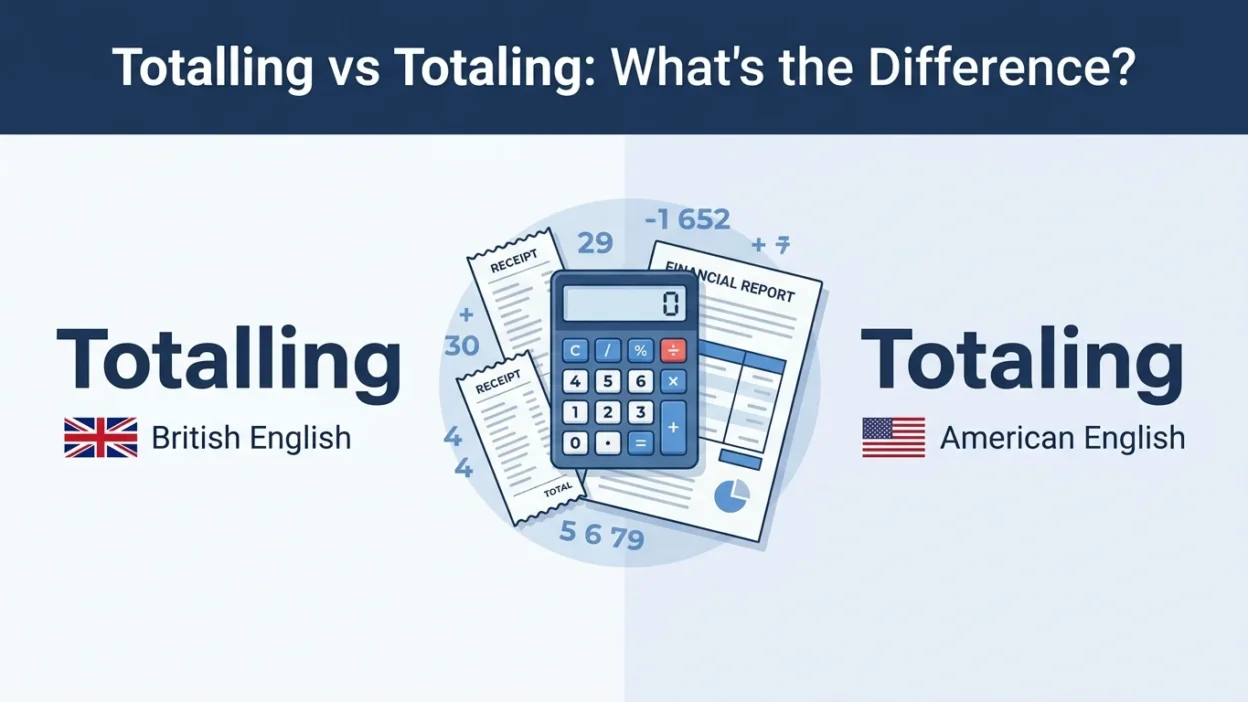
Totalling is the preferred spelling in British English, while totaling is the standard spelling in American English. Both words have the same meaning and are grammatically correct. Choose the version that matches the English style you are using and remain consistent throughout your writing.
| Spelling | English Variety | Correct? |
|---|---|---|
| Totalling | British English | ✅ Yes |
| Totaling | American English | ✅ Yes |
What Do “Totalling” and “Totaling” Mean?
Both totalling and totaling are present participles (or gerunds) of the verb total.
They mean:
- Adding numbers together to find the final amount.
- Calculating the overall sum.
- Reaching a complete amount.
- In some contexts, completely damaging something, especially a vehicle.
The meaning stays exactly the same regardless of which spelling you choose.
For example:
- She is totalling the expenses before submitting the report.
- She is totaling the expenses before submitting the report.
Both sentences are correct. The preferred spelling depends only on whether you’re using British or American English.
Totalling vs Totaling: What’s the Difference?
The difference is purely a spelling convention.
| Feature | Totalling | Totaling |
|---|---|---|
| Meaning | Adding up or calculating a total | Adding up or calculating a total |
| British English | Preferred | Less common |
| American English | Rare | Preferred |
| Pronunciation | Same | Same |
| Grammar | Correct | Correct |
There is no difference in pronunciation, meaning, or grammar.
Why Is There a Difference?
The difference comes from spelling rules followed by different English varieties.
British English often doubles the final L before adding endings like -ing or -ed, especially when the stress pattern allows it.
American English usually keeps a single L in many of these situations.
This spelling pattern appears in many other words as well.
Examples include:
| British English | American English |
|---|---|
| Travelling | Traveling |
| Cancelling | Canceling |
| Labelling | Labeling |
| Fuelled | Fueled |
| Totalling | Totaling |
These differences developed naturally over time and are now accepted standards.
When to Use “Totalling”
Use totalling when writing in British English.
It is commonly used in:
- The United Kingdom
- Australia
- New Zealand
- Ireland
- South Africa
- Many Commonwealth countries
Examples
- We are totalling this month’s sales figures.
- The accountant spent the afternoon totalling the invoices.
- Their expenses are totalling more than expected.
- She is totalling the scores from every participant.
- The repair costs are totalling thousands of pounds.
When to Use “Totaling”
Use totaling when writing in American English.
It is the preferred spelling in:
- The United States
- American businesses
- U.S. schools
- American newspapers
- U.S. government publications
Examples
- They are totaling all customer purchases.
- The company is totaling its annual revenue.
- We finished totaling the survey responses.
- She spent hours totaling the receipts.
- The damages are totaling millions of dollars.
Totalling and Totaling in the Sense of Damaging a Vehicle
Both spellings can also describe a vehicle that has been damaged beyond economical repair.
Examples in British English:
- The accident ended up totalling the car.
- Heavy flooding nearly totalled several vehicles.
Examples in American English:
- The crash ended up totaling the truck.
- The storm nearly totaled his new SUV.
Again, only the spelling changes.
Examples in Everyday Writing
Here are examples in different situations.
Business
British English:
- We are totalling quarterly expenses today.
American English:
- We are totaling quarterly expenses today.
School
British English:
- The teacher is totalling everyone’s exam marks.
American English:
- The teacher is totaling everyone’s exam scores.
Personal Finance
British English:
- I am totalling my monthly bills.
American English:
- I am totaling my monthly expenses.
Insurance
British English:
- The accident ended up totalling the vehicle.
American English:
- The collision ended up totaling the vehicle.
Common Mistakes to Avoid
Many writers make simple mistakes with these spellings.
Avoid these common errors:
- Mixing British and American spellings in one document.
- Assuming one spelling is incorrect.
- Changing spelling midway through an article.
- Ignoring your organization’s style guide.
- Thinking the meaning changes with the spelling.
Consistency is more important than choosing one version over the other.
Tips to Remember the Difference
Here are a few easy ways to remember which spelling to use.
- Totalling = British English = double L.
- Totaling = American English = single L.
- Match the spelling with your audience.
- Follow your employer’s, publisher’s, or school’s preferred style.
- Stay consistent throughout your writing.
British vs American English
The distinction between these spellings reflects broader spelling differences between British and American English.
| British English | American English |
|---|---|
| Totalling | Totaling |
| Travelled | Traveled |
| Travelling | Traveling |
| Cancelled | Canceled |
| Cancelling | Canceling |
| Labelled | Labeled |
| Labelling | Labeling |
Neither version is more correct than the other. They simply follow different spelling conventions.
Which Spelling Should You Choose?
Your choice depends entirely on your audience.
Choose totalling if:
- Your readers use British English.
- You are writing for UK-based publications.
- Your company follows British spelling conventions.
Choose totaling if:
- Your readers use American English.
- Your content is aimed at U.S. audiences.
- Your organization follows American style guides.
If you’re unsure, check previous documents or your organization’s editorial standards before deciding.
FAQs
Is totalling correct?
Yes. Totalling is the standard spelling in British English and is widely accepted in countries that follow British spelling conventions.
Is totaling correct?
Yes. Totaling is the preferred American English spelling and is correct in U.S. English.
Which spelling should I use in academic writing?
Use the spelling required by your university, journal, or style guide. British institutions generally prefer totalling, while American institutions usually use totaling.
Do totalling and totaling have different meanings?
No. Both words have exactly the same meaning. The only difference is regional spelling.
Why does British English use two Ls?
British English commonly doubles the final L before adding endings like -ing or -ed, while American English often keeps a single L.
Can I use both spellings in the same document?
It is best not to. Choose one spelling style and use it consistently throughout your writing.
Does pronunciation change between totalling and totaling?
No. Both words are pronounced the same way.
Summary
The choice between totalling and totaling is not about right or wrong. Both spellings are correct and share the same meaning, pronunciation, and grammatical function. The only distinction is regional preference. British English uses totalling, while American English prefers totaling.
When writing, always consider your audience and follow the spelling style they expect. Whether you’re preparing academic work, business reports, blog posts, or everyday emails, using the appropriate spelling consistently will make your writing look more professional and polished.