
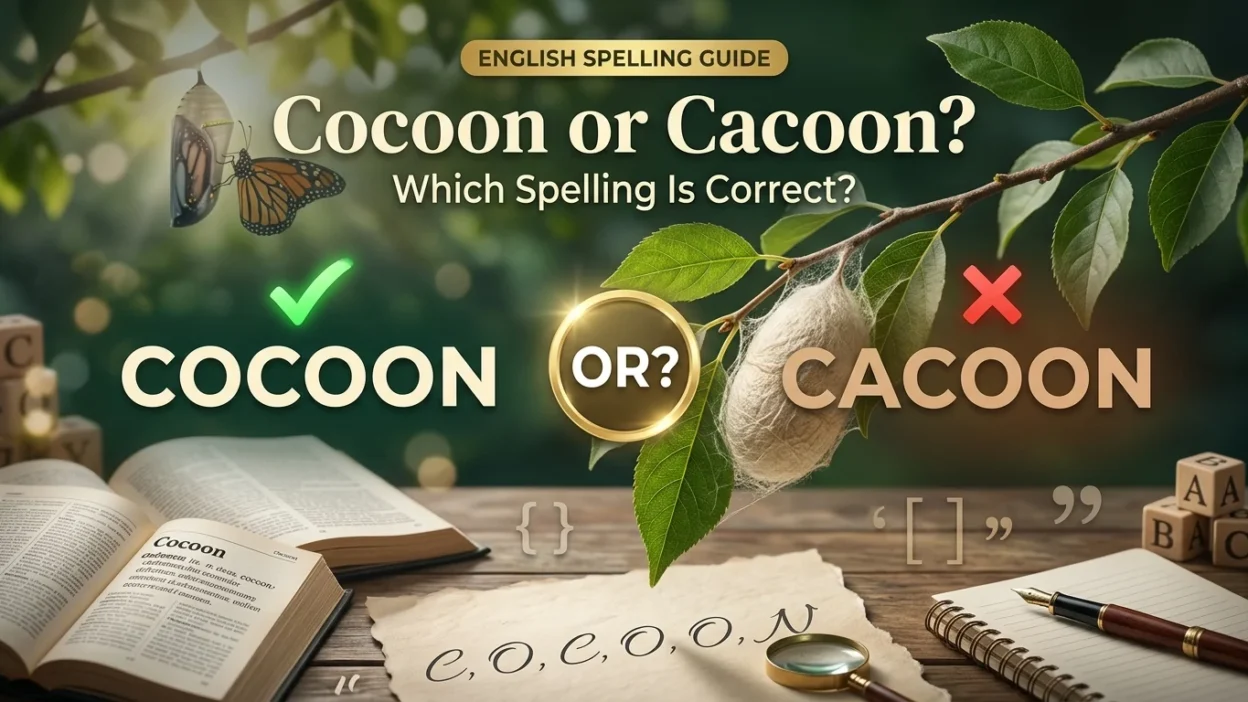
If you’ve ever hesitated between Cocoon or Cacoon, you’re not alone. The two spellings look remarkably similar, and a small spelling difference can easily cause confusion when you’re writing about insects, butterflies, or a protective covering.
The correct spelling in standard English is cocoon. Cacoon is generally considered a misspelling when you mean the protective covering made by certain insects. Once you understand the meaning and pronunciation of cocoon, it’s much easier to remember the correct form.
Quick Answer
Cocoon is the correct spelling. Cacoon is an incorrect spelling when referring to the protective covering formed by an insect or similar structure.
- ✅ Cocoon — correct
- ❌ Cacoon — incorrect
- Plural: cocoons
- Verb: cocoon
- Past tense: cocooned
There is no American vs British spelling difference for cocoon. Both American and British English use the same spelling.
What Does Cocoon Mean?
A cocoon is a protective covering created by certain insects, especially moth larvae, before they undergo transformation. The cocoon provides a protected environment during an important stage of development.
The word can also be used more broadly to describe anything that surrounds and protects a person or object.
For example:
- The caterpillar formed a cocoon on the branch.
- The moth remained inside its cocoon during development.
- The plant was protected by a cocoon of fabric.
- She wrapped herself in a warm cocoon of blankets.
In figurative language, cocoon can describe a comfortable or isolated environment that makes someone feel safe.
Why Is “Cacoon” Incorrect?
Cacoon is a common spelling mistake caused by the pronunciation and visual similarity of the word. People may hear the first vowel sound and incorrectly assume that the word is spelled with a.
However, the standard spelling is cocoon, with two o’s:
C-O-C-O-O-N
A useful way to remember it is to associate the word with the image of a caterpillar inside a cocoon. The repeated “oo” in the middle is an important part of the spelling.
Cocoon vs Cacoon: Comparison Table
| Feature | Cocoon | Cacoon |
|---|---|---|
| Correct standard spelling | ✅ Yes | ❌ No |
| Meaning | Protective covering | No standard meaning in this context |
| Used in American English | ✅ Yes | ❌ No |
| Used in British English | ✅ Yes | ❌ No |
| Plural | Cocoons | — |
| Common use | Insects, protection, figurative language | Common misspelling |
The key point is simple: cocoon is the word you should use in standard English.
How to Pronounce Cocoon
Cocoon is commonly pronounced approximately like kuh-KOON.
The second syllable receives the stronger stress.
Breaking it into sounds can make the spelling easier to remember:
co + coon
The pronunciation does not create a different British or American spelling. Both varieties of English use cocoon.
Examples of Cocoon in Sentences
Understanding the word through examples is one of the easiest ways to remember it.
Examples Related to Insects
- The caterpillar built a cocoon beneath a leaf.
- A moth emerged from its cocoon.
- The scientist observed the insect inside its cocoon.
- The tiny cocoon was attached to a tree branch.
- The caterpillar disappeared into its cocoon before transforming.
Examples in Figurative Language
The word can also describe a protective or comfortable environment.
- The blankets created a warm cocoon around the child.
- She stayed in her quiet cocoon while recovering from a busy week.
- The small room became a peaceful cocoon away from the noise outside.
- The cabin provided a cozy cocoon during the winter.
These figurative uses are perfectly natural because the word carries the idea of protection, comfort, and enclosure.
Cocoon as a Noun
The most common use of cocoon is as a noun.
For example:
The butterfly was developing inside a cocoon.
Here, cocoon identifies the protective covering surrounding the developing insect.
The plural form is cocoons:
- One cocoon
- Two cocoons
- Several cocoons
Notice that the plural is formed by simply adding -s.
Cocoon as a Verb
Cocoon can also function as a verb. As a verb, it means to surround or enclose something in a protective covering.
Examples include:
- The material cocooned the fragile equipment.
- She cocooned herself in a thick blanket.
- The insulation cocooned the pipes.
The verb can be used literally or figuratively.
Common Mistakes With Cocoon
Because cocoon is relatively short and has an unusual vowel pattern, several mistakes can appear in informal writing.
Writing Cacoon Instead of Cocoon
❌ The caterpillar is inside a cacoon.
✅ The caterpillar is inside a cocoon.
Confusing the Vowels
The incorrect spelling cacoon replaces the first o with a. Remember that the standard word begins with co-, not ca-.
Forgetting the Double “O”
❌ Cocn
❌ Cocon
✅ Cocoon
The spelling contains two consecutive o’s near the end:
c-o-c-o-o-n
Using the Wrong Plural
The correct plural is:
✅ cocoons
Not:
❌ cocoones
❌ cocoon’s
Remember that the apostrophe in cocoon’s would normally indicate possession, not a plural.
Is Cocoon an American or British Spelling?
Unlike many English spelling differences, cocoon does not change between American and British English.
Both use:
Cocoon
For example:
- American English: The moth emerged from its cocoon.
- British English: The moth emerged from its cocoon.
So, if you’re writing for readers in the United States, United Kingdom, Australia, Canada, or other English-speaking regions, cocoon is the appropriate spelling.
Cocoon vs Chrysalis: Are They the Same?
Although these words are sometimes used interchangeably in casual conversation, they don’t always refer to the same thing.
A cocoon is generally a protective covering made from silk or another material by an insect, particularly a moth.
A chrysalis specifically refers to the pupal stage of a butterfly. A butterfly pupa is not normally enclosed in a silk cocoon.
This distinction is useful if you’re writing scientifically or academically about insect development.
Therefore, saying that every butterfly develops inside a cocoon would not be scientifically precise.
Why Do People Spell Cocoon as Cacoon?
There are several possible reasons for this common error.
First, English spelling is not always predictable from pronunciation. The vowel sound in cocoon can make the spelling less obvious to someone hearing the word rather than seeing it.
Second, people may unconsciously associate the first syllable with words beginning with ca-.
Finally, because cacoon looks plausible at first glance, the error can go unnoticed during quick writing or proofreading.
The best solution is simply to memorize the standard spelling: cocoon.
Tips to Remember the Correct Spelling
Try this simple memory trick:
COCOON has “CO” twice.
Think:
CO + COON = COCOON
You can also connect the spelling with the idea of a caterpillar creating a protective covering. Visual associations are often more memorable than simply memorizing letters.
Another useful technique is to write the word several times:
cocoon — cocoon — cocoon
After repeated exposure, the correct spelling becomes much more familiar.
Frequently Asked Questions
Is cocoon or cacoon correct?
Cocoon is the correct standard spelling. Cacoon is generally a misspelling when referring to an insect’s protective covering.
What is the meaning of cocoon?
A cocoon is a protective covering made by certain insects, especially moth larvae, during their development. The word can also describe something that provides protection or comfort.
Is cacoon a real English word?
In standard modern English, cacoon is not the accepted spelling for the insect structure. It is usually an error for cocoon.
Is cocoon spelled differently in British English?
No. Cocoon is spelled the same way in both American and British English.
What is the plural of cocoon?
The plural form is cocoons. For example, “Several cocoons were attached to the branches.”
What is the difference between a cocoon and a chrysalis?
A cocoon is a protective covering produced by certain insects, particularly moths. A chrysalis is the pupal stage of a butterfly and is not the same structure.
How do you pronounce cocoon?
Cocoon is commonly pronounced kuh-KOON, with the main stress on the second syllable.
Can cocoon be used as a verb?
Yes. As a verb, cocoon means to surround or enclose something protectively. For example, “She cocooned herself in a warm blanket.”
Summary
The correct spelling is cocoon, not cacoon, when you’re referring to the protective covering associated with certain insects. The word can also be used figuratively for something that surrounds a person or object and provides comfort, safety, or isolation. Remember that the spelling contains the important “oo” combination: C-O-C-O-O-N.
Unlike words such as colour/color or labelling/labeling, cocoon does not have separate American and British spellings. Both varieties of English use cocoon, making the choice particularly straightforward. If you see cacoon in ordinary writing, it is most likely simply a spelling mistake.

William Harved is a passionate language enthusiast and digital writer specializing in English spelling, grammar clarity, and common writing mistakes. As the primary author of Spelword.com, he focuses on helping readers understand confusing word pairs, correct spelling errors, and improve everyday communication.