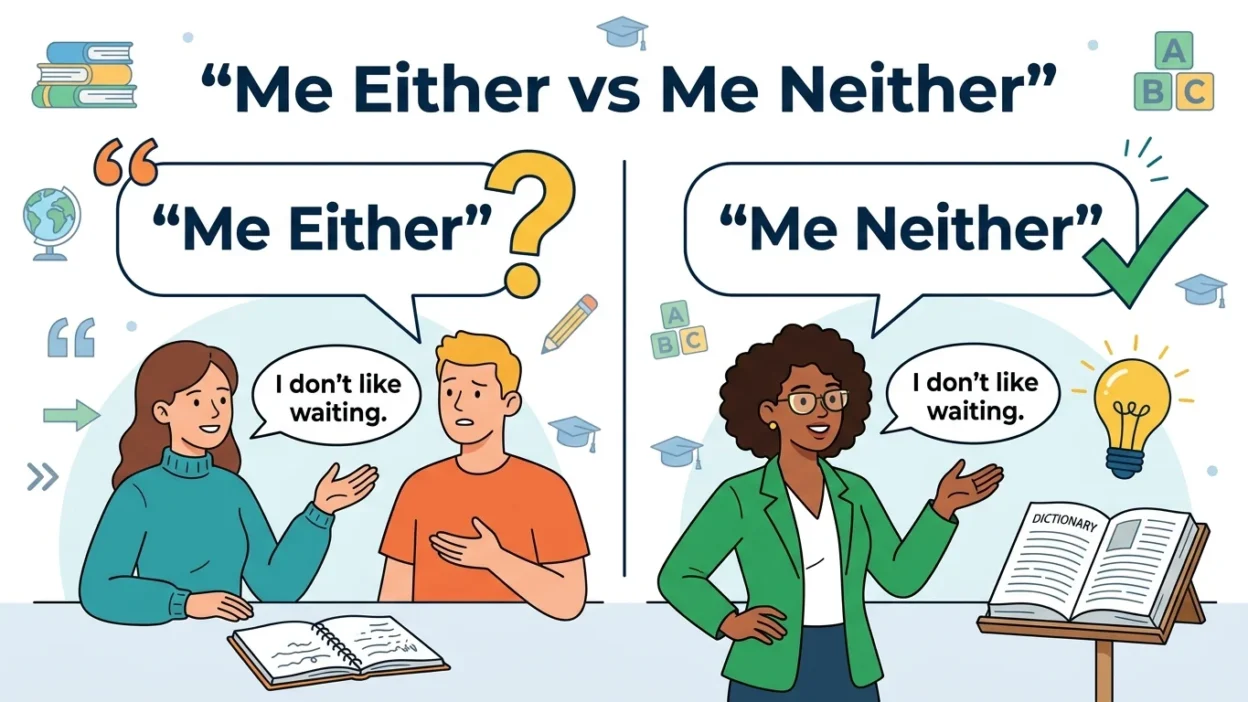
Have you ever heard someone say, “I don’t like spicy food,” and another person respond with either “me either” or “me neither”? If so, you may have wondered which expression is actually correct. The debate over me either vs me neither is one of the most common grammar questions in everyday English.
The confusion exists because both phrases are widely used, especially in casual conversation. However, traditional grammar rules and modern spoken English don’t always agree. Understanding the difference can help you sound more natural, communicate more clearly, and choose the right expression for the situation.
Quick Answer
Both me either and me neither are used to agree with a negative statement, but they differ in formality and grammatical acceptance.
- Me neither is traditionally considered the grammatically correct response.
- Me either is very common in informal American English and is widely accepted in conversation.
Examples
Person A: I don’t enjoy horror movies.
Person B: Me neither. ✅
Person B: Me either. ✅ (informal, especially in American English)
If you’re writing formally or following traditional grammar rules, me neither is usually the safer choice.
What Does “Me Neither” Mean?
Me neither is a short way of saying:
- Neither do I.
- I don’t either.
- I agree with your negative statement.
It expresses agreement with something negative.
Examples
- I don’t like coffee. → Me neither.
- I can’t swim. → Me neither.
- I wasn’t invited. → Me neither.
- I don’t understand the instructions. → Me neither.
In each example, the speaker shares the same negative experience or opinion.
What Does “Me Either” Mean?
Me either serves the same purpose in modern conversation. It is often used to agree with a negative statement.
Examples
- I don’t want to go. → Me either.
- I can’t find my keys. → Me either.
- I don’t watch that show. → Me either.
Although traditional grammar experts once discouraged this usage, it has become extremely common in everyday American English.
Me Either vs Me Neither: Comparison Table
| Feature | Me Neither | Me Either |
|---|---|---|
| Traditional grammar | ✅ Correct | ⚠ Less traditional |
| Informal conversation | ✅ Common | ✅ Very common |
| Formal writing | ✅ Preferred | ❌ Usually avoided |
| Means agreement with a negative statement | ✅ Yes | ✅ Yes |
| Common in American English | ✅ Yes | ✅ Very common |
| Common in British English | ✅ Yes | Less common |
Both phrases communicate the same basic idea, but me neither remains the more formally accepted option.
Why Do People Say “Me Either”?
The popularity of me either comes from how people naturally shorten sentences.
Consider these examples:
- I don’t like broccoli either.
- I don’t want to go either.
- I can’t swim either.
Over time, speakers began shortening these responses to simply:
- Me either.
Because it sounds natural and is widely understood, it became common in spoken English, especially in the United States.
Why Is “Me Neither” Considered More Correct?
Traditional grammar follows a logical structure.
When agreeing with a negative statement, English often uses neither.
Examples
- I don’t like onions.
- Neither do I.
- I can’t drive.
- Neither can I.
- I wasn’t there.
- Neither was I.
The shortened version becomes:
- Me neither.
This follows the established grammatical pattern of using neither with negative statements.
Examples of Me Neither in Sentences
Here are common examples of proper usage:
- I don’t enjoy crowded places. → Me neither.
- I haven’t seen that movie. → Me neither.
- I can’t speak French. → Me neither.
- I wasn’t expecting that. → Me neither.
- I don’t understand this question. → Me neither.
These responses sound natural in both spoken and written English.
Examples of Me Either in Sentences
Although more informal, these examples are very common:
- I don’t eat seafood. → Me either.
- I haven’t finished the book. → Me either.
- I can’t remember his name. → Me either.
- I wasn’t aware of the change. → Me either.
- I don’t like waking up early. → Me either.
Native speakers frequently use these expressions in casual conversation.
Common Mistakes with Me Either and Me Neither
Mistake 1: Using Them with Positive Statements
❌ I love chocolate. Me neither.
✅ I love chocolate. Me too.
Both me neither and me either should generally respond to negative statements.
Mistake 2: Using “Neither” Incorrectly
❌ I like pizza. Me neither.
✅ I like pizza. Me too.
Since the original statement is positive, use a positive agreement phrase.
Mistake 3: Using Them in Formal Writing
Formal writing typically favors complete grammatical structures.
❌ The report was delayed. Me either.
✅ The report was delayed, and neither was I informed.
In professional writing, complete sentences are usually preferred.
Mistake 4: Assuming One Is Always Wrong
Many learners think me either is completely incorrect.
In reality:
- It is common in spoken American English.
- It is widely understood.
- It is accepted in casual conversation.
The choice often depends on context rather than strict correctness.
Formal Alternatives
If you want to sound more formal, use complete responses.
Examples
Instead of:
- Me neither.
Use:
- Neither do I.
- Neither can I.
- Neither have I.
- Neither was I.
These forms are ideal for academic, professional, and formal communication.
Examples in Context
- I don’t like cold weather.
- Neither do I.
- I can’t attend the meeting.
- Neither can I.
- I haven’t finished the assignment.
- Neither have I.
These constructions follow standard grammar conventions.
Me Either vs Me Neither in Everyday Conversation
In casual speech, native speakers often choose whichever sounds natural.
Informal Dialogue
Person A: I don’t watch reality TV.
Person B: Me neither.
Person C: Me either.
Most listeners will understand both responses immediately.
Because spoken language evolves over time, both phrases have become familiar in modern English.
American vs British English
The difference between American and British English is worth noting.
American English
Both expressions are common, but me either appears more frequently in everyday speech.
Examples:
- I don’t like that restaurant.
- Me either.
Many Americans consider this perfectly natural.
British English
British speakers generally prefer:
- Me neither.
The phrase aligns more closely with traditional grammar patterns and remains more common in the UK.
Which Should You Use?
If you’re unsure, choose me neither because:
- It works in both American and British English.
- It is accepted in formal and informal situations.
- Grammar guides generally recommend it.
Grammar Rule Behind Neither and Either
Understanding the individual words helps clarify the difference.
Neither
Means:
- Not one and not the other.
- Not either.
Examples:
- Neither answer is correct.
- Neither option appeals to me.
Either
Usually means:
- One or the other.
- Also (in negative constructions).
Examples:
- Either choice is acceptable.
- I don’t like it either.
This overlap explains why me either developed naturally in speech.
Why the Debate Continues
Language changes over time.
Many expressions that were once considered incorrect eventually become accepted through widespread use.
Today:
- Grammar purists often prefer me neither.
- Everyday speakers frequently use both expressions.
- Most people understand either version instantly.
As a result, the debate continues, even though communication rarely suffers.
Frequently Asked Questions
Is me either grammatically correct?
Traditionally, me neither is considered more grammatically correct, but me either is widely accepted in casual American English.
Is me neither always correct?
Yes, me neither is generally accepted as the standard response to a negative statement.
Which is more common in American English?
Both are common, but me either appears very frequently in informal American conversation.
Which is preferred in British English?
British English generally favors me neither.
Can I use me either in formal writing?
It is usually better to avoid it in formal writing and use complete expressions such as neither do I.
What does me neither mean?
It means “I don’t either” or “the same is true for me” in response to a negative statement.
What should I say after a positive statement?
Use me too rather than me neither or me either.
Are me either and me neither interchangeable?
In many casual conversations, yes. However, me neither remains the more traditionally accepted form.
Summary
The difference between me either vs me neither comes down to grammar, usage, and context. Both expressions are commonly used to agree with a negative statement. However, me neither is traditionally regarded as the grammatically correct form and is generally preferred in formal situations.
At the same time, me either has become deeply rooted in informal American English and is widely used by native speakers. While some grammar experts still favor me neither, most listeners understand both expressions without confusion. Choosing the right one often depends on your audience, setting, and level of formality.