Punctuation can make a huge difference in how your writing is understood. Among the most commonly confused punctuation marks are the comma (,) and the semicolon (;). While both help organize sentences and ideas, they serve very different purposes. Using the wrong one can lead to awkward, unclear, or even grammatically incorrect writing.
If you’ve ever wondered whether a sentence needs a comma or a semicolon, you’re not alone. Many students, professionals, and native English speakers struggle with this distinction. The good news is that once you understand the role of each punctuation mark, choosing the right one becomes much easier.
Quick Answer
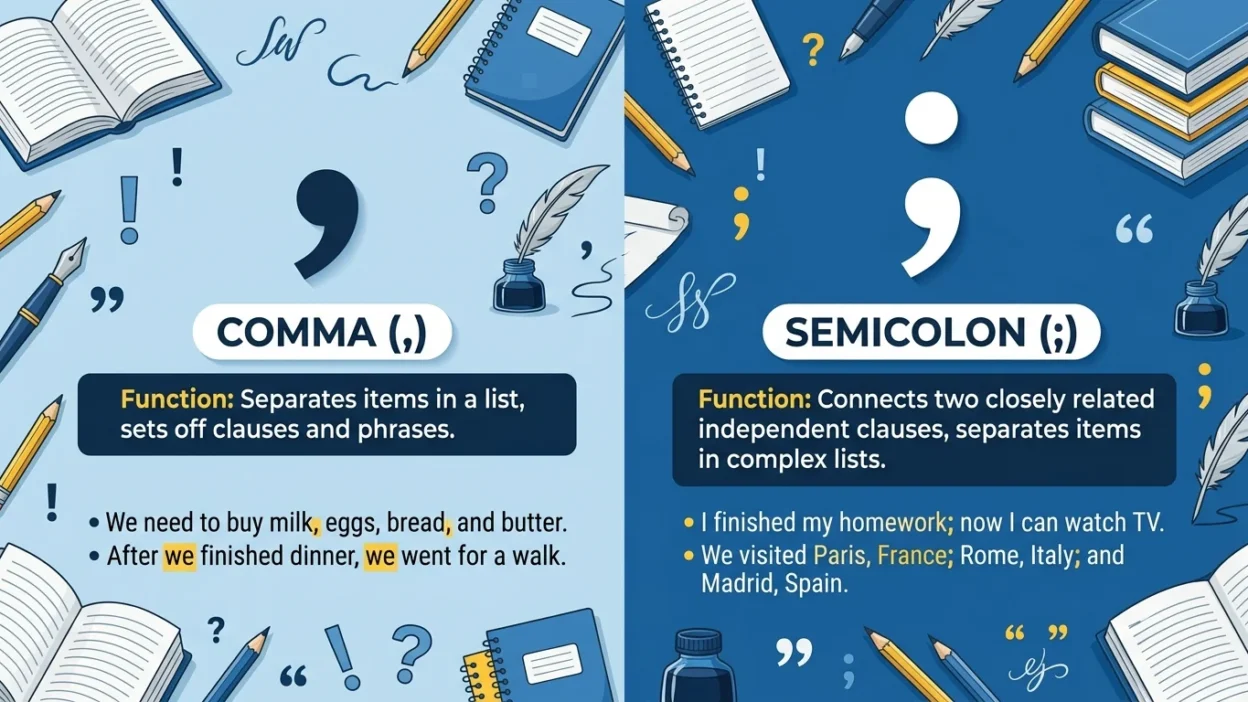
A comma (,) separates words, phrases, clauses, or items within a sentence.
A semicolon (;) connects two closely related independent clauses that could stand as complete sentences on their own.
Examples:
- I bought apples, oranges, and bananas.
- I wanted to go for a walk; it started raining.
A simple rule to remember:
- Comma = Short pause or separation
- Semicolon = Stronger connection between complete ideas
What Is a Comma?
A comma is one of the most frequently used punctuation marks in English. It helps readers understand sentence structure by separating elements and creating natural pauses.
Commas improve readability and prevent confusion.
Common Uses of Commas
Separating Items in a List
- I bought milk, bread, eggs, and cheese.
- She enjoys reading, writing, and traveling.
Separating Introductory Words or Phrases
- After dinner, we watched a movie.
- However, I disagree with that opinion.
Joining Clauses with Coordinating Conjunctions
- I wanted coffee, but the café was closed.
- She studied hard, so she passed the exam.
Adding Extra Information
- My brother, who lives in London, is visiting next week.
In these examples, commas help organize information and make sentences easier to read.
What Is a Semicolon?
A semicolon is stronger than a comma but weaker than a period. It creates a connection between two complete thoughts that are closely related.
Many writers use semicolons to show a relationship between ideas without fully separating them into different sentences.
Common Uses of Semicolons
Connecting Independent Clauses
- The weather was beautiful; we spent the day outside.
- She loves music; her sister prefers art.
Each part could be a complete sentence on its own.
Before Transitional Expressions
- He studied for hours; however, he still felt unprepared.
- We planned carefully; therefore, the project succeeded.
Separating Complex List Items
- The conference included guests from Paris, France; Berlin, Germany; and Rome, Italy.
In this case, semicolons make the list easier to understand because commas already appear within the items.
Comma vs Semicolon: Key Differences
Understanding the differences between these punctuation marks is essential for clear writing.
| Feature | Comma (,) | Semicolon (;) |
|---|---|---|
| Purpose | Separates sentence elements | Connects related complete sentences |
| Strength | Weaker pause | Stronger pause |
| Can Join Two Independent Clauses Alone? | No | Yes |
| Common Use | Lists and sentence organization | Linking related ideas |
| Example | I bought apples, oranges, and pears. | I bought apples; they were on sale. |
When to Use a Comma
A comma is appropriate when you need a brief separation within a sentence.
In Lists
- We packed clothes, snacks, water, and maps.
Before Coordinating Conjunctions
- She wanted to stay, but she had work.
- I called him, and he answered immediately.
After Introductory Elements
- In the morning, we went jogging.
- Fortunately, nobody was injured.
Around Nonessential Information
- Sarah, my best friend, lives nearby.
These uses help maintain clarity and flow.
When to Use a Semicolon
A semicolon works best when two complete ideas are strongly connected.
Between Related Independent Clauses
- The presentation ended early; everyone appreciated the extra time.
- The restaurant was crowded; we decided to order takeout.
Before Transitional Words
Common transitional words include:
- However
- Therefore
- Consequently
- Nevertheless
- Moreover
Examples:
- The plan seemed risky; nevertheless, we moved forward.
- Sales increased significantly; therefore, profits improved.
In Complex Lists
- Our offices are located in Toronto, Canada; Sydney, Australia; and Dublin, Ireland.
This prevents confusion and improves readability.
Common Mistakes with Commas and Semicolons
Many punctuation errors occur because writers use commas and semicolons interchangeably.
Mistake 1: Comma Splice
Incorrect:
- I was tired, I went to bed early.
This joins two complete sentences with only a comma.
Correct:
- I was tired; I went to bed early.
- I was tired, so I went to bed early.
- I was tired. I went to bed early.
Mistake 2: Using a Semicolon with an Incomplete Clause
Incorrect:
- Because it was raining; we stayed inside.
Correct:
- Because it was raining, we stayed inside.
The first part is not a complete sentence, so a semicolon is incorrect.
Mistake 3: Using a Comma Before Transition Words
Incorrect:
- The project was delayed, however, we finished on time.
Correct:
- The project was delayed; however, we finished on time.
Mistake 4: Overusing Semicolons
Some writers insert semicolons too often.
Incorrect:
- She likes pizza; and pasta.
Correct:
- She likes pizza and pasta.
Not every pause requires a semicolon.
Examples of Comma vs Semicolon in Context
Let’s compare them side by side.
Comma Example
- The meeting ended, and everyone went home.
The comma works because it joins clauses with the conjunction “and.”
Semicolon Example
- The meeting ended; everyone went home.
The semicolon directly links two related complete sentences.
Comma Example
- We visited museums, parks, and restaurants.
Semicolon Example
- We visited museums in New York, New York; Chicago, Illinois; and Boston, Massachusetts.
The semicolon prevents confusion in a complex list.
How to Decide Which One to Use
Ask yourself these questions:
Are You Separating Items or Parts of a Sentence?
Use a comma.
Example:
- I bought coffee, tea, and sugar.
Are You Connecting Two Complete Sentences?
Use a semicolon.
Example:
- The train was late; we missed our appointment.
Is There a Coordinating Conjunction?
Use a comma before the conjunction.
Example:
- She was nervous, but she performed well.
Is There a Transitional Word?
Use a semicolon before it.
Example:
- The report was finished; therefore, we submitted it.
American vs British English
The basic rules for commas and semicolons are largely the same in both American and British English.
One small difference involves the serial comma, often called the Oxford comma.
American English
American style guides often encourage the Oxford comma.
Example:
- Red, blue, and green.
British English
British publications vary more in their use of the Oxford comma.
Example:
- Red, blue and green.
However, semicolon usage remains virtually identical in both forms of English.
Why Proper Punctuation Matters
Correct punctuation improves clarity, professionalism, and readability.
A misplaced comma can confuse readers, while a properly used semicolon can create a smooth connection between ideas.
Whether you’re writing emails, essays, reports, blog posts, or business documents, understanding punctuation helps your message appear polished and credible.
Good punctuation also improves reader engagement because it guides people naturally through your writing.
Frequently Asked Questions
What is the main difference between a comma and a semicolon?
A comma separates parts of a sentence, while a semicolon connects closely related complete sentences.
Can a semicolon replace a period?
Yes. A semicolon can replace a period when two independent clauses are closely related.
Can a semicolon replace a comma?
Sometimes. A semicolon can replace a comma in complex lists or when joining independent clauses.
What is a comma splice?
A comma splice occurs when two complete sentences are joined with only a comma instead of proper punctuation.
Should I use a semicolon before however?
Yes. When “however” connects two independent clauses, use a semicolon before it.
Is a semicolon stronger than a comma?
Yes. A semicolon creates a stronger separation than a comma but a weaker separation than a period.
Are semicolons used often in modern writing?
They are less common than commas but remain valuable for formal, academic, and professional writing.
Do British and American English use semicolons differently?
No. Semicolon rules are generally the same in both American and British English.
Summary
Understanding comma vs semicolon is essential for clear and effective writing. A comma helps separate words, phrases, clauses, and list items, making sentences easier to read. A semicolon, on the other hand, connects closely related independent clauses and organizes complex lists where commas alone may create confusion.
Although these punctuation marks may seem similar, they serve different purposes. By learning when to use a comma and when to use a semicolon, you can improve sentence flow, avoid common grammar mistakes, and communicate your ideas with greater confidence and precision.

William Harved is a passionate language enthusiast and digital writer specializing in English spelling, grammar clarity, and common writing mistakes. As the primary author of Spelword.com, he focuses on helping readers understand confusing word pairs, correct spelling errors, and improve everyday communication.