Have you ever hesitated while writing because you weren’t sure whether to use proof or prove? These two words are closely related, and since they come from the same word family, it’s easy to confuse them. However, they have different grammatical roles and meanings, making it important to know when each one is appropriate.
In this guide, you’ll learn the difference between proof vs prove, understand their meanings, see practical examples, discover common mistakes, and learn simple tricks to remember the correct usage. By the end, you’ll be able to use both words naturally and confidently in everyday English.
Quick Answer
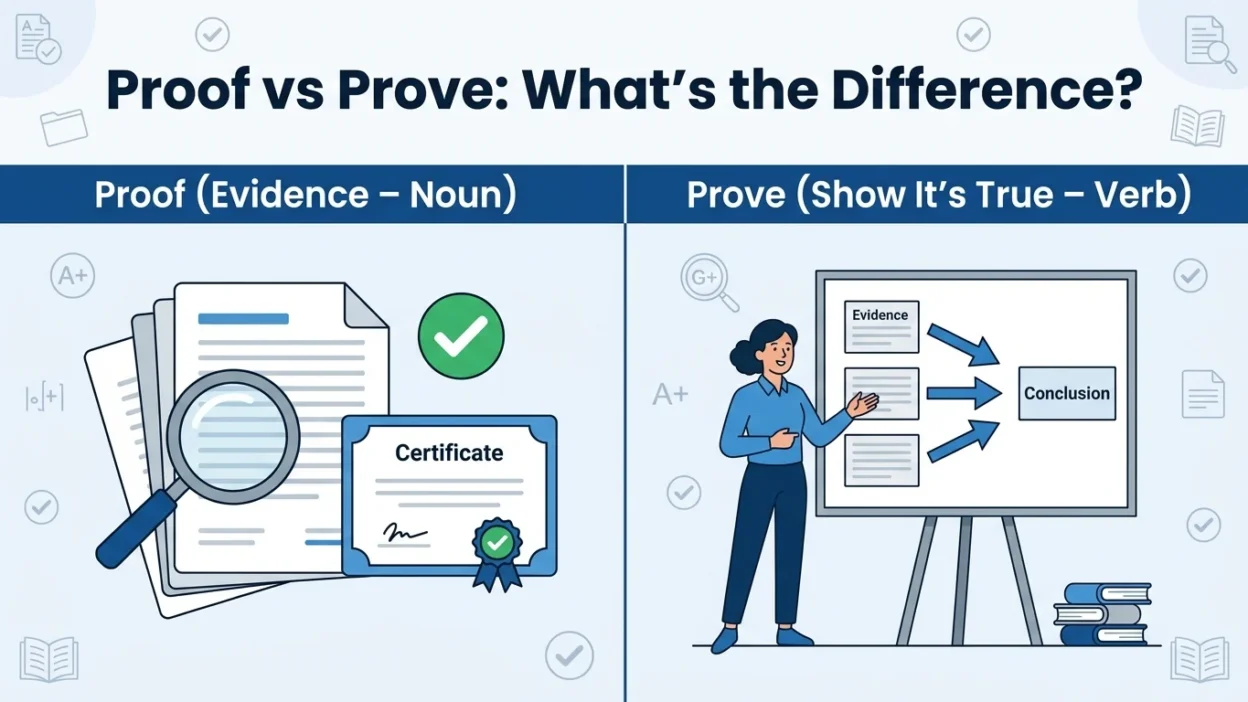
The difference between proof and prove is simple:
- Proof is usually a noun that means evidence or something that shows a statement is true.
- Prove is a verb that means to demonstrate or establish that something is true.
Examples:
- Do you have any proof of your claim? ✅
- Can you prove your claim? ✅
Think of it this way:
- Proof = the evidence.
- Prove = the action of showing evidence.
What Does “Proof” Mean?
Proof is most commonly used as a noun. It refers to evidence, facts, or information that confirms something is true.
It is widely used in everyday conversation, law, science, mathematics, journalism, and academic writing.
Examples
- We need proof before making a decision.
- She provided proof of her identity.
- The police found enough proof to continue the investigation.
- His success is proof that hard work pays off.
- There is no proof that the rumor is true.
In every example, proof refers to evidence rather than an action.
What Does “Prove” Mean?
Prove is a verb. It means to demonstrate, establish, or show that something is true through facts, evidence, or reasoning.
Examples
- Can you prove your theory?
- Scientists continue to prove new discoveries every year.
- She hopes to prove her innocence.
- The experiment will prove whether the hypothesis is correct.
- His actions prove that he is trustworthy.
Whenever someone is performing the action of demonstrating truth, use prove.
Proof vs Prove: Comparison Table
| Feature | Proof | Prove |
|---|---|---|
| Part of Speech | Noun | Verb |
| Meaning | Evidence or confirmation | Show or demonstrate something is true |
| Function | Names evidence | Describes an action |
| Example | We need proof. | We must prove it. |
| Common Usage | Law, science, everyday writing | Conversation, reports, research, arguments |
When Should You Use “Proof”?
Use proof whenever you’re referring to evidence or something that confirms a fact.
Examples
- Please provide proof of purchase.
- There is no proof of fraud.
- Medical records served as proof.
- The video offers clear proof of what happened.
- She showed proof that she completed the course.
Common expressions include:
- Proof of identity
- Proof of payment
- Proof of ownership
- Proof of residence
- Scientific proof
When Should You Use “Prove”?
Use prove whenever someone is demonstrating or establishing that something is true.
Examples
- I can prove my point.
- The results prove the effectiveness of the treatment.
- He wants to prove everyone wrong.
- Time will prove who was right.
- The lawyer must prove the case.
Here, prove always describes an action.
Common Mistakes People Make
Many English learners mix these words because they have related meanings.
Mistake 1: Using “Proof” as a Verb
❌ I will proof that I’m right.
✅ I will prove that I’m right.
Mistake 2: Using “Prove” as a Noun
❌ Do you have any prove?
✅ Do you have any proof?
Mistake 3: Confusing Their Roles
Remember:
- Proof names the evidence.
- Prove describes showing the evidence.
Easy Trick to Remember the Difference
A simple memory tip is:
Ask yourself:
Am I talking about evidence?
Use proof.
Am I talking about showing or demonstrating something?
Use prove.
For example:
- The document is proof.
- The document helps prove the claim.
This trick works almost every time.
Everyday Examples
Using “Proof”
- Please keep your proof of payment.
- The certificate is proof of completion.
- We finally found proof.
- The receipt serves as proof.
- There wasn’t enough proof to support the accusation.
Using “Prove”
- They must prove the allegations.
- The teacher asked students to prove their answers.
- Experience will prove the lesson.
- She worked hard to prove herself.
- Data can prove or disprove a theory.
Special Uses of “Proof”
The word proof has several specialized meanings.
In Mathematics
A proof is a logical demonstration showing that a statement is true.
Example:
- The student completed the geometric proof.
In Publishing
A proof is a preliminary version of a document used for checking errors before publication.
Example:
- The editor reviewed the final proof.
In Baking
As a verb in cooking, proof means allowing dough to rise before baking.
Example:
- Let the dough proof for one hour.
Although this is a verb, it has a specialized meaning unrelated to prove.
American vs British English
There is very little difference between American and British English regarding these words.
Both varieties use:
- Proof as a noun.
- Prove as a verb.
However, in publishing:
- British English sometimes uses proof copy more frequently.
- American English commonly says galley proof or simply proof.
The meanings remain the same.
Practice Sentences
Choose the correct word.
- Can you ______ your statement?
Answer: prove
- We need more ______ before making a decision.
Answer: proof
- The lawyer must ______ the client’s innocence.
Answer: prove
- The receipt is ______ of payment.
Answer: proof
- His work continues to ______ his talent.
Answer: prove
Frequently Asked Questions (FAQs)
What is the difference between proof and prove?
Proof is a noun meaning evidence, while prove is a verb meaning to demonstrate that something is true.
Is proof a noun or a verb?
It is usually a noun, although it can also be used as a specialized verb in publishing and baking.
Is prove always a verb?
Yes. Prove is a verb that describes the action of establishing or demonstrating truth.
Which is correct: “proof of” or “prove of”?
Proof of is correct. “Prove of” is not standard English.
Can I say “I have proof”?
Yes. That is a correct and common expression.
Can I say “I can proof it”?
No. The correct sentence is “I can prove it.”
Is there a difference between American and British English?
No significant difference exists. Both varieties use proof and prove in the same grammatical way.
Summary
Understanding proof vs prove becomes simple once you remember their grammatical roles. Proof is primarily a noun that refers to evidence or confirmation that something is true, while prove is a verb that describes the act of demonstrating or establishing truth. Although they share the same root, they perform different functions in a sentence and should not be used interchangeably.
Using the correct word helps your writing become clearer, more professional, and grammatically accurate. Whether you’re writing an academic paper, preparing a business report, discussing legal matters, or having an everyday conversation, knowing when to use proof and prove will improve both your confidence and communication skills.

William Harved is a passionate language enthusiast and digital writer specializing in English spelling, grammar clarity, and common writing mistakes. As the primary author of Spelword.com, he focuses on helping readers understand confusing word pairs, correct spelling errors, and improve everyday communication.