If you’ve ever wondered whether you should write walkthrough as one word or walk through as two words, you’re not alone. These terms look almost identical, but they serve different grammatical purposes. Choosing the correct form can make your writing clearer, more professional, and grammatically accurate.
The good news is that the distinction is easy to understand once you know the rule. In this guide, you’ll learn the difference between walkthrough and walk through, see practical examples, discover common mistakes to avoid, and know exactly when to use each one.
Quick Answer
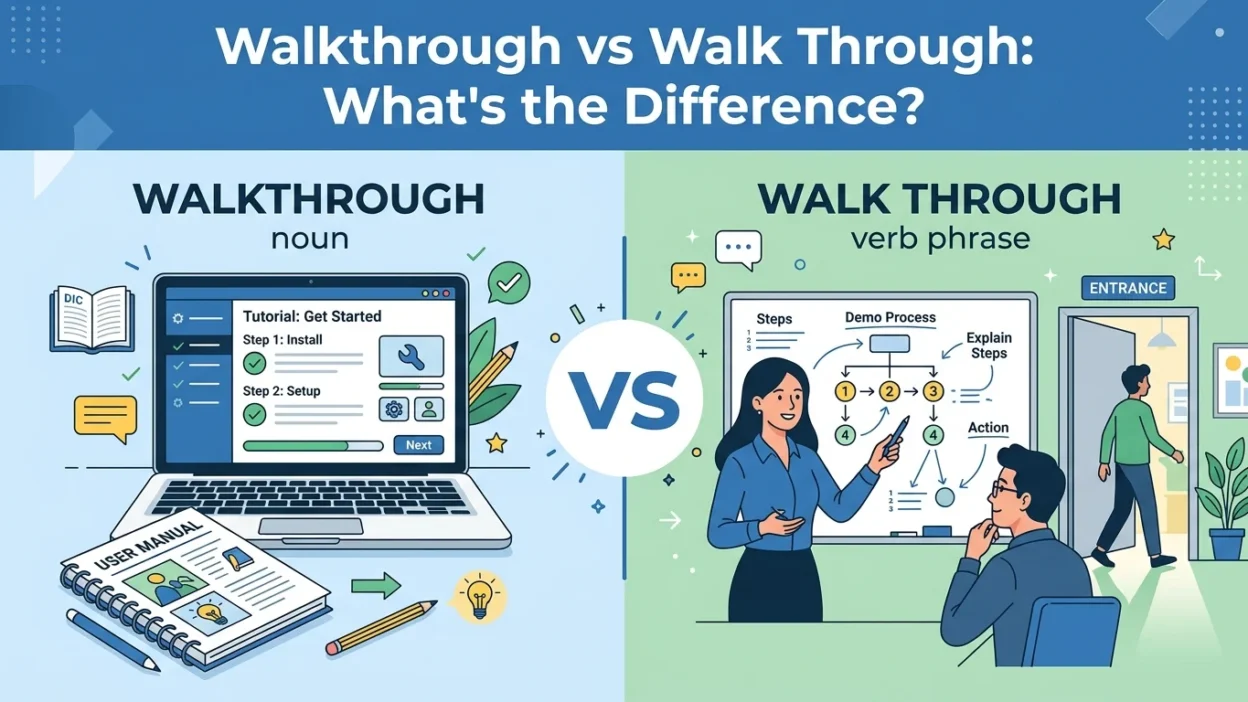
The difference between walkthrough and walk through depends on how the word functions in a sentence.
- Walkthrough (one word) is a noun or sometimes an adjective.
- Walk through (two words) is a verb phrase that means to move through something or explain something step by step.
- Both forms are correct, but they are not interchangeable in every sentence.
What Does “Walkthrough” Mean?
Walkthrough is a noun that refers to a detailed demonstration, guide, inspection, or explanation. It can also be used as an adjective before another noun.
It commonly appears in:
- Software tutorials
- Video game guides
- Business presentations
- Property inspections
- Employee training
- Technical documentation
Examples
- The trainer gave us a detailed walkthrough of the new software.
- I watched a game walkthrough before attempting the level.
- The manager scheduled a final walkthrough of the office.
- This document includes a complete walkthrough for beginners.
In each example, walkthrough names a thing rather than an action.
What Does “Walk Through” Mean?
Walk through is a verb phrase.
It has two common meanings:
- To physically move through a place.
- To explain something step by step.
Examples
- Let’s walk through the building before the meeting.
- Can you walk me through the registration process?
- The teacher will walk through today’s lesson.
- We decided to walk through the museum.
Here, walk through describes an action.
Walkthrough vs Walk Through: Key Difference
The easiest way to remember the difference is to identify whether you’re talking about a thing or an action.
| Feature | Walkthrough | Walk Through |
|---|---|---|
| Part of speech | Noun or adjective | Verb phrase |
| Meaning | Guide, demonstration, inspection | Move through or explain step by step |
| One word or two | One word | Two words |
| Used as an action | No | Yes |
| Used as a thing | Yes | No |
If the word names something, choose walkthrough.
If it describes what someone is doing, choose walk through.
When to Use Walkthrough
Use walkthrough whenever you’re referring to a guide, presentation, inspection, or tutorial.
Examples
- The software walkthrough answered all my questions.
- We completed the safety walkthrough this morning.
- The website offers a beginner walkthrough.
- I downloaded a puzzle walkthrough.
It can also function as an adjective.
Examples
- A walkthrough guide
- A walkthrough video
- A walkthrough session
- A walkthrough document
When to Use Walk Through
Use walk through whenever the sentence requires a verb.
Physical movement
- We will walk through the park.
- She walked through the hallway quietly.
- They walked through the exhibition together.
Explaining something
- Please walk me through your proposal.
- The instructor walked us through the experiment.
- Can someone walk me through this spreadsheet?
This usage is especially common in business and technical communication.
Examples in Everyday English
Here are examples showing the difference more clearly.
Correct Use of Walkthrough
- The project includes a detailed walkthrough.
- The inspector performed a final walkthrough.
- I found a helpful coding walkthrough online.
- Our onboarding walkthrough lasted one hour.
Correct Use of Walk Through
- Let’s walk through the apartment.
- I’ll walk you through each step.
- We walked through the shopping mall.
- The manager will walk through the presentation tomorrow.
Common Mistakes to Avoid
Many writers confuse these forms because they sound identical.
1. Using Walkthrough as a Verb
Incorrect:
- I’ll walkthrough the process.
Correct:
- I’ll walk through the process.
The verb should always be two words.
2. Using Walk Through as a Noun
Incorrect:
- I watched a helpful walk through.
Correct:
- I watched a helpful walkthrough.
The noun should be one word.
3. Forgetting the Context
Always ask yourself:
- Is this naming something?
- Or is someone performing an action?
This simple question usually gives you the correct answer.
Walkthrough vs Walk Through in Business Writing
Business communication frequently uses both forms.
Walkthrough
- Product walkthrough
- Project walkthrough
- System walkthrough
- Training walkthrough
Walk Through
- Walk through the proposal.
- Walk me through the budget.
- Walk us through the report.
- Walk through the implementation plan.
Professional writers often use both forms within the same document.
Walkthrough vs Walk Through in Technology
Technology documentation uses these expressions extensively.
Examples of walkthrough:
- Installation walkthrough
- Programming walkthrough
- Software walkthrough
- Troubleshooting walkthrough
Examples of walk through:
- I’ll walk you through the installation.
- Let’s walk through the code together.
- The instructor will walk through every feature.
Understanding this distinction improves technical writing significantly.
American vs British English
There is very little difference between American and British English regarding walkthrough and walk through.
In both varieties:
- Walkthrough is the standard noun.
- Walk through is the standard verb phrase.
- Professional writing follows the same grammatical distinction.
- Both forms are widely accepted.
The difference is grammatical rather than regional.
Tips for Remembering the Difference
Here are a few simple tricks.
- If you can replace it with guide, use walkthrough.
- If someone is performing an action, use walk through.
- One word usually names something.
- Two words usually describe an action.
- Read the sentence aloud to check whether it sounds natural.
These tips make the distinction much easier to remember.
Quick Comparison Table
| Situation | Correct Choice |
|---|---|
| Software guide | Walkthrough |
| Game guide | Walkthrough |
| House inspection | Walkthrough |
| Training document | Walkthrough |
| Explain the process | Walk through |
| Move through a building | Walk through |
| Guide someone step by step | Walk through |
| Demonstration document | Walkthrough |
Frequently Asked Questions
Is walkthrough one word or two?
It depends on its function. Walkthrough is one word when used as a noun or adjective, while walk through is two words when used as a verb.
What is the difference between walkthrough and walk through?
Walkthrough refers to a guide, demonstration, or inspection. Walk through describes the action of moving through something or explaining it step by step.
Can walkthrough be used as a verb?
No. Standard English uses walk through as the verb phrase.
Is “walk me through” grammatically correct?
Yes. Walk me through is a common and correct expression that means to explain something step by step.
Is walkthrough commonly used in business?
Yes. Businesses frequently use walkthrough for training sessions, project reviews, software demonstrations, and property inspections.
Do British and American English use these terms differently?
No. Both American and British English follow the same grammatical distinction between walkthrough and walk through.
How can I remember which one to use?
Remember that walkthrough names a thing, while walk through describes an action. If someone is doing something, use two words.
Summary
Understanding walkthrough vs walk through is mainly about recognizing the role each plays in a sentence. Walkthrough is a noun or adjective that refers to a guide, inspection, tutorial, or demonstration. Walk through, on the other hand, is a verb phrase used when someone physically moves through a place or explains a process step by step. Although they sound identical, their grammatical functions are different.
Using the correct form makes your writing more polished and professional, especially in business, education, technology, and everyday communication. Whenever you’re unsure, simply ask yourself whether you’re naming something or describing an action. That quick check will help you choose the correct spelling every time.

William Harved is a passionate language enthusiast and digital writer specializing in English spelling, grammar clarity, and common writing mistakes. As the primary author of Spelword.com, he focuses on helping readers understand confusing word pairs, correct spelling errors, and improve everyday communication.