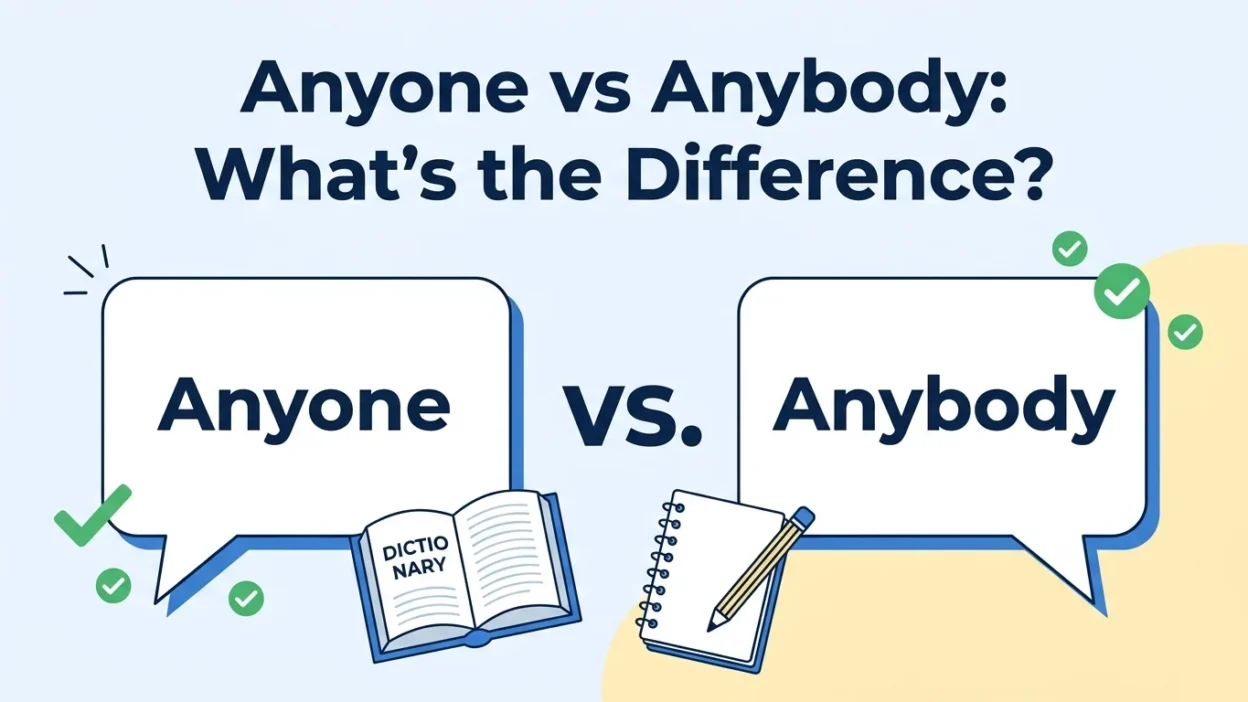
Have you ever paused while writing and wondered whether you should use anyone or anybody? You’re not alone. These two words appear in everyday conversations, emails, books, and professional writing, yet many English learners and native speakers alike are unsure if there’s any real difference between them.
The good news is that anyone and anybody have almost identical meanings. However, there are small differences in tone, style, and usage that can help you choose the most natural option for your sentence. This guide explains everything you need to know with simple definitions, practical examples, comparison tables, and common mistakes to avoid.
Quick Answer
Anyone and anybody both refer to an unspecified person and are generally interchangeable.
- Anyone is slightly more common in formal and written English.
- Anybody feels a little more conversational and informal.
- Both words are grammatically correct in American and British English.
- In most situations, choosing either word will not change the meaning of your sentence.
What Does “Anyone” Mean?
Anyone is an indefinite pronoun used to refer to any person, regardless of who they are. It often appears in questions, negative statements, and general statements.
Examples
- Does anyone know the answer?
- If anyone calls, tell them I’ll be back soon.
- Anyone can learn English with enough practice.
- I didn’t see anyone at the office.
In formal writing, anyone is often the preferred choice because it sounds slightly more polished.
What Does “Anybody” Mean?
Anybody is also an indefinite pronoun that means any person. It carries the same meaning as anyone but tends to sound more relaxed and conversational.
Examples
- Does anybody want some coffee?
- I didn’t tell anybody about the surprise.
- Can anybody help me move this table?
- Anybody can make mistakes.
You’ll frequently hear anybody in everyday speech and casual conversations.
Anyone vs Anybody: Key Differences
Although the meanings are the same, the difference lies mostly in style and tone.
| Feature | Anyone | Anybody |
|---|---|---|
| Meaning | Any person | Any person |
| Formality | Slightly more formal | Slightly more informal |
| Common in writing | Yes | Sometimes |
| Common in conversation | Yes | Very common |
| Grammar | Correct | Correct |
| Interchangeable | Yes | Yes |
In nearly every sentence, you can replace one with the other without changing the meaning.
When Should You Use Anyone?
Choose anyone when writing:
- Academic essays
- Business emails
- Professional reports
- Official documents
- Formal presentations
Examples
- If anyone has questions, please contact the instructor.
- Anyone wishing to participate should register online.
- We appreciate anyone who volunteers.
These sentences sound natural and professional.
When Should You Use Anybody?
Choose anybody when speaking casually or writing informally.
Examples
- Is anybody home?
- Did anybody see my phone?
- I don’t think anybody noticed.
- Has anybody tried this restaurant?
These examples reflect everyday spoken English.
Examples of Anyone and Anybody in Sentences
Here are more examples showing that both words can often be swapped.
Using Anyone
- Has anyone finished the assignment?
- I don’t know anyone in this city.
- Anyone interested may apply.
- Can anyone explain this rule?
Using Anybody
- Has anybody finished the assignment?
- I don’t know anybody here.
- Anybody can join the club.
- Can anybody explain this game?
Notice that the meaning remains exactly the same.
Anyone vs Anybody in Questions
Both words are commonly used in questions.
Examples
- Is anyone available?
- Is anybody available?
- Does anyone understand?
- Does anybody understand?
Both versions are correct. The choice depends on the level of formality.
Anyone vs Anybody in Negative Sentences
These pronouns also work equally well in negative sentences.
Examples
- I didn’t invite anyone.
- I didn’t invite anybody.
- We couldn’t find anyone.
- We couldn’t find anybody.
Again, there is no difference in meaning.
Anyone vs Anybody in Positive Statements
They are also used in general statements about people.
Examples
- Anyone can become a good writer.
- Anybody can become a good writer.
- Anyone is welcome.
- Anybody is welcome.
Both forms are acceptable and natural.
Common Mistakes to Avoid
Many learners confuse the usage of these words. Here are some mistakes to avoid.
1. Thinking They Have Different Meanings
This is the most common misconception.
Incorrect belief:
- Anyone and anybody mean different things.
Correct:
- They mean the same thing.
2. Mixing Formal and Informal Tone
Although both are correct, choosing the right tone improves your writing.
Formal
- If anyone requires assistance, please ask.
Casual
- If anybody needs help, just ask.
3. Using Them with Specific People
These words refer to an unknown or unspecified person.
Incorrect
- Anybody named Sarah is my sister.
Correct
- My sister is named Sarah.
Anyone vs Anybody in American and British English
There is no significant difference between American and British English regarding anyone and anybody.
In both varieties:
- Both words are correct.
- Both are commonly understood.
- Anyone appears slightly more often in formal writing.
- Anybody is frequently heard in everyday conversation.
Neither version is considered incorrect in either country.
Quick Comparison Table
| Situation | Better Choice |
|---|---|
| Formal writing | Anyone |
| Business email | Anyone |
| Academic writing | Anyone |
| Friendly conversation | Anybody |
| Casual text message | Anybody |
| Everyday speech | Anybody |
| Official notice | Anyone |
Remember, these are style preferences rather than grammar rules.
Tips for Choosing Between Anyone and Anybody
If you’re unsure which word to use, these simple guidelines can help.
- Use anyone for professional or formal writing.
- Use anybody in casual conversations.
- Stay consistent within the same document.
- Don’t worry too much because both are grammatically correct.
- Focus more on tone than meaning.
Frequently Asked Questions
Is anyone more formal than anybody?
Yes. Anyone generally sounds slightly more formal, making it common in professional and academic writing.
Are anyone and anybody interchangeable?
Yes. In almost every situation, they can replace each other without changing the meaning of the sentence.
Which word is more common in everyday conversation?
Anybody is often heard more frequently in casual spoken English, although anyone is also very common.
Can I use anyone in an email?
Yes. Anyone is an excellent choice for professional emails because it sounds slightly more formal.
Is anybody grammatically correct?
Absolutely. Anybody is a correct English pronoun and is widely used by native speakers.
Do British and American English use these words differently?
No. Both American and British English accept anyone and anybody, with only minor differences in style and personal preference.
Which word should English learners use?
Both are correct, but learning to use anyone in formal situations and anybody in casual conversations can make your English sound more natural.
Summary
The comparison between anyone vs anybody is much simpler than many people expect. Both words mean any person and are grammatically correct in virtually every context. The main distinction is tone rather than meaning. Anyone tends to sound slightly more formal and is common in professional, academic, and official writing, while anybody has a friendlier, more conversational feel that fits everyday speech.
Choosing between them ultimately depends on your audience and writing style. If you’re writing a business email, report, or essay, anyone is often the safer option. For conversations, text messages, or informal writing, anybody sounds perfectly natural. Understanding this subtle difference will help your English sound smoother and more confident.