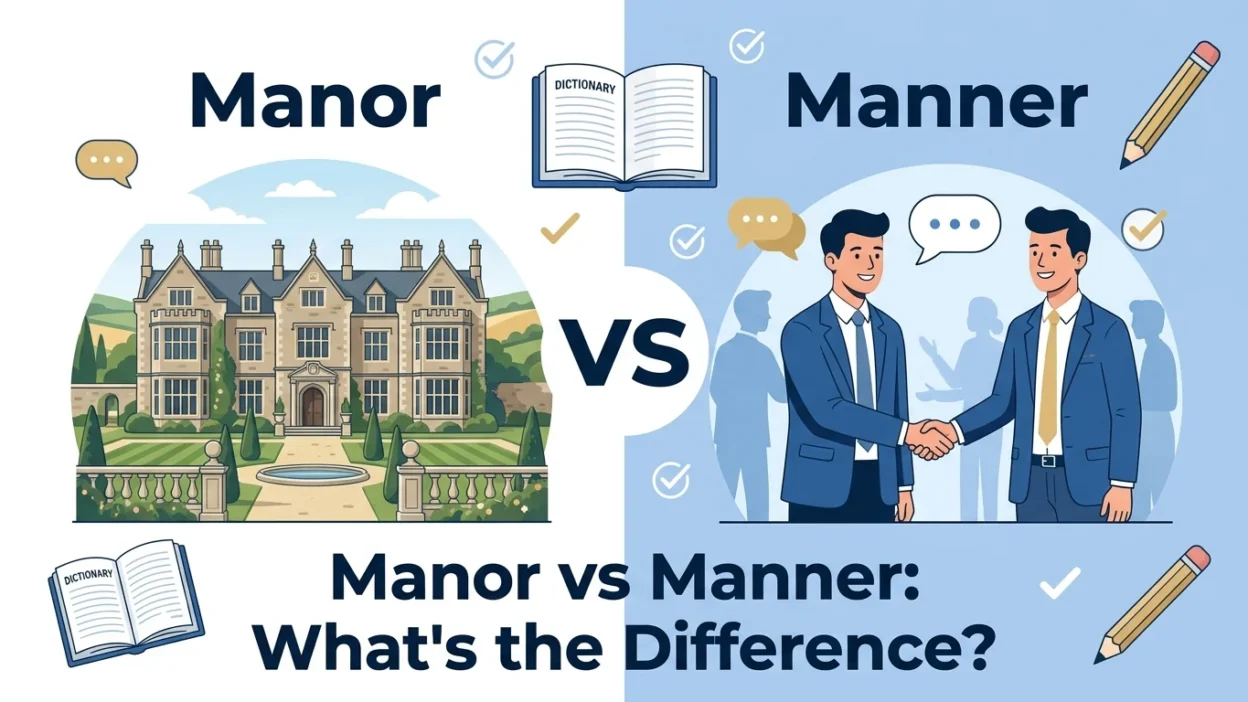
Have you ever seen the words manor and manner and wondered if they are related? Because they sound almost identical, they’re often confused in writing and conversation. However, despite their similar pronunciation, these two words have completely different meanings and are used in very different contexts.
Learning the difference between manor and manner is easier than you might think. Once you understand what each word means, you’ll avoid one of the most common English vocabulary mistakes. This guide explains their meanings, examples, key differences, common errors, and helpful tips to remember which word to use.
Quick Answer
The difference between manor and manner is simple:
- Manor is a noun that refers to a large country house or an estate, especially one associated with historical landownership.
- Manner is a noun that refers to the way something is done or the way a person behaves.
- Although they sound alike, they are not interchangeable.
What Does “Manor” Mean?
Manor is a noun that traditionally refers to a large country house together with the surrounding land. Historically, a manor belonged to a wealthy landowner or noble family during the feudal period.
Today, the word is also used to describe impressive historic homes or estates.
Examples
- They visited a beautiful manor in the English countryside.
- The old manor has been converted into a luxury hotel.
- The family inherited a historic manor.
- The castle and nearby manor attract thousands of tourists every year.
In every example, manor refers to a property or estate.
What Does “Manner” Mean?
Manner is a noun that refers to the way something happens, the method used, or a person’s behavior.
It is commonly used in both formal and everyday English.
Examples
- She spoke in a calm manner.
- His friendly manner impressed everyone.
- Please complete the task in the same manner.
- The teacher praised the student’s polite manner.
Unlike manor, manner has nothing to do with buildings or land.
Manor vs Manner: Key Differences
Although these words sound similar, their meanings are entirely different.
| Feature | Manor | Manner |
|---|---|---|
| Meaning | Large estate or country house | Way of doing something or behavior |
| Part of Speech | Noun | Noun |
| Related To | Property, history, architecture | Actions, behavior, methods |
| Common Context | Historic estates | Everyday communication |
| Interchangeable | No | No |
The easiest way to remember the difference is to associate manor with property and manner with behavior or method.
When Should You Use Manor?
Use manor whenever you’re referring to a large estate, historic house, or country residence.
Common situations include:
- History books
- Architecture
- Real estate
- Tourism
- Literature
- Historical fiction
Examples
- The royal manor overlooks the valley.
- We toured a medieval manor during our vacation.
- The abandoned manor inspired many ghost stories.
- Restoration work began on the historic manor.
When Should You Use Manner?
Use manner whenever you’re talking about behavior, style, method, or the way something is done.
Examples
- He answered politely in a respectful manner.
- The machine operates in a safe manner.
- She completed the assignment in an organized manner.
- Children should learn good manners from an early age.
Notice that manners is the plural form often used when discussing polite behavior.
Manor vs Manner in Everyday English
Let’s compare them in real sentences.
Using Manor
- The wealthy family owned a magnificent manor.
- Tourists visited the ancient manor.
- The old manor is now a museum.
- Their wedding was held at a historic manor.
Using Manner
- She greeted us in a cheerful manner.
- Please respond in a professional manner.
- His calm manner helped everyone relax.
- The experiment was conducted in a careful manner.
The difference becomes obvious once you understand the context.
Common Mistakes to Avoid
Because these words are homophones, writers sometimes confuse them.
1. Using Manor Instead of Manner
Incorrect:
- She behaved in a polite manor.
Correct:
- She behaved in a polite manner.
Behavior requires manner, not manor.
2. Using Manner Instead of Manor
Incorrect:
- They bought a beautiful country manner.
Correct:
- They bought a beautiful country manor.
Buildings and estates require manor.
3. Confusing Manners with Manor
Remember:
- Manners = polite behavior.
- Manor = estate or large house.
These words have completely different meanings.
Manor and Manner in Literature
Both words frequently appear in books, but in different contexts.
Manor
Authors use manor when describing:
- Historic estates
- Noble families
- Countryside homes
- Gothic novels
- Historical settings
Manner
Writers use manner to describe:
- Character behavior
- Speaking style
- Personality
- Actions
- Emotional expression
Recognizing these contexts makes reading easier.
American vs British English
There is no major difference between American and British English regarding manor and manner.
In both varieties:
- Manor refers to a country estate or historic residence.
- Manner refers to behavior, style, or method.
- The spelling remains the same.
- The meanings remain the same.
However, manor appears more frequently in British history because of England’s historical manorial system.
Tips for Remembering the Difference
These memory tricks can help.
- Manor contains the letters or, reminding you of an old estate or historic property.
- Manner contains mann, which can remind you of how a person behaves.
- Think of good manners, not good manors.
- Think of country manor, not country manner.
These simple associations make the words much easier to remember.
Quick Comparison Table
| Situation | Correct Word |
|---|---|
| Historic estate | Manor |
| Country house | Manor |
| Luxury estate | Manor |
| Ancient residence | Manor |
| Polite behavior | Manner |
| Speaking style | Manner |
| Method of working | Manner |
| Professional conduct | Manner |
Frequently Asked Questions
What is the difference between manor and manner?
Manor refers to a large country house or estate, while manner refers to the way something is done or how someone behaves.
Are manor and manner interchangeable?
No. Although they sound alike, they have completely different meanings and cannot replace each other.
Is manor a house?
Yes. A manor is traditionally a large country house or estate, often with historical significance.
What does manner mean in English?
Manner means the way something is done, someone’s behavior, or a particular style of action.
Is “good manor” correct?
No. The correct phrase is good manners, which refers to polite behavior.
Do American and British English use these words differently?
No. Both American and British English use manor and manner with the same meanings.
How can I remember the difference between manor and manner?
Remember that manor relates to houses and estates, while manner relates to behavior and methods.
Summary
Understanding manor vs manner is straightforward once you know what each word represents. Manor refers to a large country house or historic estate, making it common in discussions about architecture, history, tourism, and literature. Manner, on the other hand, refers to behavior, style, or the way something is done. Although they sound the same, they belong in completely different contexts.
Choosing the correct word helps make your writing clearer and more professional. Whenever you encounter these homophones, think about whether you’re talking about a place or a way of acting. That simple distinction will help you use manor and manner correctly every time.

Dani Morrison is a dedicated language writer and spelling expert at Spelword.com, where she focuses on helping readers understand common English spelling mistakes and confusing word pairs. With a passion for clear communication, Dani creates easy-to-follow guides that simplify complex grammar and spelling rules for everyday use.