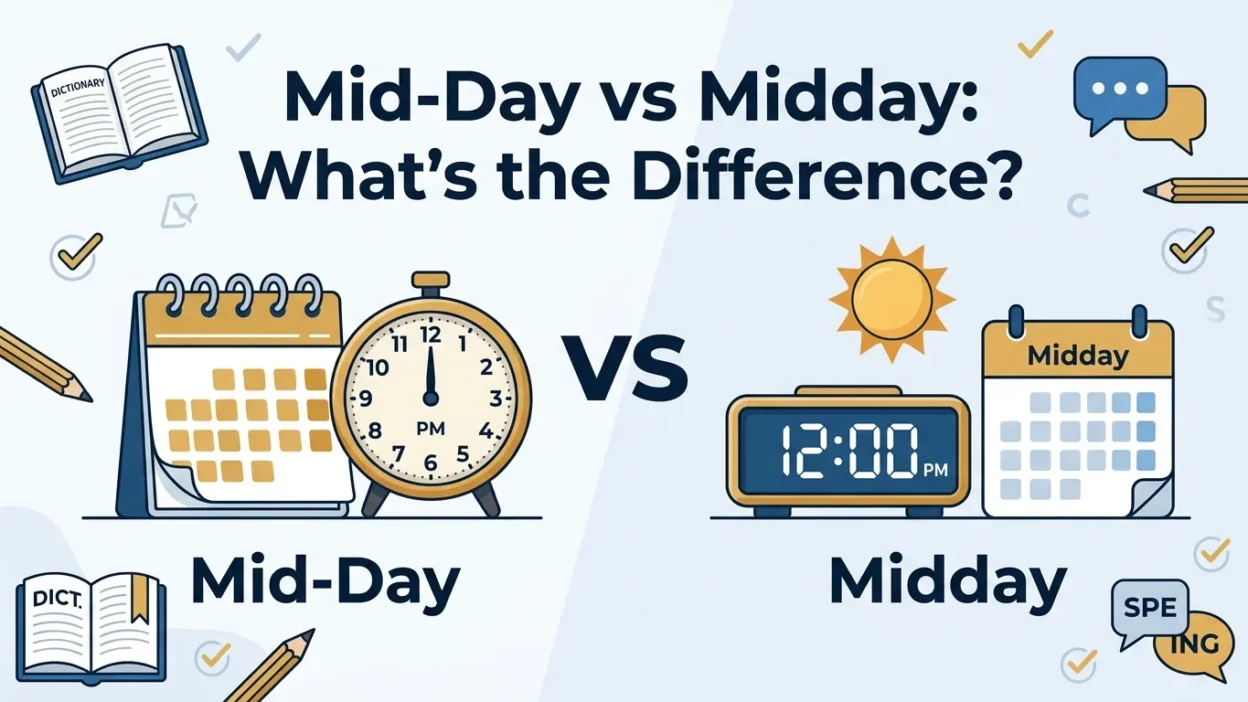
If you’ve ever wondered whether to write mid-day or midday, you’re not alone. These two spellings often cause confusion because they look almost identical and refer to the same general time of day. However, one form is considered the standard spelling in modern English, while the other is much less common.
The good news is that the difference between mid-day and midday is mostly about spelling conventions rather than meaning. In this guide, you’ll learn which form is preferred, how each is used, examples, common mistakes, regional differences, and helpful tips to remember the correct spelling.
Quick Answer
The main difference between mid-day and midday is spelling.
- Midday (one word) is the standard and widely accepted spelling in modern English.
- Mid-day (hyphenated) is an older or less common variant that occasionally appears in certain publications or styles.
- Both refer to the middle of the day, usually around noon.
- In most writing, midday is the recommended choice.
What Does “Midday” Mean?
Midday is a noun that refers to the middle part of the day, generally around 12:00 p.m. (noon) or the hours surrounding it.
It is commonly used in:
- Everyday conversation
- News articles
- Business writing
- Weather reports
- Academic writing
- Literature
Examples
- We’ll meet at midday.
- The sun is strongest around midday.
- Many shops close briefly at midday.
- The temperature usually peaks by midday.
In all these examples, midday functions as a noun indicating a time of day.
What Does “Mid-Day” Mean?
Mid-day has the same meaning as midday but uses a hyphen.
Although it still appears occasionally, especially in older books or publications following specific style guides, it is much less common in modern English.
Examples
- The event begins at mid-day.
- Farmers often rest during the mid-day heat.
- She returned home around mid-day.
While these sentences are understandable, most modern dictionaries recommend writing midday as one word.
Mid-Day vs Midday: Key Differences
The meanings are identical, but the spelling differs.
| Feature | Mid-Day | Midday |
|---|---|---|
| Meaning | Middle of the day | Middle of the day |
| Modern Usage | Less common | Standard |
| Spelling | Hyphenated | One word |
| Preferred in Current English | Rarely | Yes |
| Accepted | Sometimes | Yes |
For most writers, midday is the better choice.
Why Is Midday More Common?
English spelling has gradually shifted toward combining many compound words into a single word.
Examples include:
- Today
- Tomorrow
- Everyday (in some contexts)
- Inside
- Midday
As a result, midday has become the standard spelling in dictionaries and modern publications.
When Should You Use Midday?
Use midday in almost every type of writing.
It works well in:
- School assignments
- Business emails
- Newspapers
- Blogs
- Professional reports
- Academic papers
Examples
- Lunch will be served at midday.
- The meeting starts at midday.
- We reached the summit by midday.
- Most deliveries arrive before midday.
These examples follow current standard English.
When Might You See Mid-Day?
Although uncommon, mid-day still appears in:
- Older books
- Historical writing
- Certain newspaper style guides
- Creative writing for stylistic effect
Examples
- The mid-day bells rang loudly.
- Travelers rested during the mid-day sun.
These spellings are not incorrect, but they are less common today.
Midday in Everyday English
Native speakers overwhelmingly prefer midday.
Examples include:
- I’ll call you around midday.
- We stopped working at midday.
- The restaurant opens again after midday.
- The weather becomes hotter by midday.
This spelling is familiar and natural in modern communication.
Common Mistakes to Avoid
Many learners make simple spelling mistakes.
1. Assuming Both Spellings Are Equally Common
Although both exist, midday is far more common in modern English.
2. Writing Mid Day as Two Words
Incorrect:
- We arrived at mid day.
Correct:
- We arrived at midday.
The two-word spelling is generally not considered standard.
3. Mixing Spellings in the Same Document
Choose one spelling and stay consistent.
For most writing, use midday throughout.
Midday in Professional Writing
Professional writers almost always choose midday.
Examples:
- Midday meeting
- Midday report
- Midday deadline
- Midday forecast
This spelling appears in business communication, journalism, and official documents.
Midday in Literature
Modern authors generally use midday, while older literature may occasionally contain mid-day.
Examples:
- The quiet of midday settled over the village.
- The travelers rested until midday.
Current publishing standards usually favor the one-word form.
American vs British English
There is very little difference between American and British English.
American English
Most American dictionaries and publications use:
- Midday
British English
British English also strongly prefers:
- Midday
Although mid-day occasionally appears in older British publications, midday is now the standard spelling in both varieties.
Tips for Remembering the Difference
These simple tricks can help.
- Think of today, tomorrow, and midday as single words.
- If you’re writing modern English, choose midday.
- Only use mid-day if following a specific style guide.
- Avoid writing mid day as two separate words.
- When in doubt, dictionaries recommend midday.
These memory tips make the choice easy.
Quick Comparison Table
| Situation | Better Choice |
|---|---|
| Modern writing | Midday |
| Business email | Midday |
| Academic paper | Midday |
| Newspaper article | Midday |
| Blog post | Midday |
| Older literature | Mid-Day (occasionally) |
| Historical quotation | Mid-Day (sometimes) |
| Everyday conversation | Midday |
Frequently Asked Questions
What is the difference between mid-day and midday?
There is no difference in meaning. The main difference is spelling. Midday is the standard modern form, while mid-day is an older or less common variant.
Which spelling is correct: midday or mid-day?
Both spellings are correct, but midday is the preferred spelling in modern English.
Is midday one word?
Yes. Most dictionaries and style guides recommend writing midday as one word.
Can I use mid-day in formal writing?
You can, but midday is generally preferred because it follows current spelling conventions.
Is “mid day” written as two words?
No. The two-word spelling mid day is generally considered nonstandard.
Do American and British English spell midday differently?
No. Both American and British English usually use midday as the preferred spelling.
Why is midday written as one word?
English has gradually combined many compound words into single words, and midday follows this modern spelling trend.
Summary
Understanding mid-day vs midday is mainly about choosing the standard spelling. Both forms refer to the middle of the day, usually around noon, and their meanings are identical. However, midday has become the accepted spelling in modern English and is recommended by most dictionaries, publishers, and style guides. The hyphenated form mid-day still appears occasionally, especially in older texts, but it is far less common today.
Using midday consistently will make your writing look more polished, professional, and up to date. Whether you’re writing an academic paper, a business email, a blog post, or everyday correspondence, choosing the standard spelling helps ensure clarity and aligns with modern English usage.

William Harved is a passionate language enthusiast and digital writer specializing in English spelling, grammar clarity, and common writing mistakes. As the primary author of Spelword.com, he focuses on helping readers understand confusing word pairs, correct spelling errors, and improve everyday communication.