Choosing the right word is important, especially when discussing computers, software, and digital tools. One question that often comes up is unselect vs deselect. Since both words seem to describe removing a selection, many people wonder whether they are interchangeable or if one is more correct than the other.
The good news is that the difference is straightforward. While unselect and deselect can both mean removing a selected item, deselect is the standard and widely accepted term in English, particularly in technology, user interfaces, and professional writing. This guide explains the meanings, differences, examples, and common mistakes so you can use the correct word with confidence.
Quick Answer
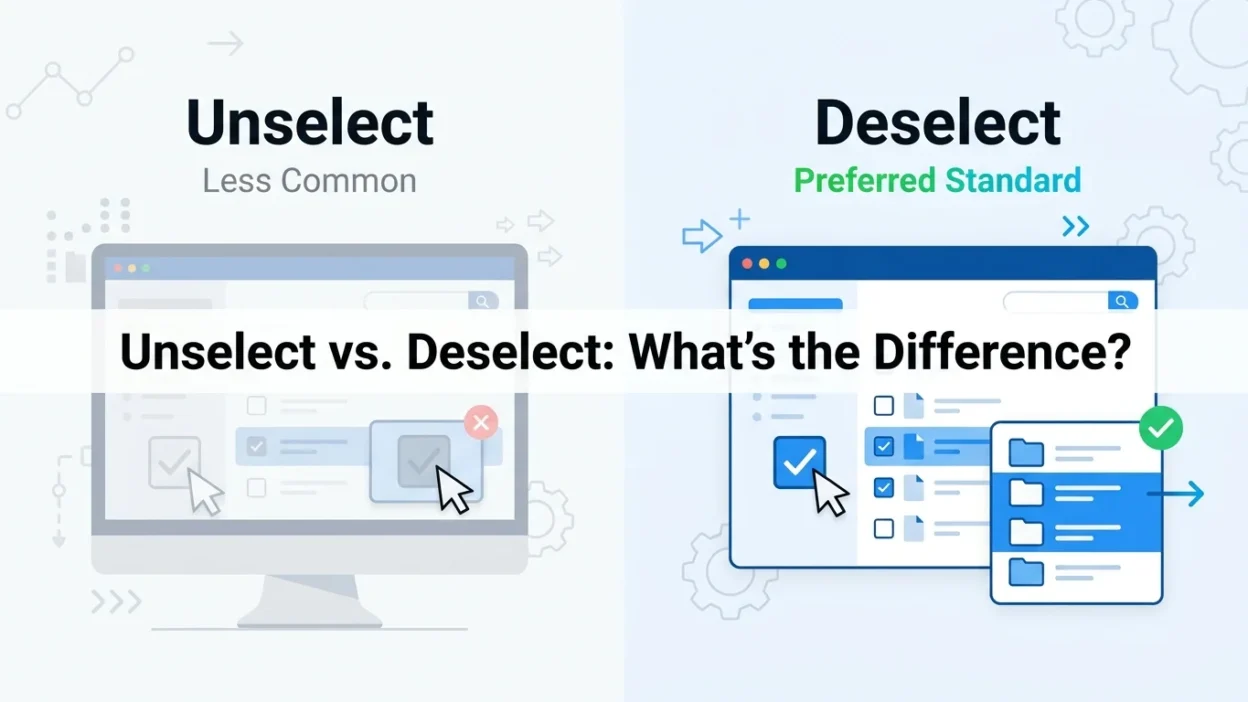
Deselect is the preferred and standard English word for removing a selection from an item, option, or object.
Unselect is understandable and occasionally appears in informal contexts, but it is much less common and is generally not the preferred choice in software documentation or professional writing.
- ✅ Click the checkbox again to deselect the option.
- ⚠️ Click the checkbox again to unselect the option. (Understandable but less common.)
In most situations, especially in technology and computing, deselect is the better word.
What Does “Deselect” Mean?
Deselect is a verb that means to remove something from a selected state.
It is commonly used in computer software, mobile apps, websites, graphic design programs, spreadsheets, and operating systems.
Examples of “Deselect”
- Click outside the image to deselect it.
- Press Ctrl + D to deselect the selected object.
- You can deselect multiple files by clicking them again.
- The app allows users to deselect unwanted items.
- Tap the checkbox to deselect the option.
In each example, deselect means removing an active selection.
What Does “Unselect” Mean?
Unselect is also a verb that generally means to remove a selection.
Although native English speakers understand it, unselect is far less common than deselect. Many dictionaries either list it as less common or omit it altogether, while software developers and technical writers overwhelmingly prefer deselect.
Examples of “Unselect”
- The program lets users unselect multiple images.
- Please unselect the highlighted text.
- You can unselect the file before continuing.
These sentences are understandable, but replacing unselect with deselect sounds more natural and professional.
Unselect vs Deselect: Key Differences
| Feature | Unselect | Deselect |
|---|---|---|
| Part of Speech | Verb | Verb |
| Meaning | Remove a selection | Remove a selection |
| Commonness | Less common | Very common |
| Used in software | Occasionally | Standard term |
| Professional writing | Rarely preferred | Strongly preferred |
| Dictionary support | Limited | Widely accepted |
| Recommended choice | Usually no | Yes |
Why Is “Deselect” More Common?
The prefix de- often means remove, reverse, or undo.
Examples include:
- Decode
- Deactivate
- Defrost
- Decompress
Likewise, deselect naturally means remove a selection.
The prefix un- also means reverse or not, but English speakers have historically adopted deselect as the standard term in computing.
That is why nearly every major software program uses deselect in menus, tooltips, and user guides.
Examples in Everyday Technology
Here are common situations where deselect is the preferred word.
In Microsoft Excel
- Press Esc to deselect the selected cells.
In Photoshop
- Choose Select > Deselect from the menu.
In Mobile Apps
- Tap the selected photo again to deselect it.
In File Explorer
- Click an empty space to deselect all files.
In Online Forms
- Deselect any options you no longer want.
These examples reflect the wording users see in most software applications.
When Can You Use “Unselect”?
Although unselect is less common, it is not always considered incorrect.
You may encounter it in:
- Informal conversations
- Older software
- User-created documentation
- Internal company instructions
- Casual online discussions
However, if your goal is polished, professional English, deselect remains the better choice.
Common Mistakes to Avoid
Here are mistakes people often make when using these words.
Using “unselect” in formal documentation
❌ Please unselect the file.
✅ Please deselect the file.
Assuming both words are equally common
Although both are understandable, deselect appears much more frequently in software interfaces and technical documentation.
Mixing terms within the same document
Avoid switching between unselect and deselect in one guide.
Choose one term and stay consistent.
Professional writers almost always choose deselect.
Side-by-Side Examples
- Please deselect the checkbox.
- Please unselect the checkbox.
Both communicate the same meaning, but the first sounds more natural.
Another example:
- Users can deselect unwanted files before uploading them.
- Users can unselect unwanted files before uploading them.
Again, deselect is the preferred option.
Tips to Remember the Difference
A simple memory trick can help.
Think about common technology commands.
Many computer commands begin with de-:
- Deactivate
- Decode
- Decompress
- Delete
- Deselect
Since software commonly uses de- for removing or reversing actions, remembering deselect becomes much easier.
If you’re writing documentation, tutorials, blog posts, or technical instructions, use deselect.
Which Word Should You Use?
For almost every situation, choose deselect.
Use deselect when:
- Writing software documentation
- Creating tutorials
- Explaining computer functions
- Writing professional content
- Developing user interfaces
- Producing educational materials
Reserve unselect only if you are matching wording already used by a specific application or organization.
American vs British English
There is no significant difference between American and British English regarding unselect and deselect.
Both varieties overwhelmingly prefer deselect in computing and technology.
Examples:
- American English: Click anywhere to deselect the image.
- British English: Click anywhere to deselect the image.
Likewise, both audiences understand unselect, but it is much less common.
Practice Sentences
Choose the correct word.
- Click outside the object to ______ it.
- ✅ Deselect
- You can ______ multiple files before moving them.
- ✅ Deselect
- The graphic editor allows users to ______ selected layers.
- ✅ Deselect
- Most software menus use the command ______.
- ✅ Deselect
- Which word is more common in professional documentation?
- ✅ Deselect
FAQs
Is unselect a real English word?
Yes. Unselect is a real word and is understood by English speakers, but it is much less common than deselect.
Which is correct, unselect or deselect?
Both can describe removing a selection, but deselect is the standard and preferred term in professional English.
Why do software programs use deselect?
Software developers and technical writers have long adopted deselect as the standard command for removing a selection.
Can I use unselect in everyday conversation?
Yes. People will usually understand what you mean, although deselect sounds more natural.
Is deselect more formal?
Yes. Deselect is more widely accepted in technical writing, software documentation, and educational materials.
Are unselect and deselect interchangeable?
In many situations, yes. However, deselect is generally the recommended choice because it is more common.
Is there any difference between American and British English?
No. Both American and British English strongly prefer deselect over unselect.
Summary
Understanding unselect vs deselect is easier once you know how these words are used in modern English. Both describe removing an item from a selected state, but deselect has become the accepted standard in technology, computing, software documentation, and professional communication. Although unselect is understandable, it appears far less often and may sound less polished to many readers.
If you want your writing to sound natural, accurate, and consistent with industry standards, deselect is almost always the best choice. Whether you are writing tutorials, explaining software features, or giving computer instructions, choosing deselect will make your content clearer and more professional while matching the terminology users expect to see.

Dani Morrison is a dedicated language writer and spelling expert at Spelword.com, where she focuses on helping readers understand common English spelling mistakes and confusing word pairs. With a passion for clear communication, Dani creates easy-to-follow guides that simplify complex grammar and spelling rules for everyday use.