Have you ever wondered whether you should say “I feel good” or “I feel well”? Or maybe you’ve heard someone say, “She sings good,” and weren’t sure if it was correct. The debate around well vs good is one of the most common grammar questions for English learners and even native speakers.
The good news is that the difference is easy to understand once you know the basic grammar rules. In this guide, you’ll learn what well and good mean, how they differ, when to use each one, common mistakes to avoid, and plenty of real life examples to help you speak and write with confidence.
Quick Answer
The difference between well vs good is simple:
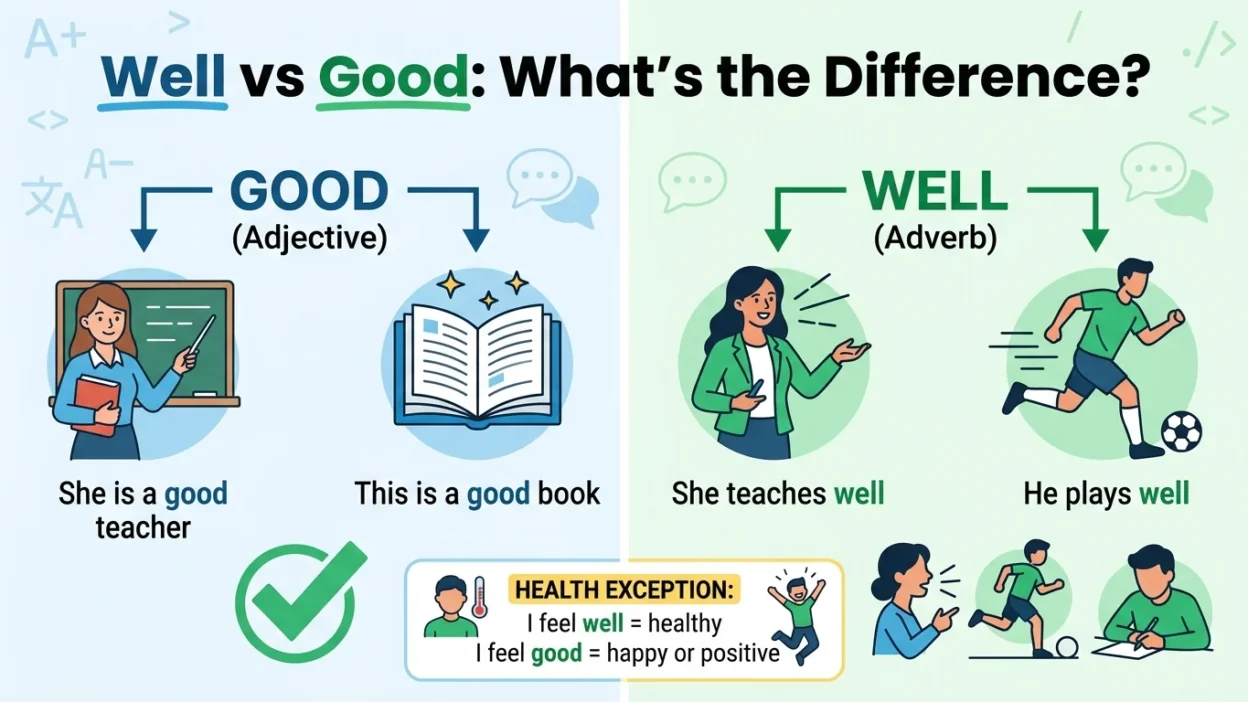
- Good is usually an adjective. It describes a noun or pronoun.
- Well is usually an adverb. It describes a verb, showing how an action is performed.
Examples:
- She is a good teacher. ✅
- She teaches well. ✅
- I feel good. ✅
- He plays football well. ✅
Although there are a few exceptions, remembering this basic rule will help you use both words correctly in most situations.
What Does “Good” Mean?
Good is an adjective that describes a person, place, thing, or idea. It tells us about the quality or condition of something.
Examples
- This is a good book.
- She is a good friend.
- We had a good meal.
- That was a good decision.
- He has good manners.
In every example, good describes a noun.
Common Uses of “Good”
People often use good to describe:
- Quality
- Character
- Performance
- Behavior
- Objects
- Experiences
Whenever you’re describing a noun, good is usually the correct choice.
What Does “Well” Mean?
Well is most commonly an adverb. It describes how an action happens.
Examples
- She sings well.
- He writes well.
- They worked well together.
- The machine runs well.
- She speaks English well.
In each sentence, well modifies the verb by explaining how something is done.
“Well” Can Also Be an Adjective
One exception often surprises learners.
Well can also be an adjective when talking about someone’s health.
Examples:
- I am well now.
- She isn’t feeling well today.
- Are you well enough to travel?
Here, well means healthy, not “in a good way.”
Well vs Good: Comparison Table
| Feature | Good | Well |
|---|---|---|
| Part of Speech | Usually an adjective | Usually an adverb |
| Describes | Nouns and pronouns | Verbs |
| Main Meaning | High quality or satisfactory | In a good manner |
| Can Describe Health? | Sometimes (“I feel good”) | Yes (“I feel well”) |
| Example | She is a good student. | She studies well. |
When Should You Use “Good”?
Use good whenever you’re describing a noun or pronoun.
Examples
- The movie was good.
- He is a good driver.
- They bought a good car.
- This coffee tastes good.
- Our vacation was good.
Notice that good describes things, people, or experiences.
When Should You Use “Well”?
Use well when you’re describing how someone performs an action.
Examples
- She dances well.
- He answered the question well.
- They communicate well.
- The engine works well.
- The team played well.
Here, well explains how the action happened.
Why Do People Say “I Feel Good”?
This is one of the most confusing examples.
Both sentences can be correct.
I Feel Good
This means you are happy, satisfied, or emotionally positive.
Example:
- I feel good after helping my neighbor.
I Feel Well
This means you are physically healthy.
Example:
- I finally feel well after recovering from the flu.
In everyday conversation, especially in informal English, many native speakers use “I feel good” to mean both emotionally and physically well.
Common Mistakes with Well vs Good
Many English learners make the same mistakes.
Here are the most common ones.
Incorrect
- She sings good.
Correct
- She sings well.
Incorrect
- He drives good.
Correct
- He drives well.
Incorrect
- This pizza tastes well.
Correct
- This pizza tastes good.
Incorrect
- She is a well student.
Correct
- She is a good student.
Learning whether you’re describing a noun or a verb usually solves the problem.
Easy Trick to Remember
Ask yourself one simple question.
Are you describing a thing or person?
Use good.
Example:
- He’s a good doctor.
Are you describing an action?
Use well.
Example:
- He treats patients well.
This quick check makes choosing the correct word much easier.
Real-Life Examples
At School
Correct:
- Emma is a good student.
- Emma studies well.
At Work
Correct:
- He’s a good manager.
- He manages the team well.
In Sports
Correct:
- She’s a good athlete.
- She performs well under pressure.
In Daily Conversation
Correct:
- The soup tastes good.
- The children behaved well.
These examples show how both words often appear together but have different grammatical roles.
Why This Difference Matters
Using well and good correctly makes your English sound clearer and more natural.
It also helps in:
- Academic writing
- Professional emails
- Job interviews
- Business communication
- School assignments
- Everyday conversations
Small grammar improvements can make a big difference in how confidently you communicate.
American vs British English Differences
There is very little difference between American and British English when it comes to well vs good.
Both varieties follow the same grammar rules.
However, in casual American English, phrases like “I’m doing good” are more common in everyday speech, even though many grammar experts prefer “I’m doing well.”
In formal writing and professional communication, both American and British English generally recommend:
- I’m doing well. ✅
- She performed well. ✅
- He’s a good employee. ✅
Tips for Remembering the Difference
Here are a few simple reminders:
- Good = adjective
- Well = adverb
- Good describes things or people.
- Well describes actions.
- Well can also mean healthy.
- After linking verbs like “is,” “seems,” and “looks,” use good unless talking about health.
Practicing these patterns will help them become natural over time.
FAQs
What is the main difference between well and good?
Good is usually an adjective that describes nouns, while well is usually an adverb that describes verbs.
Is it correct to say “I feel good”?
Yes. It usually means you feel happy or emotionally positive. It is also commonly used in everyday English.
Is “I feel well” correct?
Yes. It means you are healthy or not sick.
Why is “She sings good” incorrect?
Because sings is a verb, it should be modified by the adverb well.
Can well be an adjective?
Yes. It is an adjective when describing someone’s health, such as “She is well now.”
Which is more formal: “I’m doing good” or “I’m doing well”?
“I’m doing well” is generally considered the more grammatically correct and formal expression.
Do British and American English use these words differently?
The grammar rules are the same, although informal American English more commonly accepts expressions like “I’m doing good.
How can I remember when to use good or well?
Remember that good describes people or things, while well usually describes actions. If you’re talking about health, well can also be an adjective.
Summary
Understanding well vs good becomes much easier once you know their grammatical roles. Good is mainly an adjective used to describe people, places, things, or ideas, while well is generally an adverb that explains how an action is performed. The main exception is when well describes someone’s health, where it functions as an adjective.
Although native speakers sometimes blur the distinction in casual conversation, using well and good correctly will improve both your spoken and written English. By recognizing whether you’re describing a noun or a verb, you’ll make better grammar choices and communicate with greater confidence in school, work, and everyday life.

William Harved is a passionate language enthusiast and digital writer specializing in English spelling, grammar clarity, and common writing mistakes. As the primary author of Spelword.com, he focuses on helping readers understand confusing word pairs, correct spelling errors, and improve everyday communication.